The air in the high Himalayas does not feel like the air anywhere else. It is thin, sharp, and carries the faint, persistent scent of blue pine and burning juniper. When you step onto the tarmac at Paro, the silence is the first thing that strikes you—a deep, resonant quiet that feels less like an absence of noise and more like a physical presence. This is Bhutan, a kingdom that has turned isolation into an art form, carefully guarding its borders and its culture while quietly building one of the most sophisticated luxury travel circuits on earth.
For the modern traveler, luxury has historically been defined by excess—more space, more thread count, more culinary complexity. But in the steep valleys of Bhutan, luxury is defined by access. It is the privilege of stepping into a geography that remains largely untouched by the frenetic pace of the twenty-first century, guided by hospitality brands that understand how to frame the landscape rather than compete with it.
The Architecture of Isolation
Bhutan’s approach to tourism is famously governed by its policy of High Value, Low Volume. It is a calculated, brilliant strategy that has preserved the country’s ecological and cultural integrity. But beneath the economics lies a profound architectural philosophy. The luxury lodges that dot the landscape do not stand apart from their environment; they submit to it.
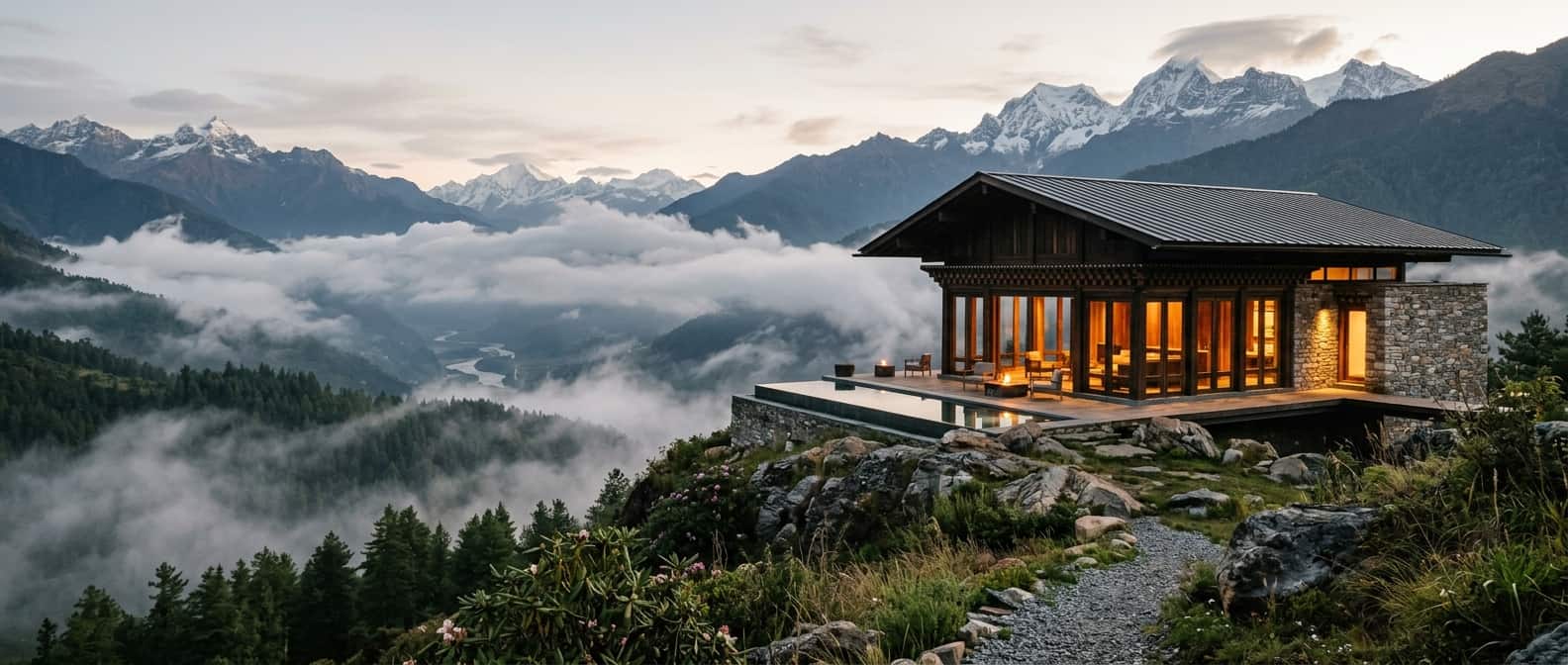
Built from rammed earth, local timber, and stone, these sanctuaries mimic the grand dzongs (fortresses) that have anchored Bhutanese valleys for centuries. They are designed to age beautifully, weathering the brutal Himalayan winters and the lush monsoon summers with equal grace. Inside, the design language is one of monastic minimalism. Expansive glass walls frame the jagged peaks, while bukharis (traditional wood-burning stoves) radiate heat into rooms stripped of unnecessary ornamentation. The focus is entirely on the view, the light, and the quiet.
The Paro Valley: Landing in the Clouds
Every journey to Bhutan begins in Paro. The flight itself is a preamble to the country’s dramatic topography—a sweeping descent past Mount Everest and Makalu, before banking sharply between forested ridges to touch down on a narrow strip of asphalt.
The Paro Valley is an exercise in scale. Rice paddies terrace down to the emerald waters of the Paro Chhu river, while prayer flags stitch the mountain passes together. It is here that you find the iconic Taktsang Palphug Monastery, or Tiger’s Nest, clinging impossibly to a sheer cliff face at 10,000 feet. The ascent is physically demanding, a steady climb through forests of oak and rhododendron, but the reward is a space of profound spiritual gravity. Returning to a valley lodge after the trek—perhaps to a hot stone bath infused with native Artemisia—is a ritual that bridges the physical exhaustion of the mountain with the refined comfort of high-end hospitality.
Punakha: The Winter Capital
If Paro is the stoic gateway, Punakha is the gentle heart. Situated at a lower elevation, the Punakha Valley is subtropical, lush with banana trees, poinsettias, and terraced fields of red rice. The air here is warmer, the light softer, and the pace of life perceptibly slower.
At the confluence of the Mo Chhu (Mother River) and Pho Chhu (Father River) stands the Punakha Dzong, arguably the most beautiful fortress in the country. To walk through its towering courtyards is to step into a living museum of Bhutanese history, where crimson-robed monks move quietly past intricately carved timber galleries. The luxury lodges in this valley are typically set high on the ridges, offering panoramic views of the river basin. Mornings begin with mist rising off the water, slowly revealing the gold-spired roofs of the dzong below. It is an environment that demands stillness, asking the traveler to simply sit, watch, and absorb.
The Lodge Circuit: Aman, Six Senses, and COMO
The brilliance of Bhutan’s luxury offering lies in the circuit. Brands like Aman, Six Senses, and COMO have not just built singular hotels; they have established a network of lodges across the central and western valleys. This allows the traveler to move seamlessly from Paro to Punakha, to Gangtey and Bumthang, without ever stepping out of the ecosystem of world-class service.
Amankora was the pioneer, establishing five distinct lodges that set the benchmark for Himalayan minimalism. Each property is unique to its valley—the lodge in Gangtey, for instance, looks out over a vast glacial wetland home to endangered black-necked cranes. Six Senses followed with a focus on sustainability and wellness, integrating deep local traditions into their spa therapies and culinary programs. COMO blends contemporary design with deep-rooted wellness philosophies, particularly at their flagship Uma Punakha, which feels like an exclusive private estate suspended over the valley. Moving between these lodges is less like a traditional hotel hop and more like an expertly curated expedition through a private kingdom.
The Spiritual Currency of Slow Travel
Ultimately, the draw of Bhutan is not just the physical beauty or the architectural refinement; it is the philosophical undercurrent of the place. In a world that prizes speed, Bhutan offers the profound luxury of slowness.
It is found in the rhythmic chanting of monks in a dimly lit temple. It is found in the long, winding drives over high mountain passes, where the only marker of time is the shifting angle of the sun. It is found in the deliberate, thoughtful conversations with local guides who view their country not just as a product to be consumed, but as a living, breathing entity to be shared with respect. Bhutan does not ask you to rush. It asks you to arrive, to be present, and to recognize that true luxury is not what you can accumulate, but what you can strip away until only the essential remains.