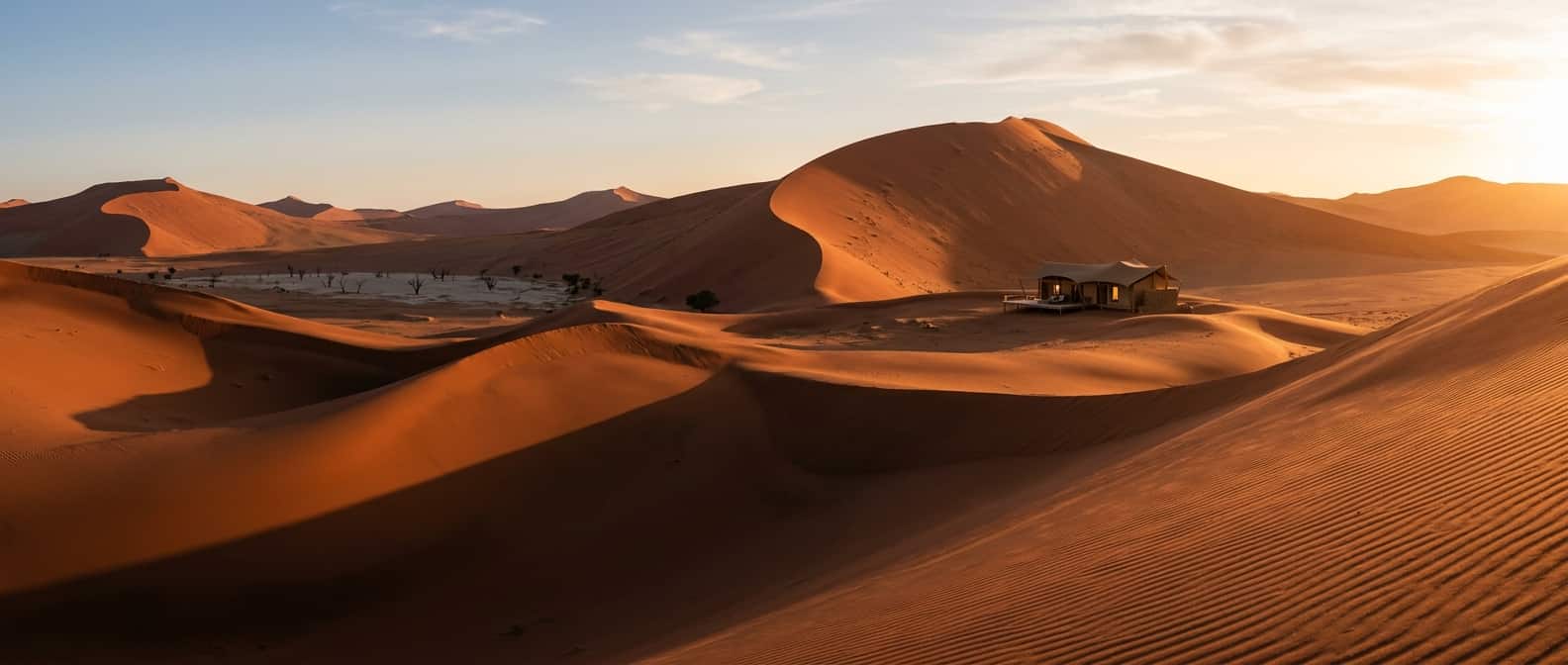
The first thing you notice is the profound, absolute silence. Standing at the crest of a three-hundred-metre sand dune in the pre-dawn cold, the wind shifts the fine, iron-rich sand with a sound like shifting silk. As the sun breaches the horizon, the landscape ignites into impossible shades of apricot, rust, and violent orange. This is Namibia—a place that does not merely invite observation, but demands total immersion in its ancient, stark geology.
For the affluent Indian traveler who has already tracked the Big Five across the Serengeti and witnessed the Great Migration in the Maasai Mara, Namibia offers an entirely different proposition. Here, the luxury lies not in the density of wildlife, but in the exclusivity of space. It is a country of staggering scale and profound emptiness, where the definition of privilege is having a million acres of pristine desert entirely to yourself.
The Allure of the Void
In an era where true isolation is the ultimate luxury, Namibia’s vastness is a revelation. The country is larger than France but holds a population of just over two and a least half million. For the seasoned traveler, this translates to private concessions the size of small European nations, shared with only a handful of other guests.
The appeal for the Indian luxury market is shifting. We are seeing a move away from the high-adrenaline, checklist-driven safari toward slow, contemplative travel. Namibia answers this call with landscapes that feel prehistoric. From the deeply carved canyons of the south to the fossilized coastal deserts, it is a destination that recalibrates your sense of scale and time. The lodges that dot this harsh environment are triumphs of remote engineering, offering high-thread-count comfort, climate-controlled sanctuaries, and world-class cellars hundreds of kilometers from the nearest paved road.
Sossusvlei: Architecture of Sand
The Namib Desert is the oldest on earth, and its visual pinnacle is Sossusvlei. This is a landscape defined by towering parabolic dunes—some of the highest in the world—that shift and reshape with the coastal winds. The luxury here is access. While day-trippers queue at the park gates at sunrise, guests at private reserves like Little Kulala have exclusive access to private gates, allowing them to be at the base of Big Daddy or the skeletal dead trees of Deadvlei before the light even touches the sand.
Little Kulala, newly rebuilt to blend seamlessly into the bleached environment, represents the pinnacle of desert luxury. Suites are climate-controlled cocoons of pale wood, raw linen, and expansive glass, featuring private plunge pools that seem to defy the arid environment. Sleeping under the stars on the suite's private rooftop deck, wrapped in a down duvet, is an experience that redefines wilderness romance.
The Skeleton Coast: Where the Desert Meets the Atlantic
Moving north, the warmth of the dunes gives way to the moody, atmospheric chill of the Skeleton Coast. This is one of the most inhospitable and dramatically beautiful coastlines on the planet, where the cold Benguela Current collides with the hyper-arid Namib Desert. The coastline gets its name from the whale bones and rusted shipwrecks that litter its foggy shores.
To experience this region in luxury requires flying in by light aircraft. Shipwreck Lodge, architecturally designed to mimic the fragmented hulls of stranded vessels, offers a surreal, cozy refuge against the harsh elements. Here, days are spent driving along the desolate beaches, searching for desert-adapted brown hyenas, tracking solitary lions that scavenge along the shore, and listening to the roar of the Atlantic from the warmth of a wood-fired stove. It is an edgy, raw form of luxury that leaves a lasting psychological impact.
Damaraland: Tracking the Desert-Adapted
Inland from the Skeleton Coast lies Damaraland, a chaotic landscape of flat-topped mountains, deep gorges, and ancient riverbeds. It is here that Namibia’s unique wildlife truly shines. The animals in Damaraland are free-roaming, surviving outside the confines of national parks. Tracking desert-adapted elephants—smaller, with wider feet for walking on sand—and the critically endangered black rhino is an exercise in patience and awe.
Camps like Hoanib Valley Camp or Desert Rhino Camp offer an unfiltered connection to this terrain. Partnering closely with local conservation trusts, these lodges allow guests to track rhinos on foot alongside expert rangers. Returning to camp after a dusty, exhilarating day tracking prehistoric beasts to find a silver-service dinner set up under a camelthorn tree, complete with South African reserve wines, perfectly encapsulates the high-low contrast that defines the modern luxury safari.
Conservation as the Ultimate Luxury
The true luxury of a Namibian journey is the knowledge that your presence actively sustains the wilderness. Namibia is a global leader in community-based conservation, writing environmental protection into its constitution. The ultra-luxury lodges operating in the remote conservancies do so in direct partnership with local communities, ensuring that the revenue from high-end tourism funds anti-poaching units, school construction, and wildlife research.
For the discerning traveler, this means that an investment in a Namibian safari is an investment in the continent’s ecological future. The exclusivity of the experience—the private guides, the silent solar-powered camps, the lack of other vehicles at a sighting—is intrinsically linked to this low-volume, high-value model of tourism.
When to Go and How to Arrive
Namibia is truly a year-round destination, but the dry winter months from May to October offer the most comfortable daytime temperatures and the clearest skies for astrophotography. The summer months (November to April) bring the possibility of dramatic afternoon thunderstorms, transforming the desert into a brief, violent carpet of green.
Due to the immense distances, the only way to execute a Namibian itinerary at a tier-one level is via a private flying safari. Moving between the dunes of Sossusvlei, the fog of the Skeleton Coast, and the rocks of Damaraland in a chartered Cessna Grand Caravan not only saves days of driving on corrugated gravel roads but offers an unparalleled aerial perspective of the landscape’s shifting geometry. It is the ultimate expression of freedom in one of the world's last great wildernesses.