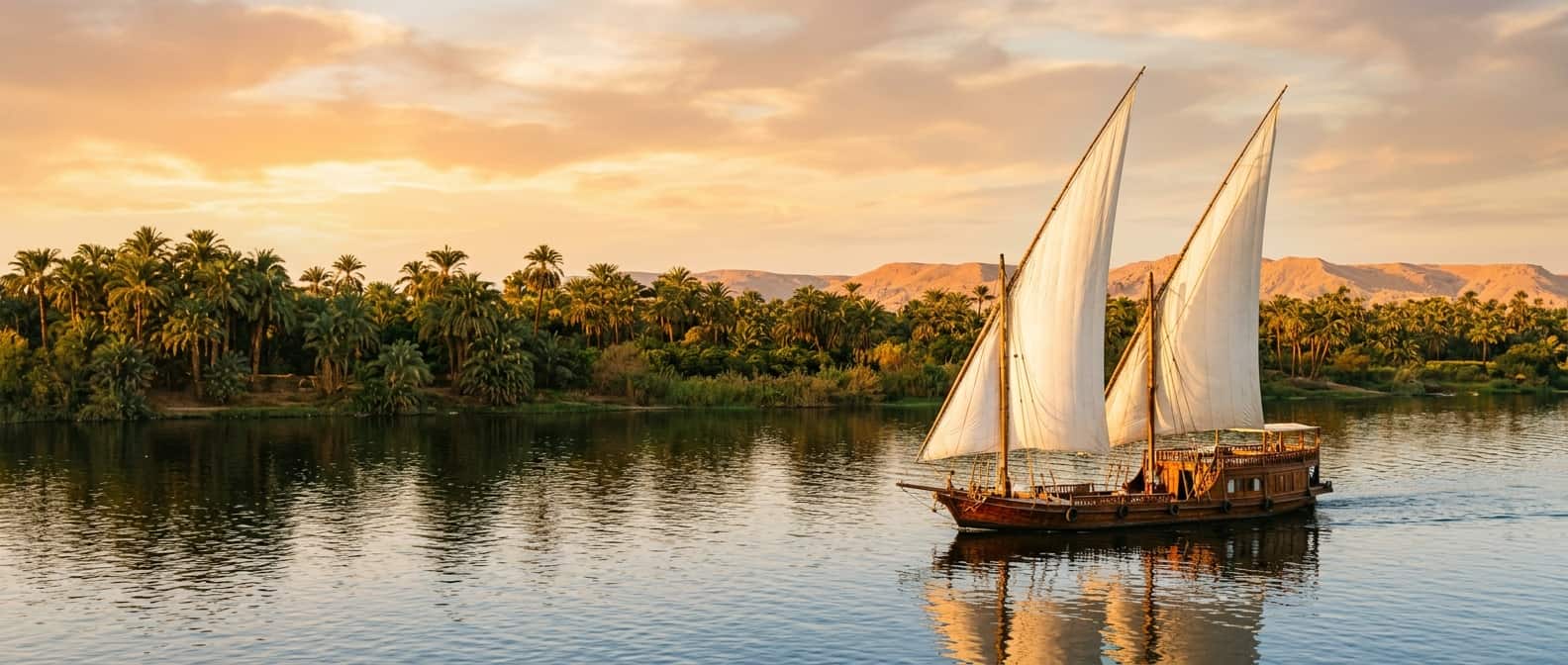
The afternoon light over the Nile does not so much fade as it thickens, turning the river into a ribbon of hammered copper. From the timbered deck of a twin-sailed boat, the only sound is the snap of white canvas catching a northerly breeze and the rhythmic splash of river water against the hull. There are no diesel engines thrumming beneath your feet, no buffet queues to navigate, and no disembodied announcements interrupting the call to prayer echoing from a distant minaret. This is the Nile as it was meant to be navigated: in profound, unhurried silence.
The Return of the Dahabiya
For decades, the standard approach to the Nile has been defined by volume rather than nuance. The river between Luxor and Aswan is crowded with floating hotels—four-story cruise ships carrying hundreds of passengers, moving in a rigid, synchronized convoy from one temple to the next. But there is a quieter, more discerning way to experience Egypt’s defining waterway.
The dahabiya—a traditional, shallow-bottomed houseboat featuring two elegant lateen sails—was the preferred mode of transport for aristocrats, archaeologists, and European royalty in the nineteenth century. Today, these vessels have been resurrected and refined for the modern affluent traveler. Stripped of the maritime kitsch that plagues larger ships, contemporary luxury dahabiyas offer a masterclass in floating minimalism. They typically accommodate no more than twelve to fourteen guests across six or seven spacious, wood-paneled cabins.
To board a dahabiya is to step away from the industrialization of travel. These boats rely primarily on the wind, drifting gracefully upstream. When the air is still, a small, discreet tugboat pulls the vessel from a distance, ensuring the silence on deck remains unbroken. It is a return to an era of slow travel, where the journey itself is given as much reverence as the destination.
The Rhythm of the River
Life on a dahabiya imposes a different sort of temporal reality, one governed not by itineraries but by the subtle shifts in light and wind. Mornings begin with thick, dark Egyptian coffee served on a shaded upper deck, watching farmers tend to date palms and sugarcane fields exactly as their ancestors did millennia ago. The proximity to the water—you are often close enough to hear the rustle of the papyrus reeds—creates an intimacy with the landscape that a massive cruise liner simply cannot replicate.
Because they are smaller and lighter, dahabiyas are unburdened by the strict docking schedules of mega-ships. They can moor at minor islands, pull up to secluded sandbanks for an impromptu afternoon swim, or stop at riverside villages untouched by the heavy footfall of mass tourism.
The pace of the days feels remarkably expansive. Between excursions, afternoons are surrendered to the pure luxury of idleness. Guests recline on shaded daybeds with a book, watch the feluccas dart across the water like white moths, or simply observe the timeless tableaux of rural Egyptian life unfolding along the riverbanks. The rhythm is hypnotic, stripping away the noise of the modern world and allowing the deep, ancient resonance of the Nile to take hold.
Private Access to Antiquity
The true currency of luxury travel is access, and nowhere is this more apparent than in Egypt. While massive ships dump thousands of passengers simultaneously onto the docks of Kom Ombo and Edfu, a dahabiya operates with a nimble, almost stealthy grace.
Sailing on a private or semi-private charter means your resident Egyptologist can orchestrate visits to the major temples at their quietest hours. You might find yourself walking through the towering hypostyle hall of Karnak in the cool, blue light of dawn, before the tourist buses arrive from the Red Sea resorts. You might explore the Temple of Horus at Edfu just as the late afternoon sun casts long, dramatic shadows across its impossibly preserved reliefs.
Beyond the marquee sites, the dahabiya allows for detours into less charted territory. You can disembark at the quarries of Gebel el-Silsila, where the sandstone for the great temples was cut, an area often bypassed by larger ships. You can walk through the ruins of El Kab, surrounded by immense mud-brick walls dating back to the Early Dynastic period. This is not merely sightseeing; it is an immersive, highly curated engagement with antiquity, guided by scholars who can read the hieroglyphs as easily as a morning newspaper.
The Culinary Experience on Board
On a standard Nile cruise, dining is an exercise in crowd control—vast, uninspired buffets designed to feed hundreds quickly. On a luxury dahabiya, the culinary program is an intimate, highly localized affair, drawing heavily on the agricultural bounty of the riverbanks.
With a kitchen serving only a dozen guests, the onboard chef can source ingredients dynamically. Freshly baked aish baladi (Egyptian flatbread) is procured from village markets along the route. Fishermen pull up to the boat to offer the morning’s catch of Nile perch. Meals are an elegant fusion of traditional Egyptian flavors and Mediterranean refinement—think slow-roasted lamb shoulder with fragrant spices, bright salads of pomegranate and parsley, and delicate pastries dripping with local honey.
Dining itself is a fluid experience. Lunch might be served under a canvas awning on the top deck as you drift past the Temple of Philae. Dinner could be orchestrated as a formal, candlelit affair in the wood-paneled dining room, or, more magically, as a private barbecue on a deserted, moonlit island, with rugs spread across the sand and traditional Nubian music playing softly in the background.
When to Sail and How to Charter
The window for the perfect Nile journey is distinct. The months from October to April offer the most comfortable climate, with crisp mornings and bright, temperate afternoons ideal for exploring the temples. November and February are particularly sublime, avoiding both the peak crowds of the Christmas holidays and the oppressive heat of the Egyptian summer.
For affluent travelers from India, the ultimate way to experience this is through a full private charter. Securing a beautifully appointed boat—like those operated by Nour El Nil or the meticulously restored vessels of the Sanctuary Retreats fleet—ensures total privacy for an extended family or a group of close friends. It transforms a historical tour into a floating, bespoke estate.
The Nile has witnessed millennia of empires, invasions, and grand ambitions. Yet, seen from the deck of a dahabiya, with the wind filling the lateen sails and the golden escarpments glowing in the twilight, the river feels intimately, almost impossibly, yours.