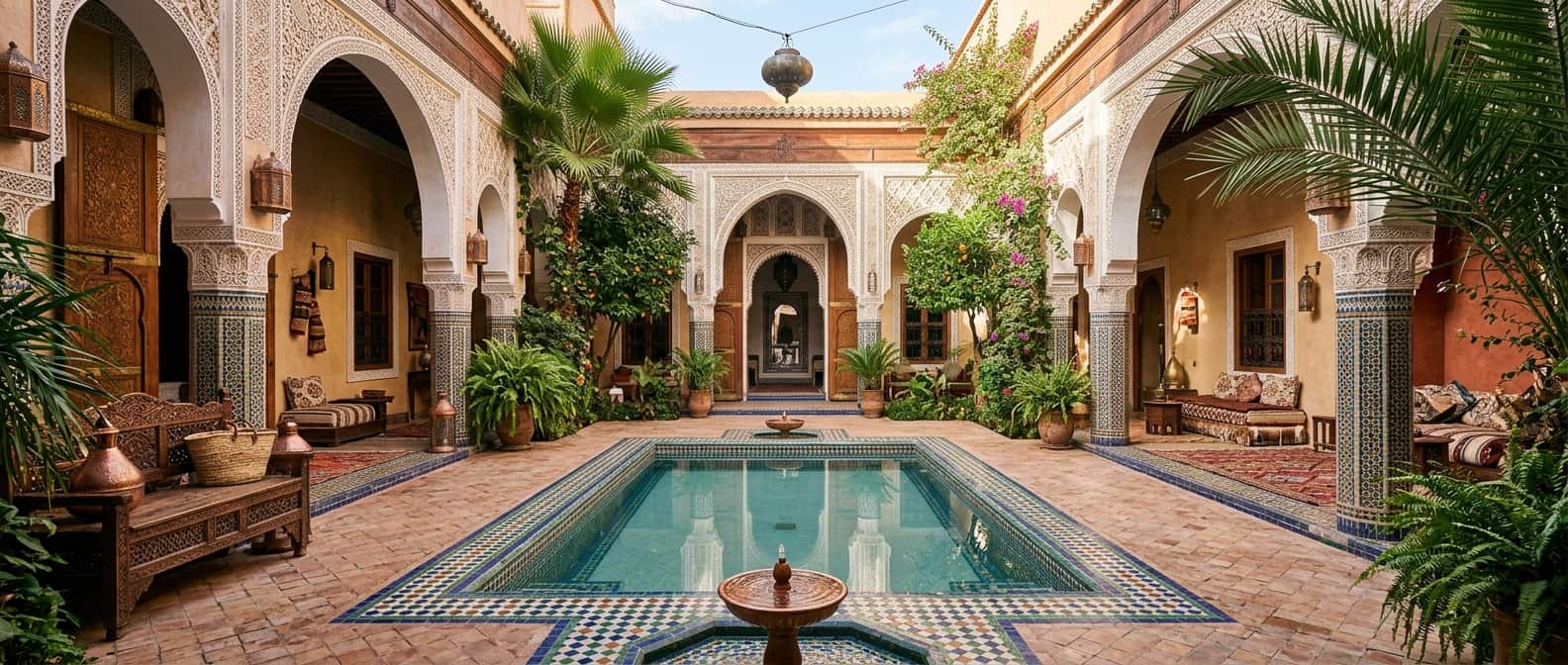
There is a distinct thermal shift when you step off the chaotic, sun-baked alleys of the Medina and into the courtyard of a traditional Moroccan riad. The air cools instantly, scented with orange blossom and cedarwood. The relentless hum of the souks gives way to the geometric precision of zellige tilework and the slow, rhythmic trickle of a central fountain. This is the duality of Marrakech—a city of overwhelming sensory density, hiding its most profound luxuries behind heavy, unmarked wooden doors.
For the modern luxury traveler, Morocco is no longer about checking off the frenetic highlights. It is about accessing these hidden sanctuaries, moving seamlessly from palatial urban retreats to the stark, silent altitudes of the Atlas Mountains, and finding the quietest corners of a vibrantly loud country.
The Architecture of Stillness
Marrakech does not reveal its wealth on the street. Its luxury is entirely internalized. The traditional riad—a multi-story home built around an open courtyard—was designed specifically to turn inward, creating a private universe insulated from the public sphere.
Today, this architectural philosophy translates into some of the most exclusive hospitality experiences on the African continent. The focus here is not on sprawling lobbies or expansive beach clubs, but on hyper-personalized service within walled gardens. It is a slow, methodical approach to luxury, where time is measured in pots of mint tea poured from a great height, and afternoons are spent in the dim, steam-filled chambers of a private hammam.
The Palatial Standard: Royal Mansour and Amanjena
If there is a benchmark for uncompromised luxury in North Africa, it is Royal Mansour. Commissioned by King Mohammed VI, the property is a masterclass in Moroccan craftsmanship. There are no standard rooms or suites; guests reside in private three-story riads, each with its own rooftop plunge pool. An underground network of tunnels allows the staff to move invisibly, ensuring that your privacy is absolute. It feels less like a hotel and more like a private invitation into a royal enclave.
Just outside the city limits, Amanjena offers a different, but equally compelling, interpretation of Moroccan luxury. Set against the backdrop of the High Atlas, the resort relies on the signature Aman minimalism—vast pavilions of rose-tinted clay, reflection pools that mirror the sky, and an overwhelming sense of space. It is the perfect antidote to the sensory overload of the Medina, a place where the architecture forces you to slow down and breathe.
Ascending the Atlas: High-Altitude Retreats
The true privilege of Moroccan travel is the ability to change landscapes entirely within a two-hour drive. Leaving the flat, dusty plains of Marrakech, the road winds upward into the High Atlas Mountains, where the air turns sharp and the terracotta earth gives way to terraced valleys and snow-capped peaks.
Here, luxury takes on a more rugged, expeditionary tone without sacrificing comfort. Properties like Kasbah Tamadot—Sir Richard Branson’s mountain retreat—cling to the cliff edges, offering panoramic views of the valleys below. The luxury here is experiential: private treks through ancient Berber villages, guided by locals who have navigated these paths for generations, followed by evenings spent by a roaring fire with a glass of robust Moroccan red wine. It is a striking contrast to the manicured gardens of Marrakech, offering a profound sense of isolation.
The Agafay Canvas: Desert Solitude
For those who want the desert experience without the exhaustive ten-hour drive to the deep Sahara, the Agafay Desert provides a stark, stony alternative just forty-five minutes from the city. This is not the rolling dunes of Merzouga, but a dramatic, lunar landscape of white dunes and rocky outcrops.
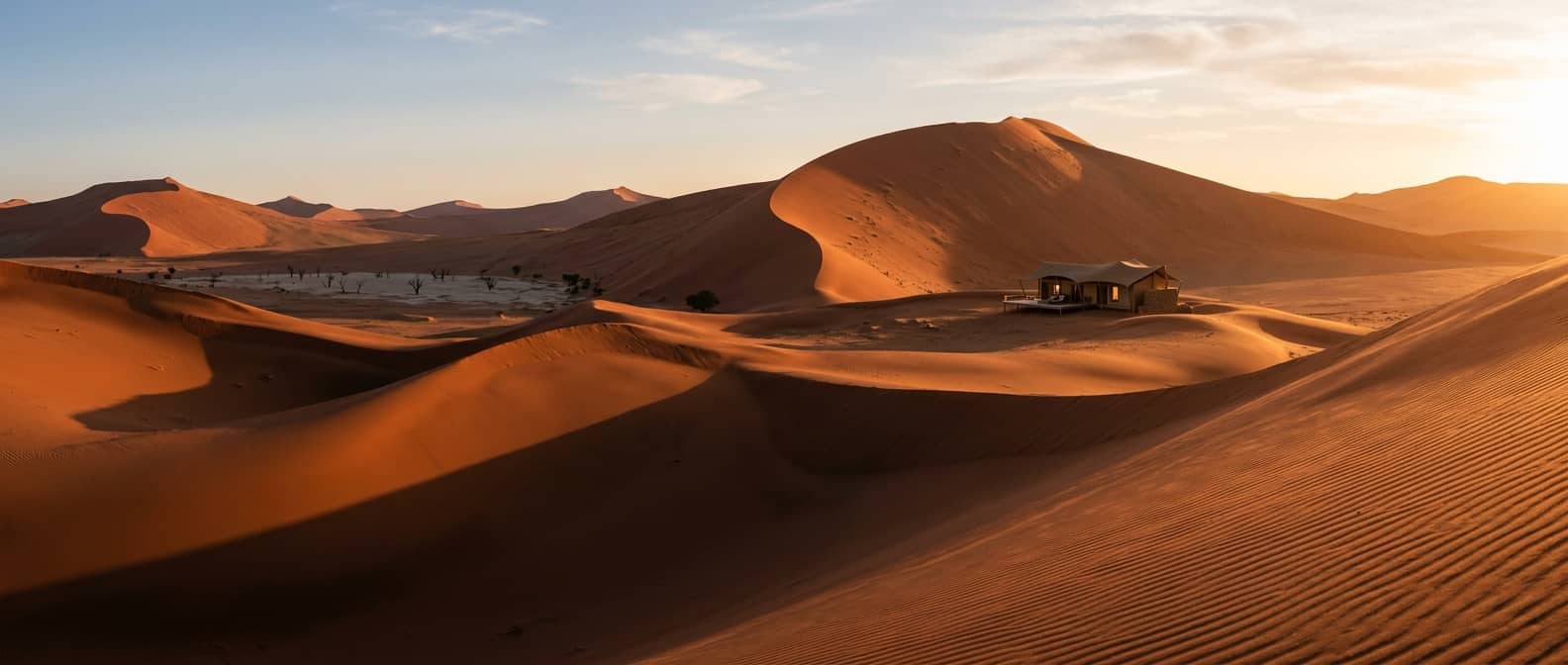
Luxury camps here have elevated the concept of "glamping" into something resembling a nomadic palace. Air-conditioned canvas suites, private plunge pools carved into the rock, and dining under a brilliantly clear night sky offer a brief, highly curated immersion into desert life. It is the perfect one-night interlude between the city and the mountains, allowing you to experience the vast, silent emptiness of the Moroccan terrain.
Navigating the Nuances of Moroccan Travel
Traveling through Morocco at this tier requires an understanding of the local rhythms. It is a country that rewards patience and a willingness to surrender control to those who know the landscape best.
Securing the right guide is not just a luxury; it is a necessity. The labyrinthine alleys of the souks are unnavigable by GPS, and the best artisans, antique dealers, and private dining rooms are entirely unlisted. Engaging a deeply connected fixer—someone who can orchestrate a private dinner in an abandoned kasbah or secure an after-hours viewing of the Yves Saint Laurent Museum—is what separates a standard trip from a truly bespoke Moroccan narrative.
Ultimately, the luxury of Marrakech and its surrounds lies in its contrasts. It is the ability to stand in the vibrant heart of the Medina at noon, and by sunset, find yourself in absolute silence, watching the fading light turn the peaks of the Atlas Mountains a deep, bruised purple.