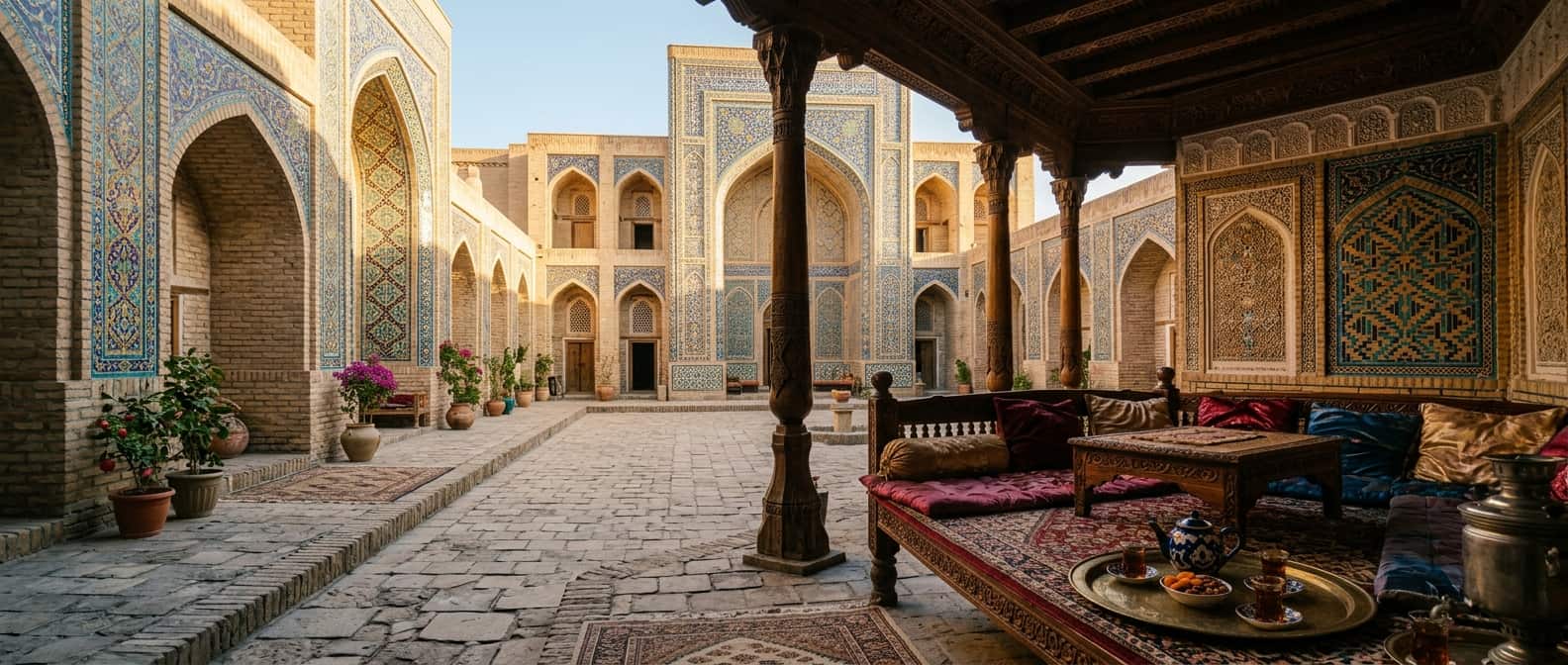
There is a specific quality to the light in Bukhara just before dusk, when the desert sun drops below the high walls of the old city and turns the glazed turquoise tiles of the minarets into soft, luminous beacons. In the courtyards of centuries-old merchant houses, the heat of the day gives way to the scent of spiced tea and dry earth. For decades, this leg of the ancient Silk Road was viewed purely through the lens of rugged expeditions and rigid group tours. But a quiet, deliberate shift is taking place across Uzbekistan.
Today, a new wave of design-forward restorations and highly private access is transforming the region into one of the most compelling short-haul destinations for the affluent Indian traveler. It is a place where history is no longer just observed from behind a velvet rope, but lived in, slept in, and experienced with absolute exclusivity.
The New Silk Road
The pivot toward slow, refined luxury in Uzbekistan has been subtle but profound. Driven by improved connectivity—including seamless direct flights from Delhi—the logistics of reaching Central Asia have never been smoother. Yet, the true luxury lies on the ground. The modern discerning traveler is bypassing the standard coach routes in favor of private, historian-led explorations and exclusive access to sites long closed to the general public.
This is the Silk Road reimagined for those who value time and space above all else. It is about standing alone in the shadow of Timur’s empire, guided by scholars who read the Kufic script on 14th-century mausoleums as fluently as a morning newspaper. The infrastructure has matured to meet these demands, with discreet boutique properties and private logistics seamlessly bridging the distances between the great caravan cities.
Samarkand: The Architecture of Empire
To arrive in Samarkand is to confront scale in its most majestic form. The Registan, with its three madrasahs flanking a vast public square, remains one of the architectural marvels of the Islamic world. But experiencing it in true luxury requires a recalibration of timing. The privilege here is access: arranging for a private sunrise visit before the city awakes, watching the morning light catch the gold leaf of the Tilya-Kori Madrasah in absolute silence.
Accommodation in Samarkand has historically been functional, but the landscape is shifting. Discerning travelers are finding solace in restored courtyard homes hidden behind nondescript wooden doors in the old town. These private sanctuaries offer walled gardens, shaded iwans, and a level of personalized service that rivals the riads of Marrakech, providing a necessary retreat from the monumental scale of the city outside.
Bukhara: The Merchant’s Sanctuary
If Samarkand is defined by imperial grandeur, Bukhara is a study in intimate, atmospheric luxury. The entire old city is a protected architectural reserve, a labyrinth of trading domes, stone pools, and mud-brick alleys. Here, the concept of luxury aligns perfectly with heritage.
The finest places to stay are the impeccably restored homes of 19th-century wealthy merchants. Properties that blend traditional craftsmanship—intricately carved elm pillars, vibrant Suzani tapestries, and hand-painted alabaster—with the exact standards of modern comfort. Days in Bukhara are best spent slowly: an afternoon appointment with a master miniaturist, a private viewing of antique ikat silks, or a secluded hammam experience reserved entirely for your use. It is a destination that demands, and rewards, a slower pace.
The Culinary Shift
Central Asian cuisine is historically hearty and communal, centered around the ritual of plov (pilaf). The luxury evolution in Uzbekistan’s culinary scene is not about altering the essence of these dishes, but refining their delivery. Dining has moved from crowded banquet halls to highly curated, private experiences.
Imagine an evening in a centuries-old courtyard, the table set with vintage Soviet crystal and hand-painted ceramics. The plov is prepared by a master oshpaz exclusively for your party, using heirloom rice and organic saffron. This is paired with an emerging selection of local, low-intervention wines from the Fergana Valley. It is an elevation of traditional hospitality, focusing on provenance, privacy, and the sheer atmospheric beauty of the setting.
The Logic of the Journey
The appeal of Uzbekistan for the Indian luxury traveler lies in its rare combination of profound cultural depth and geographical proximity. It is an immersion into an entirely different world, achieved without the friction of a long-haul flight or the intense jet lag associated with western destinations.
Uzbekistan does not offer the standardized, recognizable luxury of a European capital. Instead, it offers something increasingly scarce: true discovery, padded with carefully orchestrated comfort. It is a destination for those who have seen the world’s grand capitals and now seek out places where history is palpable, the aesthetics are unparalleled, and the sense of exclusivity is absolute.