The descent into Paro is famously thrilling, the aircraft weaving through steep, pine-clad Himalayan ridges before the runway suddenly reveals itself in a narrow valley. It is an arrival that demands your full attention, setting the tone for a country that asks the same of its visitors. Stepping onto the tarmac, the air is thin, crisp, and smells faintly of woodsmoke. There are no crowds, no aggressive touts, and no billboards. In an era where global travel often feels homogenous and oversubscribed, Bhutan remains a fiercely guarded sanctuary of quietude. For the discerning Indian traveler, it offers something increasingly rare: absolute, unadulterated serenity just a short flight from Delhi or Mumbai.
This is a destination that has never chased volume. Instead, it has cultivated an ecosystem of high-design, low-impact luxury that feels entirely organic to its dramatic topography.
The High-Value Philosophy
Bhutan’s approach to tourism is rooted in its policy of High Value, Low Volume. By enforcing a sustainable daily tariff, the kingdom effectively filters out mass tourism, preserving its pristine landscapes and deeply ingrained Buddhist culture. This isn’t simply about exclusivity for exclusivity’s sake; it is an act of cultural preservation.
For the luxury traveler, this translates to an almost private experience of the country. You can stand in the courtyard of a 17th-century dzong (fortress) and hear nothing but the flutter of prayer flags and the chanting of monks. The roads winding through the mountains are quiet, the ancient forests are untouched, and the few luxury lodges that dot the valleys are designed not as imposing monoliths, but as intimate, hidden sanctuaries. This philosophy ensures that your journey feels less like a vacation and more like a private audience with the Himalayas.
Amankora: Pioneering the Lodge Circuit
The concept of a luxury circuit in Bhutan was arguably invented by Aman. Rather than building a single sprawling resort, they created Amankora—a collection of five distinct, intimate lodges scattered across the central and western valleys (Paro, Thimphu, Punakha, Gangtey, and Bumthang). The name marries the Sanskrit word for peace with the Bhutanese word for a circular pilgrimage, and that is exactly what it offers.
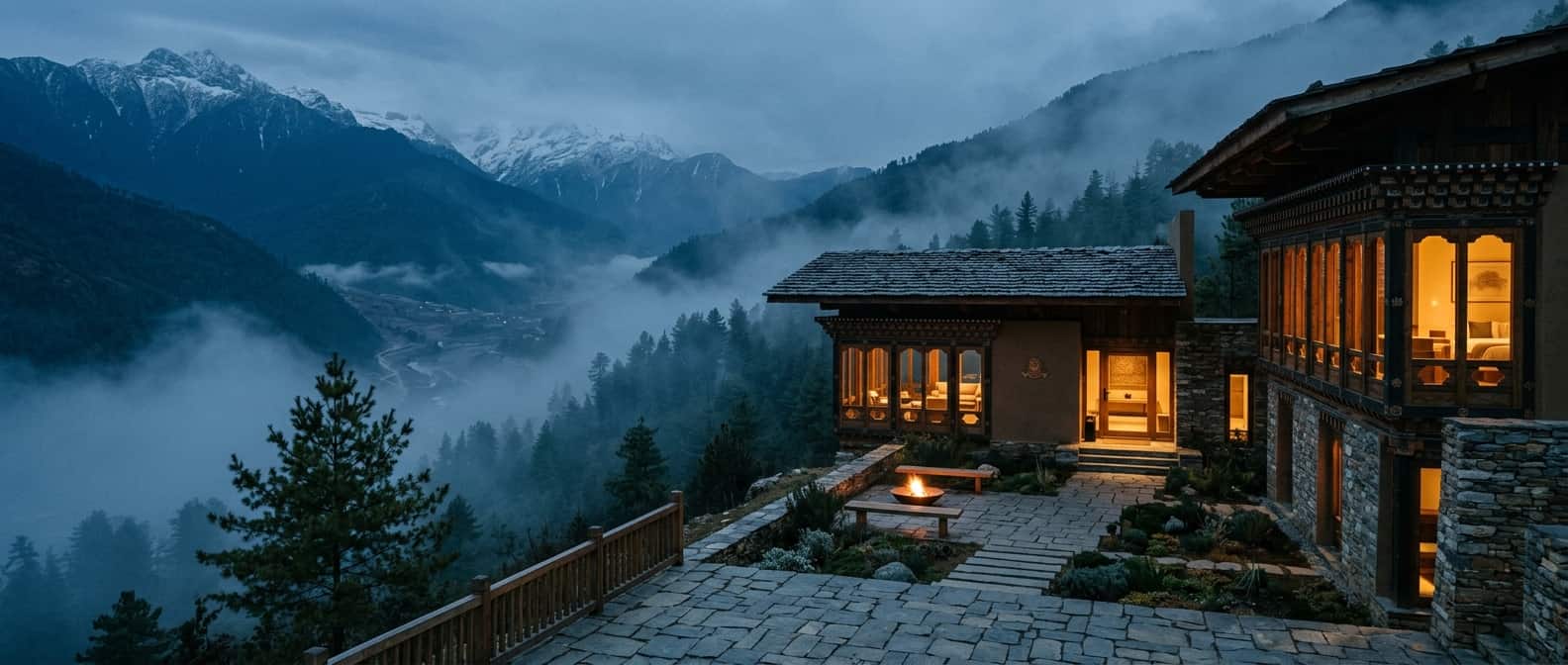
Each lodge features the brand’s signature minimalist aesthetic, seamlessly blended with traditional Bhutanese architecture: rammed-earth walls, timber framing, and wood-burning bukhari stoves in every suite. The beauty of Amankora lies in its frictionless movement. You can travel from the misty, high-altitude pine forests of Paro to the sub-tropical, terraced rice paddies of Punakha, carrying nothing but a daypack, while your luggage and preferences effortlessly precede you. It is a masterclass in understated elegance, where the luxury is found in the stillness, the warmth of the hot stone baths, and the flawless, intuitive service.
Six Senses: Wellness in the Clouds
If Aman established the circuit, Six Senses elevated the wellness narrative. Also operating a five-lodge journey, Six Senses Bhutan leans heavily into the kingdom’s ethos of Gross National Happiness, translating it into comprehensive, bio-individual wellness programming.
Their lodges are architectural marvels, designed to disappear into their surroundings while maximizing the dramatic views. The Thimphu lodge, known as the "Palace in the Sky," sits perched above the capital, while the Punakha lodge is a "Flying Farmhouse" suspended over the valley floor. Here, the focus is on restoration. After a day of hiking to remote monasteries, you return to deeply personalized spa treatments incorporating local herbs, guided meditation sessions in glass-walled pavilions, and sleep-enhancing rituals. It is a place where modern luxury intersects with ancient Himalayan healing practices, offering a profound reset for the mind and body.
Curated Encounters
The true luxury of Bhutan lies not just in the thread count of the linens, but in the access it provides. The best lodges arrange experiences that transcend the typical tourist itinerary.
This might mean a private archery lesson with a local champion, or a quiet morning blessing from a senior monk in a monastery closed to the general public. It could be a private picnic set up in a meadow overlooking the Tiger’s Nest, complete with white linen, silver service, and traditional Bhutanese dumplings (momo) elevated by a world-class chef. These encounters are never staged; they are authentic, respectful interactions with a living culture, facilitated by guides who are often as educated and well-traveled as the guests they host.
The Logistics of Luxury
Planning a journey to Bhutan requires precision. The visa process, the daily tariffs, and the limited flight schedules (operated only by Drukair and Bhutan Airlines) demand expert orchestration. For Indian nationals, the process is streamlined compared to other nationalities, but to access the ultra-luxury tier, advanced planning is non-negotiable.
The ideal itinerary spans seven to ten days, allowing enough time to acclimatize and traverse the valleys without feeling rushed. It is a journey best undertaken in the spring (March to May) when the rhododendrons are in bloom, or in the autumn (September to November) for the clearest, sharpest views of the high peaks. But whenever you choose to go, the Kingdom of the Thunder Dragon offers a profound reminder of the restorative power of empty spaces and quiet mountains.
Sources
- Amankora Journey — Details Amankora's customized itineraries across unique valleys in Bhutan, emphasizing expert guides and exclusive experiences.
- Luxury Resort in the Kingdom of Bhutan - Amankora — Describes Amankora as a luxury lodge chain offering bespoke journeys and private transfers.
- IRCTC Introduces India-Bhutan Rail Journey — Contextualizes the growing high-end demand from India with new premium travel options.