The first scent of a Japanese summer is often petrichor on hot asphalt, the hum of a million cicadas in a Kyoto temple garden. It is a season of intensity, of vibrant festivals and deep, humid greens. But there is another version of summer in Japan, one that exists on a different register. It is found on the country’s northernmost island, Hokkaido, and it smells of lavender, damp earth, and the clean, mineral air of volcanic highlands.
While the well-trodden ‘golden route’ of Tokyo, Kyoto, and Osaka swelters, Hokkaido unfolds under a temperate, almost forgiving, sun. This is a landscape of vast, rolling hills that call to mind Tuscany or Provence, of caldera lakes so still they seem to hold the sky captive, and of a design language that privileges space, material, and a profound connection to the natural world. For the discerning Indian traveller, a Hokkaido summer is not just an escape from the heat; it is an entry into a more elemental, and ultimately more restful, Japan.
Furano and Biei: The Rolling Hills
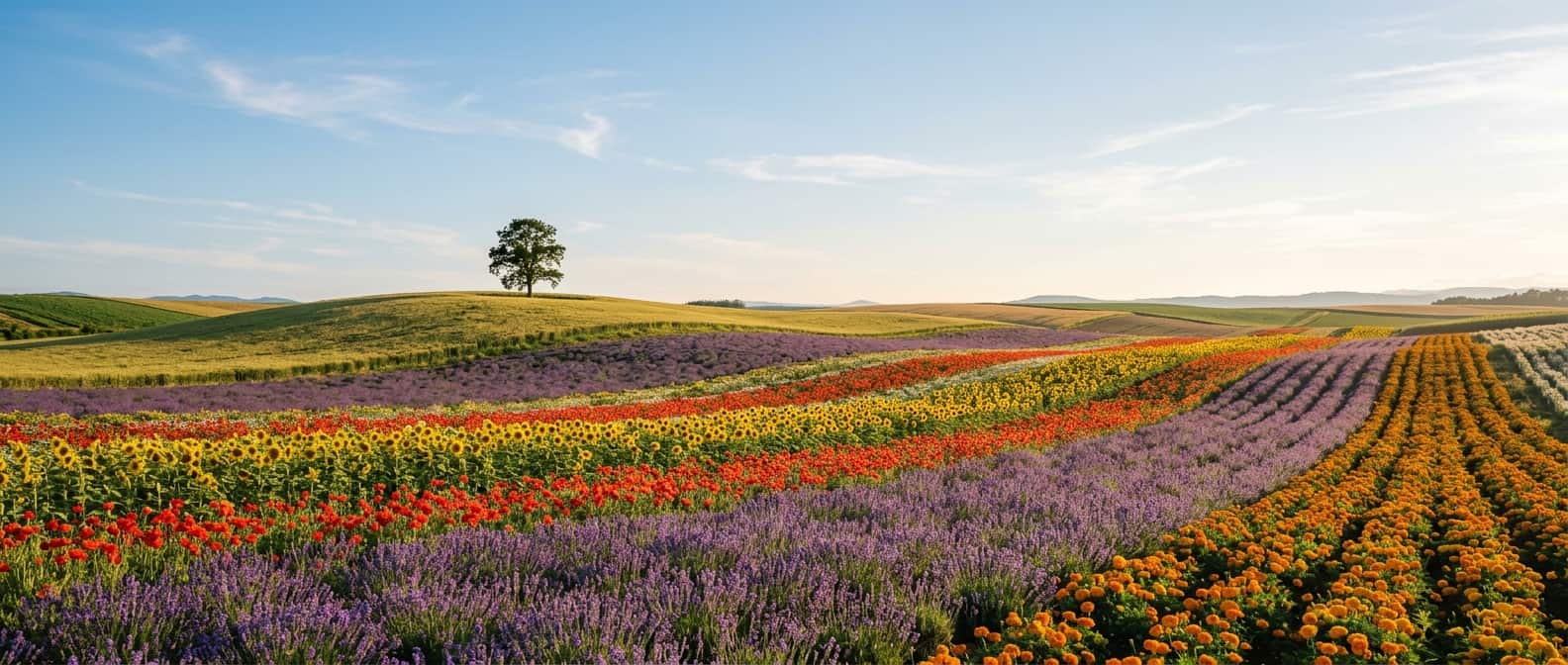
The heart of Hokkaido’s summer iconography is here, in the agricultural towns of Furano and Biei. This is the Japan of tourism posters, but to experience it in person is to understand their appeal is no exaggeration. The land is a canvas of orderly, undulating stripes—purple lavender, scarlet poppies, white baby’s breath, and fields of golden wheat. Farm Tomita is the most famous, a precise and dazzling display of floriculture, but smaller, quieter farms like the Shikisai-no-Oka offer a more expansive, panoramic experience.
The true luxury of this area, however, is found not in the fields themselves but in the spaces between them. Driving the country roads of Biei’s “Patchwork Hill” reveals a quiet, pastoral geometry. A solitary oak tree on a crest, a cluster of silver birch, a red-roofed farmhouse—these are the only punctuation marks in a landscape of immense scale. The food here is a direct reflection of this terroir. Small cafes and restaurants serve dishes made with startlingly fresh produce: white asparagus, sweet corn, and dairy from local farms that rivals the best of Europe. It is a subtle, farm-to-table ethos that has been practiced here long before it became a global trend.
Shikotsu-Toya: The National Parks
Southwest of Sapporo lies Shikotsu-Toya National Park, a region defined by water and volcanic activity. The park is home to two immense caldera lakes, Lake Shikotsu and Lake Toya, each with a distinct character. Lake Shikotsu is the deeper and more dramatic of the two, its startlingly clear, blue water ringed by steep, forested cliffs and volcanic peaks, including Mount Tarumae, which often trails a plume of steam. The area feels primal, a reminder of the powerful forces that shaped this island.
Lake Toya is more serene, its landscape softened by a collection of small islands at its center. It is a place for quiet contemplation, best experienced from the water on a canoe or from the minimalist vantage point of an onsen resort built on its shores. The Windsor Hotel Toya Resort & Spa, perched on a mountain between the lake and the ocean, offers a commanding perspective of this unique geography. To sit in an open-air bath here, feeling the cool air on your skin while gazing at the still water below, is to understand the Japanese art of finding stillness within a wild landscape.
Niseko: The Green Season
Known globally as a winter paradise, Niseko’s transformation in summer is its best-kept secret. The ski runs become lush hiking trails, the snow-covered peaks reveal themselves as verdant mountains, and the valley floor bursts with life. The ‘green season’ in Niseko is an active pursuit, a time for mountain biking, hiking Mount Yotei—Hokkaido’s serene, Fuji-like volcano—or playing golf on world-class courses.
This is also where some of Japan’s most interesting modern luxury accommodations are found. The energy that fueled Niseko’s ski boom has resulted in a collection of design-led hotels and private villas that are just as compelling in summer. Properties like Zaborin, a collection of 15 private villas each with its own indoor and outdoor onsen, offer a contemporary take on the traditional ryokan. Here, the luxury is one of privacy, space, and a direct, unmediated connection with the surrounding birch forest. The culinary scene mirrors this, with restaurants that champion local Hokkaido produce in sophisticated, often surprising, ways.
Sapporo and Otaru: The Urban Interludes
Hokkaido’s capital, Sapporo, is a city built on a grand, orderly scale, with wide, tree-lined avenues and a grid system that feels more North American than Japanese. Its pleasures are straightforward: the fresh seafood at the Nijo Market, the eponymous beer enjoyed at the Sapporo Beer Garden, and the calm of Odori Park, which acts as the city’s green spine. In summer, the park is alive with flower festivals and beer gardens, offering a civilized, relaxed urbanity.
A short train ride away, the port town of Otaru offers a different flavour. Its beautifully preserved canal, lined with Victorian-style gaslights and stone warehouses, speaks to its history as a major herring-fishing hub. Today, these warehouses are home to glassworks studios, music box museums, and sake distilleries. Otaru is a city for wandering, for indulging in a six-tiered ice cream cone, and for appreciating a sense of preserved time, a quiet contrast to the wildness of the island’s interior.
The Art of the Stay: Onsen and Architecture
A trip to Hokkaido would be incomplete without a deep immersion in onsen culture. The island’s volcanic geology means it is rich with natural hot springs, and the experience is a cornerstone of Japanese hospitality. In Hokkaido, this tradition is often expressed through a modern architectural lens. Ryokans and resorts are designed to frame the landscape, to bring the outside in through vast windows, natural materials like cedar and stone, and private, open-air baths (rotenburo).
Beyond the singular luxury of Zaborin, properties like Akan Yuku no Sato Tsuruga in the Akan Mashu National Park offer a more traditional, yet equally refined, experience. The focus is on a holistic sense of place—the water, the food, the views of Lake Akan, and the deep connection to the indigenous Ainu culture. The choice of where to stay in Hokkaido is not just a logistical one; it is a decision about how you wish to engage with the island’s profound natural beauty.
A Note on Getting There and Around
While there are no direct flights from India to Sapporo’s New Chitose Airport (CTS), convenient connections are available via Tokyo, Osaka, or other Asian hubs like Hong Kong and Seoul. From Tokyo, the flight to Sapporo is a brief 90 minutes.
To truly experience the scale and diversity of Hokkaido, a self-driven car is essential. The roads are wide, well-maintained, and signage is available in English. Driving allows for the freedom to explore the backroads of Biei, to stop at a scenic viewpoint over a lake, and to discover the small, family-run restaurants that are the soul of the island’s culinary scene. It is the final piece of the puzzle, the element that transforms a trip from a tour into a personal journey through Japan’s wild, beautiful north.