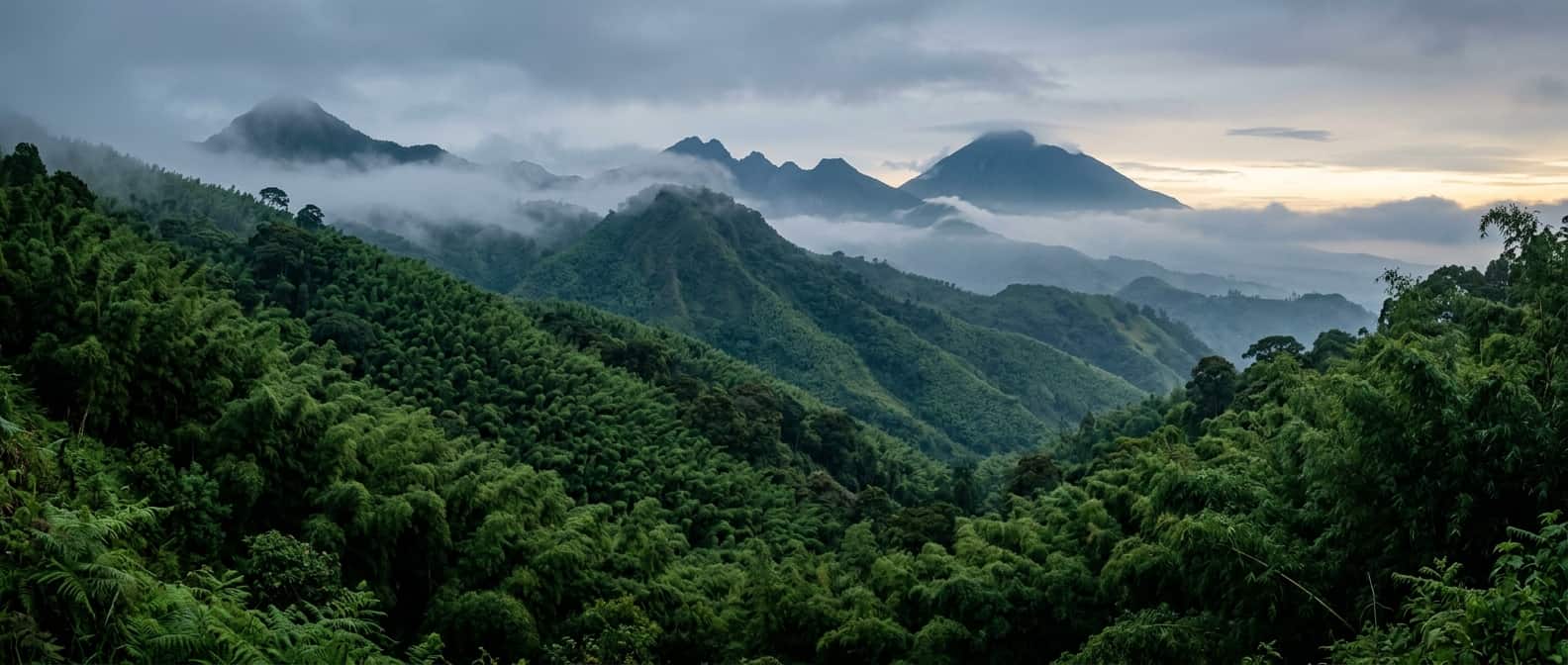
The air at six thousand feet carries a distinct, heavy dampness—a blend of crushed eucalyptus, wet volcanic earth, and the sharp chill of an equatorial morning. Here, the mist does not simply sit on the mountains; it clings to the bamboo forests like spun glass, shifting and parting only when the wind moves down the slopes of the Virunga Massif. This is not the vast, sun-bleached savanna of the Serengeti, nor the endless horizon of the Kalahari. It is a vertical, intimate world.
For the modern luxury traveler, Africa has long been defined by the wide-open plains and the ritual of the morning game drive. But a profound shift is occurring. Affluent travelers are increasingly seeking out the continent's quiet, high-altitude frontiers, trading the traditional safari for purpose-driven, singular encounters. Rwanda has positioned itself at the absolute apex of this movement, offering an experience that is as environmentally rigorous as it is unconditionally luxurious.
The Shift to High-Altitude Luxury
The appeal of Rwanda lies in its uncompromising exclusivity. Gorilla trekking has always been a profound wildlife experience, but until recently, the logistics required a certain tolerance for ruggedness. The lodges were functional, designed purely to facilitate the trek rather than to serve as destinations in their own right. That paradigm has shattered.
Over the last five years, a select group of ultra-luxury operators has redefined the Volcanoes National Park region. They have brought with them a philosophy of low-impact, high-yield tourism, ensuring that the footprint remains minimal while the standard of hospitality rivals the finest estates in Europe. This is a model built on scarcity. With strict limits on daily trekking permits and a deliberate cap on lodge capacities, Rwanda has created an environment where the luxury of space and silence is absolute. It is a destination that demands intentionality, rewarding those who make the journey with an atmosphere of profound isolation and bespoke care.
Volcanoes National Park: The Theatre of the Silverback
The Virunga Massif is a chain of eight free-standing volcanoes spanning Rwanda, Uganda, and the Democratic Republic of Congo. The Rwandan sector, Volcanoes National Park, is the most accessible and arguably the most dramatic. It is a landscape of staggering verticality, where dense bamboo gives way to Hagenia woodlands draped in old-growth moss.
Trekking into this environment is an exercise in sensory immersion. The paths are steep, the mud is thick, and the air thins with every hundred meters of elevation. The effort is an intrinsic part of the experience, a necessary preamble to the encounter. When the trackers finally signal a halt, and the foliage parts to reveal a family of mountain gorillas going about their morning routine, the effect is arresting. There are no vehicles, no glass panes, no physical barriers. It is a moment of raw, unmediated proximity, governed by the quiet authority of the silverback. The luxury here is not just the sighting itself, but the privilege of entering their domain entirely on their terms.
Singita Kwitonda Lodge: Conservation as Design
Set on a breathtaking 178-acre stretch of land right on the edge of the park, Singita Kwitonda Lodge represents the pinnacle of sustainable luxury architecture. The lodge was built with an acute awareness of its surroundings, utilizing local volcanic rock, woven ceilings, and hand-fired terracotta brick. It feels less like an imposition on the landscape and more like an organic extension of it.
Each of the eight suites and the four-bedroom Kataza House features a private heated plunge pool, indoor and outdoor fireplaces, and expansive glass walls that frame the brooding peaks of Mount Sabyinyo, Gahinga, and Muhabura. The design is deliberately inward-looking, offering a sanctuary of warmth and tactile comfort after a demanding morning on the mountain. The culinary program is equally rooted in the region, drawing on an extensive on-site kitchen garden to produce fresh, vibrant dishes that feel grounding and restorative. Singita’s presence here is ultimately a conservation project disguised as a luxury hotel, actively working to expand the buffer zone around the park and reforest the adjacent land.
One&Only Gorilla’s Nest: The Canopy Estate
If Kwitonda is grounded in the volcanic earth, One&Only Gorilla’s Nest is suspended in the canopy. Hidden within a dense grove of eucalyptus trees, the resort feels like a floating village of high-design treehouses. It is a masterclass in atmospheric luxury, where the scent of eucalyptus permeates the air and the sound of the forest is a constant, soothing backdrop.
The freestanding lodges are accessed via winding wooden walkways, ensuring complete privacy. Inside, the spaces are characterized by rich, dark woods, modern Rwandan artwork, and expansive decks that invite guests to seamlessly blend the indoor and outdoor environments. The spa, a central focus of the Gorilla’s Nest experience, draws on traditional African botanicals and offers treatments specifically designed to soothe muscles fatigued from the trek. Dining here is a theatrical affair, with private tables set under the stars or within the resort's spectacular rose garden. It is a place of refined, almost dreamlike tranquility.
The Logistics of the Trek
Undertaking a gorilla trek requires a level of logistical precision that the top lodges handle with effortless grace. Permits are strictly limited and must be secured months in advance. The morning begins early, with guests congregating at the park headquarters in Kinigi, where they are assigned to a specific gorilla family based on fitness levels and the trackers' morning reports.
The luxury operators ensure that this process is seamless. Guests are outfitted with waterproof gear, gaiters, and walking sticks, and are accompanied by private guides and porters who assist with equipment. The return to the lodge is equally choreographed: boots are whisked away to be cleaned, hot baths are drawn, and restorative massages are scheduled. It is this flawless transition from the raw unpredictability of the jungle to the absolute comfort of the suite that defines the modern Rwandan travel experience.
In the end, luxury in Volcanoes National Park is about access and stewardship. It is the realization that the ultimate privilege is not just witnessing one of the world's most endangered primates, but doing so in a way that actively contributes to their survival.