The air on Jeju Island tastes of salt and soil. It’s a clean, elemental taste, carried on a wind that never seems to stop. This is the first thing you notice when you step off the plane, a world away from the electric hum of Seoul. This island, a volcanic teardrop south of the mainland, is Korea’s traditional honeymoon getaway, but it holds a different kind of promise for the modern traveller: the promise of space, of quiet, and of a luxury defined not by opulence, but by its deep connection to the earth.
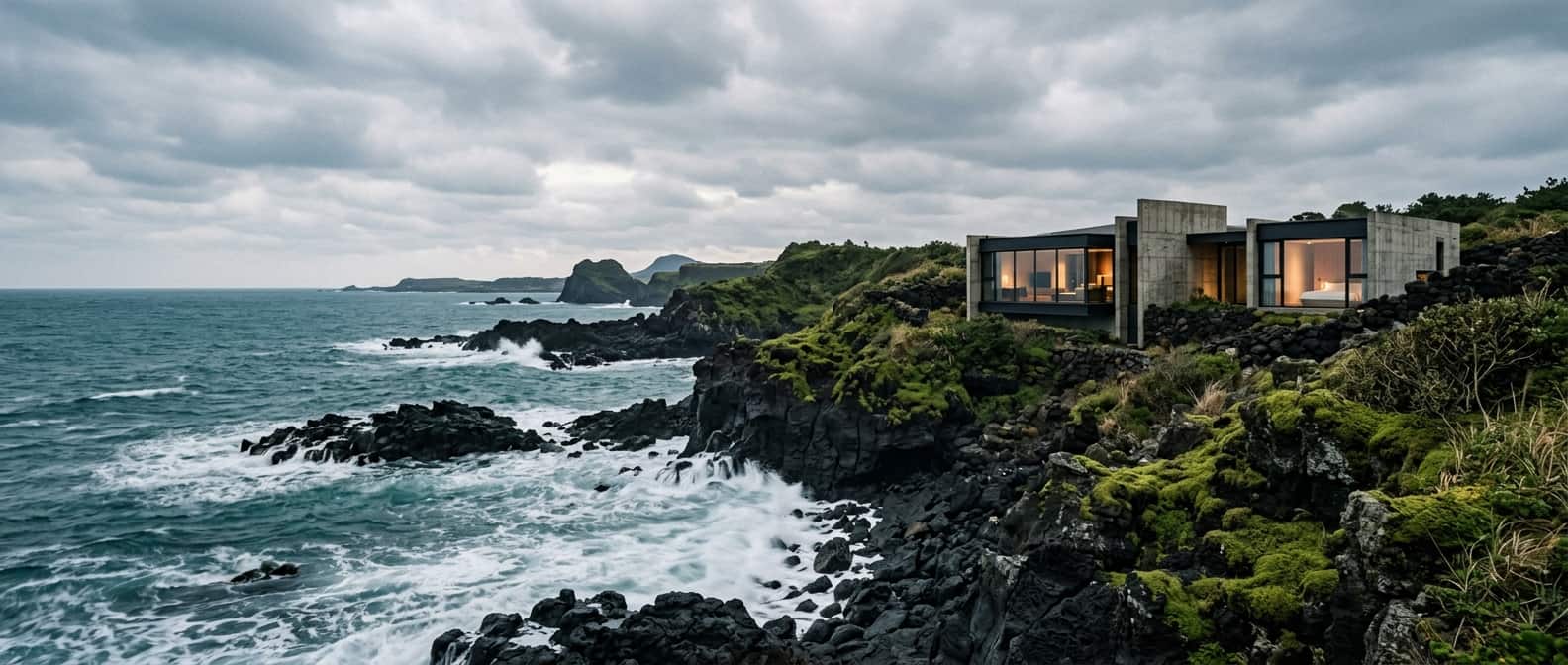
Jeju is a place shaped by elemental forces. At its heart stands Hallasan, a dormant shield volcano whose ancient lava flows carved the island’s coastline into a dramatic fringe of black rock. Along its shores, the Pacific Ocean is a constant, churning presence, its colour shifting from turquoise to indigo with the passing clouds. This is not the Korea of K-Pop and cosmetics; this is a wilder, more contemplative Korea, a place that asks you to slow down, to look closer, and to simply be.
For the discerning traveller from India, accustomed to the grand palaces of Rajasthan or the tranquil backwaters of Kerala, Jeju offers a new vocabulary of escape. It’s a landscape that is at once raw and meticulously curated, where minimalist concrete-and-glass villas sit nestled in ancient forests, and where a meal can be a quiet meditation on the island’s unique terroir.
The Wind's Dominion: An Introduction to Jeju
Locals call Jeju Samdado, the island of three abundances: wind, rocks, and women. The wind is the most dominant. It sculpts the trees, whispers through fields of silver grass, and whips the sea into a constant motion. To understand Jeju, you must first understand its relationship with this ever-present force. The island’s traditional houses are built low to the ground, with thick stone walls to blunt the gales. The fields are partitioned by neat, interlocking walls of black volcanic rock, a testament to generations of farmers clearing the land and using what the volcano gave them to protect their crops.
The women, the legendary haenyeo, are perhaps the most potent symbol of the island’s spirit. These ‘sea women’, many in their 60s and 70s, free-dive into the cold, rough waters to harvest abalone, sea urchins, and octopus, a tradition passed down through generations. To watch them from the cliffs—their bright orange buoys bobbing on the waves before they emerge, sleek and powerful as seals—is to witness a profound connection between humanity and nature. Theirs is a story of resilience and strength, a living piece of cultural heritage that defines the island’s soul.
Where to Stay: The Architecture of Retreat
Luxury on Jeju is not about gilded taps or ostentatious lobbies. It is about architecture that defers to the landscape, creating spaces of sanctuary and contemplation. The island has become a canvas for some of South Korea's most thoughtful architects, who use concrete, glass, and volcanic stone to frame the natural world.
The Podo Hotel, designed by the celebrated Korean-Japanese architect Itami Jun, is a prime example. Its name means ‘grape’, and from above, the interlocking, organically shaped roofs of its villas resemble a cluster of grapes. Inside, each room is a quiet haven, with private courtyards and windows that look out onto the slopes of Hallasan. The hotel is a study in texture and light, a place that feels both grounded and deeply modern.
Another is the JW Marriott Jeju Resort & Spa, perched on a cliff overlooking the southern coast. Its design, by Bill Bensley, is theatrical and layered, inspired by the island’s farming heritage but executed with a bold, contemporary flourish. Infinity pools seem to merge with the ocean below, and guest rooms are designed as calm, neutral-toned sanctuaries, letting the staggering ocean views take centre stage. These are not just places to sleep, but destinations in themselves, designed for slow days of reading, swimming, and watching the weather roll in.
The Volcanic Heart: Exploring Hallasan National Park
All roads on Jeju eventually lead towards Hallasan. The dormant volcano is the island's spiritual and geographical centre, a UNESCO Biosphere Reserve that rises 1,950 meters above sea level. To hike its trails is to journey through a changing ecosystem, from dense forests of pine and oak at its base to the open, windswept grasslands of the sub-alpine zone.
Several trails snake up its flanks, but the Seongpanak trail is one of the most rewarding, a steady, nine-kilometre climb to the summit. The hike is not a simple walk; it’s a physical commitment, a pilgrimage that takes a full day. The path is often paved with volcanic stones, a reminder of the mountain's fiery origins. As you ascend, the noise of the world falls away, replaced by the sound of your own breathing and the rustle of the wind in the leaves.
The reward for your effort is the Baengnokdam, a vast crater lake at the summit. Often shrouded in mist, the view from the top is a breathtaking panorama of the entire island, a reminder of how this single mountain created everything around you. It’s a humbling experience, a moment of perspective that stays with you long after you’ve descended.
Coastal Drives and Hidden Galleries: The Art of the Road
One of the greatest pleasures of Jeju is the freedom of the open road. Renting a car is essential to uncovering the island’s secrets. The coastal roads, particularly Highway 1132 which circumnavigates the island, offer an ever-changing spectacle of cliffs, beaches, and small fishing villages.
The southern coast, from Seogwipo to the Songaksan mountain, is particularly stunning. Here, you can find the Jusangjeolli Cliffs, a mesmerising formation of hexagonal basalt pillars that look as though they were carved by a giant sculptor. Further west, the landscape softens into small, quiet beaches like Hyeopjae, with its impossibly white sand and turquoise water, offering a view of the tiny, verdant Biyangdo Island.
Interspersed along these drives are unexpected pockets of art and culture. The Yumin Art Nouveau Collection, housed in a breathtaking building designed by the legendary Tadao Ando, is a must-visit. The building itself is a work of art, a play of concrete, light, and water that leads you to a stunning collection of French glasswork. It is a quiet, meditative space where art and architecture exist in perfect harmony with the surrounding nature.
A Taste of the Island: Jeju's Unique Culinary Language
Jeju’s cuisine is a direct reflection of its landscape: simple, honest, and deeply flavourful. It’s a culinary dialect distinct from the mainland, shaped by the sea and the volcanic soil. The island is famous for its black pork, a breed of pig native to Jeju, prized for its rich, clean flavour. A classic black pork barbecue, grilled over charcoal and eaten with fresh greens and a pungent anchovy dipping sauce, is an essential island experience.
The seafood, naturally, is exceptional. Abalone, harvested by the haenyeo, is a local delicacy, often served raw and sliced thin, or cooked in a rich, savoury porridge. Sea urchin soup, with its briny, umami depth, is another local specialty.
To truly understand the island’s palate, visit one of the traditional five-day markets, like the one in Seogwipo. Here, you can see the building blocks of Jeju’s cuisine: stalls piled high with glistening silver hairtail fish, baskets of tart, fragrant hallabong oranges (a local citrus), and vendors selling bracken fern and other foraged mountain vegetables. It’s a vibrant, sensory experience that connects you directly to the lifeblood of the island.
The Way of Water: Submersion and Stillness
The final piece of the Jeju puzzle is its relationship with water. Not just the ocean, but the water that flows from the mountain. The Jeongbang Waterfall in Seogwipo is one of the few in Asia to fall directly into the sea, a powerful cascade of fresh water meeting salt.
For a more immersive experience, seek out the island’s natural swimming spots. The Donnaeko Valley offers a series of ice-cold freshwater pools, hidden in a lush forest, that are a bracing and restorative shock to the system on a warm day.
But perhaps the ultimate expression of water and wellness is found in the spas of the luxury hotels. At the JW Marriott, the spa experience is built around the island's volcanic geology, with treatments using local botanicals and heated volcanic stones. It’s a final act of surrender to the island’s elemental power, a way to absorb its quiet, healing energy before your return to the world. Jeju reminds you that the greatest luxury is not what is added, but what is stripped away: noise, haste, and distraction. What is left is the wind, the rock, and the sea—a landscape that gets under your skin and stays with you, long after you’ve left its shores.
Planning Your Escape: A Practical Guide
Getting There: From India, the most convenient route is to fly to Seoul's Incheon International Airport (ICN). From Seoul, Gimpo International Airport (GMP) offers dozens of daily flights to Jeju International Airport (CJU), a journey of just over an hour.
When to Go: Spring (April to June) and Autumn (September to November) offer the most pleasant weather for exploring, with mild temperatures and clear skies. Summer is peak season but can be hot and humid, while winter is quiet and often sees snow on Hallasan.
Getting Around: A rental car is highly recommended to explore the island at your own pace. The roads are well-maintained and signage is available in English.
Visas: Indian citizens require a visa to visit South Korea. It is advisable to apply well in advance of your planned travel dates through the Korean embassy or consulate in India.