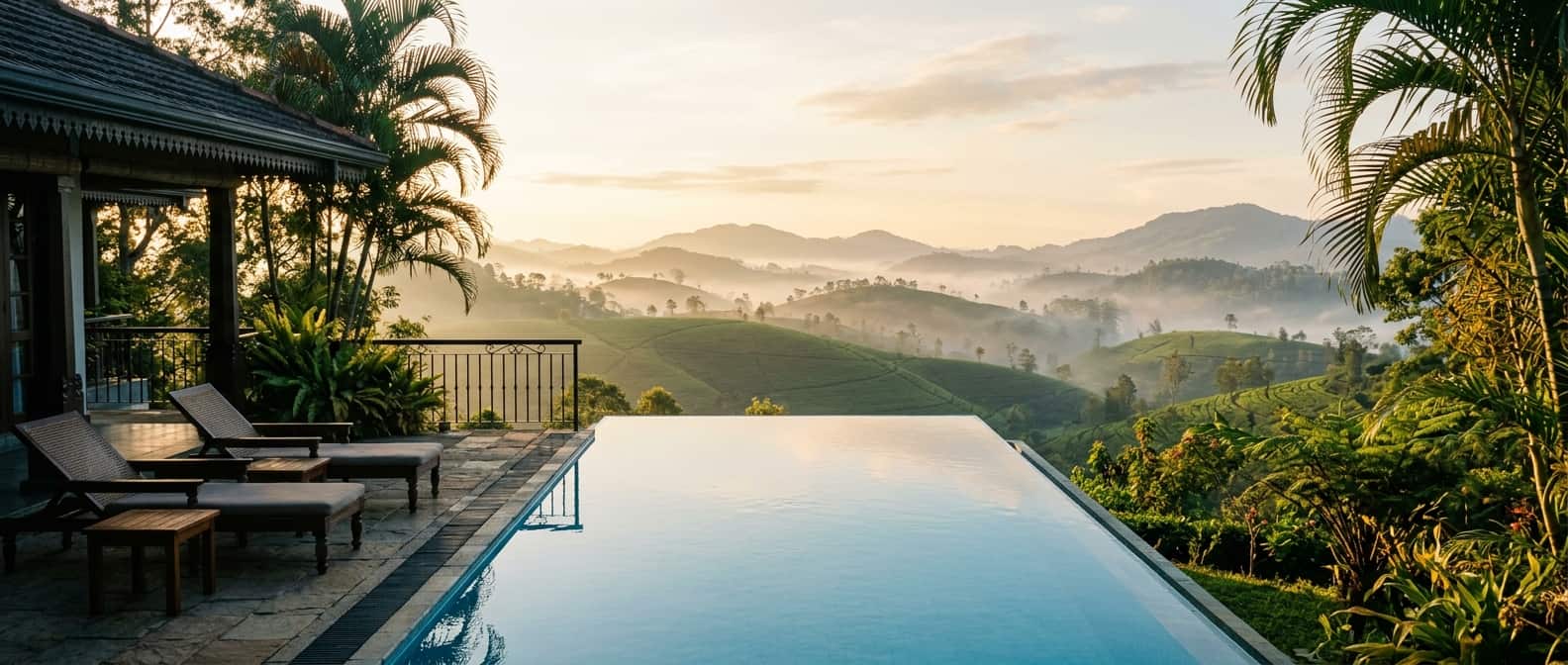
The air in the Central Highlands of Sri Lanka does not simply carry moisture; it carries the scent of crushed cardamom and wet earth, a heavy, fragrant veil that settles over the tea gardens of Hatton before the sun has fully cleared the peaks. In the early morning, the only sound is the distant, rhythmic clicking of tea pluckers moving through the verdant rows, their bright sarees vivid against a sea of emerald. This is a landscape that feels ancient, yet for the luxury traveler, it is currently undergoing a quiet, sophisticated rebirth.
For the Indian traveler, Sri Lanka has long been a familiar neighbor—a place of rapid weekenders and cricket matches. But in 2024, the island has shed its "budget getaway" image to reveal a world of high-concept boutique hospitality that rivals the best of Southeast Asia. It is a renaissance defined not by marble lobbies or gold-plated fixtures, but by space, stillness, and a profound connection to the land.
The Return of the Pearl
The resurgence of Sri Lanka as a primary luxury destination is no accident. Following a period of economic recalibration, the island has emerged with a sharpened focus on high-value, low-impact tourism. The ease of travel for Indian passport holders—often benefiting from simplified visa procedures—has made it the definitive short-haul choice for those who have already exhausted the Maldives or Dubai.
But beyond the logistics, there is a palpable shift in how people are visiting. We are seeing a move away from the frantic multi-city tours and toward "slow circuits." A typical ten-day itinerary now prioritizes three nights in a single tea bungalow over three different cities in three days. The luxury here lies in the ability to watch the mist roll over a valley from a private veranda, a gin and tonic in hand, with nowhere else to be.
Hill Country Elegance: The Tea Trails
The journey into Sri Lanka’s soul begins in the hills. The Central Highlands, a UNESCO World Heritage site, are home to the legendary Ceylon Tea Trails, a collection of five restored colonial-era tea planter bungalows. Each bungalow—from the lakeside Summerville to the high-perched Tientsin—offers a window into a bygone era, updated with modern sensibilities.
Here, the experience is governed by the "Butler Service," a term that feels inadequate for the level of intuitive care provided. Your day begins with "bed tea" served in fine bone china and ends with a four-course dinner that bridges the gap between traditional British fare and fiery Sri Lankan flavors. The hills are for walking; a trek through the estates with a resident naturalist reveals the intricate ecology of the tea plant, while a visit to the factory offers a sensory dive into the withering, rolling, and drying of the world’s finest leaves.
Tropical Modernism: The Bawa Legacy
To understand luxury in Sri Lanka, one must understand Geoffrey Bawa. The father of "Tropical Modernism," Bawa’s architectural philosophy—where the line between the indoors and the outdoors is intentionally blurred—remains the blueprint for the island’s best hotels.
A pilgrimage to Lunuganga, Bawa’s country estate in Bentota, is essential for any design-conscious traveler. The gardens are a masterpiece of controlled wildness, a series of outdoor "rooms" that frame views of the Dedduwa Lake. Staying in one of the boutique suites at Lunuganga is less like a hotel stay and more like being a guest in a visionary’s private world. This aesthetic—raw concrete, local timber, reflecting pools, and expansive glass—is echoed in properties like Jetwing Lighthouse in Galle and the minimalist Kandalama in Dambulla, which appears to be swallowed by the jungle.
The New Coastline: Secret Villas and Southern Chic
While the West Coast has the history, the South Coast has the energy. The stretch from Ahangama to Hiriketiya has evolved from a backpacker’s surf secret into a playground for the "barefoot luxury" set. Here, the accommodation of choice is the private villa.
Properties like Ani Private Resorts offer a level of exclusivity that is hard to find elsewhere in the Indian Ocean. Set on a cliff overlooking the turquoise waters of Dickwella, these are all-inclusive estates designed for multi-generational families or groups of friends who want a curated, private experience.
Further west, the historic town of Galle remains the island’s cultural anchor. Inside the UNESCO-protected Fort, boutique hotels like Amangalla occupy grand colonial buildings that have stood for centuries. The luxury here is found in the high ceilings, the creak of original teak floorboards, and the slow pace of life as the sun sets over the ramparts.
Cinnamon and Sea Salt: A Sensory Palate
Sri Lankan cuisine in the luxury sector has moved far beyond the standard hotel buffet. There is a newfound pride in indigenous ingredients—jackfruit, gotu kola, wood apple, and the ubiquitous Ceylon cinnamon.
At the island's top tables, traditional "Rice and Curry" is elevated to a degustation experience. Imagine fifteen small clay pots, each containing a different texture and heat profile, from the creamy sweetness of a dhal tempered with coconut milk to the sharp, citrusy bite of a lunu miris. On the coast, the focus shifts to the daily catch. In Weligama, you can watch the stilt fishermen at dawn and find their catch—jumbo prawns and red snapper—grilled over charcoal at a beachside table by dusk.
Practicalities: Curating the Circuit
For the discerning Indian traveler, a 10-day circuit is the ideal duration. Start in the Cultural Triangle to take in the heights of Sigiriya at dawn, then move south to the Tea Country for cool air and quiet walks. End your journey on the South Coast, using Galle as a base for exploring the boutique shops and hidden beaches of the Southern Province.
Direct flights connect major Indian metros like Delhi, Mumbai, and Chennai to Colombo’s Bandaranaike International Airport. From there, the most luxurious way to navigate the island is by private chauffeur-guide or, for a more scenic entry into the hills, the Cinnamon Air seaplane, which offers bird's-eye views of the cascading waterfalls and dense canopy that define this emerald isle.
Sri Lanka is not just a destination; it is a feeling. It is the realization that luxury doesn’t always have to be loud. Sometimes, it is as simple as the sound of the rain on a terracotta roof, the taste of a sun-warmed mango, and the sight of a blue whale breaching in the distance. The renaissance is here, and it is waiting to be discovered.
Sources
- Resplendent Ceylon — The benchmark for luxury hospitality in Sri Lanka, including Tea Trails and Cape Weligama.
- Geoffrey Bawa Trust — Insights into the architectural heritage and the "Tropical Modernism" movement.
- Ani Private Resorts — Details on the ultra-luxury private villa model in the Southern Province.
- Sri Lanka Tourism Development Authority — Updates on tourism trends and visa-free travel developments for 2024.