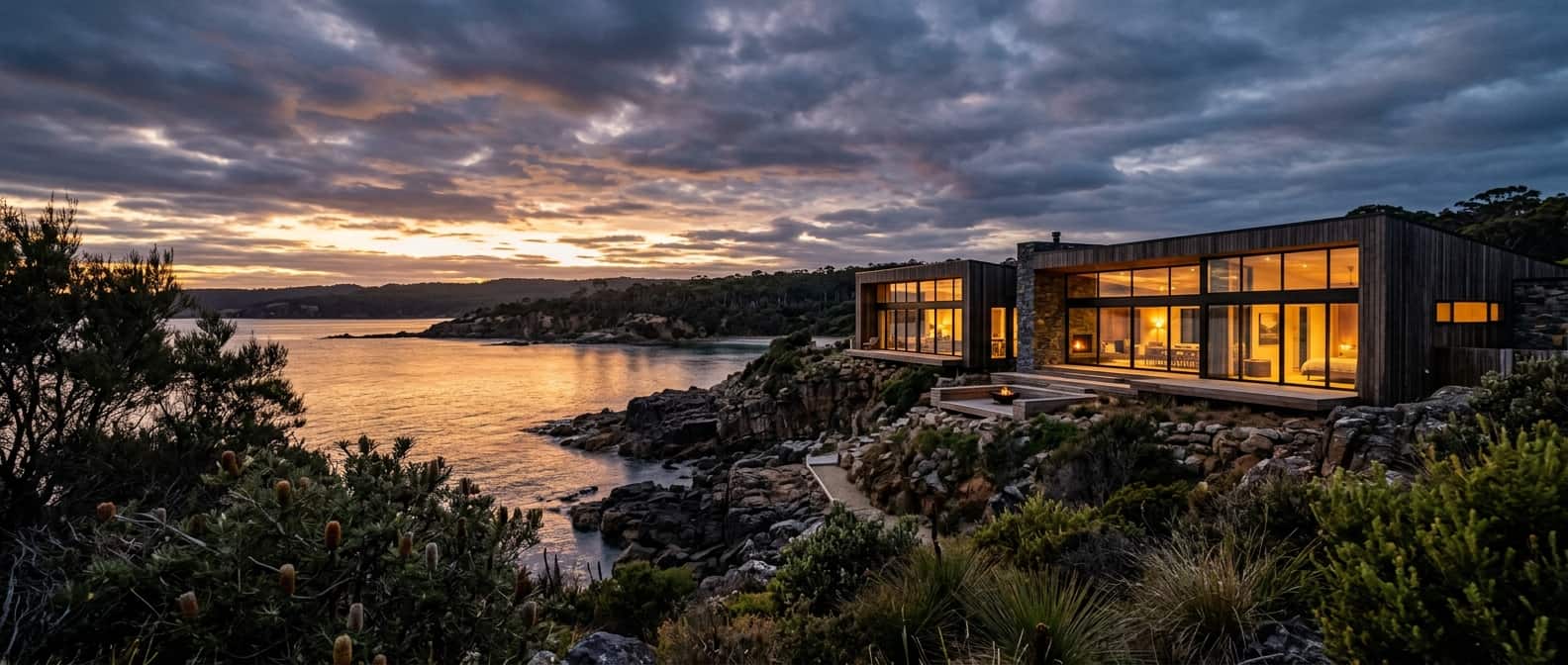
The air at the bottom of the world feels different—sharper, heavier, entirely unbreathed. Looking out over Great Oyster Bay as the evening light turns the granite peaks of the Hazards mountain range a bruised, brilliant pink, the noise of the northern hemisphere vanishes. This is Tasmania, a rugged island state off Australia's southern coast that has quietly transformed from an overlooked outpost into a sanctuary for the world's most discerning, privacy-seeking travelers. For affluent Indian globetrotters shifting their gaze from the crowded promenades of Europe toward experiential long-haul destinations, this island represents the ultimate currency: absolute stillness.
In a travel landscape increasingly defined by 'beyond beige' trends—where connection to place and culture outweighs sheer opulence—Tasmania delivers an unapologetic wilderness paired with astonishingly high design. Here, luxury is not measured by the number of marble columns, but by the sheer expanse of private wilderness, the purity of the ingredients on your plate, and the silence of ancient rainforests.
The New Frontier of Australian Luxury
Historically, the Indian luxury traveler’s Australian itinerary has been comfortably predictable: the cosmopolitan energy of Sydney, the laneways of Melbourne, and perhaps a curated foray to the Great Barrier Reef. Yet, as appetites evolve toward profound isolation and off-grid adventures, Tasmania has emerged as the country’s most compelling narrative.
Separated from the mainland by the notoriously turbulent Bass Strait, the island—often affectionately called the Apple Isle—retains an untamed character. It is a place where Gondwana-era rainforests meet violently beautiful coastlines. Recognizing the allure of this raw topography, a handful of visionary hoteliers have embedded extraordinary design-led lodges into the landscape, offering a version of luxury that is deeply respectful of its environment.
Saffire Freycinet: Architecture as Landscape
Any conversation about Tasmanian luxury begins at Saffire Freycinet. Suspended above Great Oyster Bay, the lodge’s main building sweeps upward in a curve that mimics the surrounding dunes and the rolling peaks of the Hazards across the water. It is a masterclass in organic architecture, demanding attention without disrespecting the coastal scrubland it occupies.
The experience at Saffire is deliberately insulated. With just 20 suites, the staff-to-guest ratio ensures a kind of telepathic service. Suites feature walls of floor-to-ceiling glass, framing views so perfect they feel rendered. Days here are spent knee-deep in a tidal estuary, wearing waders, plucking Pacific oysters straight from the water, and pairing them with a crisp local Riesling as the tide shifts around you. It is sensory, immediate, and utterly unforgettable.
Pumphouse Point: Isolation on Lake St Clair
If Saffire is a celebration of the coast, Pumphouse Point is a study in alpine solitude. Located within the Cradle Mountain-Lake St Clair National Park, the property is defined by its striking geography: a 1940s hydroelectric pumphouse situated at the end of a 250-meter concrete flume, completely surrounded by Australia's deepest lake.
To stay in the Pumphouse itself is to sleep suspended over water. The design is an exercise in industrial restraint—exposed pipes and concrete softened by rich Tasmanian timbers, bespoke wool throws, and an honesty bar stocked with exceptional local spirits. The luxury here is the isolation. There are no televisions, no hurried itineraries. Guests spend their time hiking the glacial landscape, rowing across the glass-like surface of the lake, or simply watching the unpredictable weather roll across the mountains from the warmth of the lounge.
The Culinary Narrative of the Apple Isle
Tasmania’s culinary scene is the beating heart of its luxury offering. Benefiting from the cleanest air in the world and pristine waters, the island's produce requires very little manipulation. This is the realm of wild abalone, black truffles, and some of the most celebrated cool-climate wines in the southern hemisphere.
Dining at these wilderness lodges is intrinsically tied to the land. Chefs forage for sea botanicals, source wagyu from nearby farms, and pour single-malt whiskies distilled just down the road. The emphasis is on terroir—a true taste of place. It is a compelling counterpoint to the imported extravagance often found in traditional luxury hotels, offering a dining experience that feels grounded and fiercely local.
The Logistics of Going Off-Grid
Reaching the edge of the world requires a considered approach. For travelers arriving from India, a transit through Melbourne or Sydney is necessary, followed by a short flight to Hobart or Launceston. To truly experience the scale of the island, private charter flights or helicopters are the preferred method of transit between lodges, transforming travel days into spectacular scenic tours of the rugged interior.
Tasmania’s climate is maritime and notoriously changeable, affectionately described as "four seasons in one day." The peak season runs from December to March (the Australian summer), offering long, golden days. However, the 'dark mofo' winter months of June to August hold a distinct, moody appeal, perfect for dark skies, crackling fires, and the possibility of witnessing the Southern Lights (Aurora Australis).
In an era where true escape is increasingly difficult to manufacture, Tasmania offers something rare: a place where luxury and wilderness are not in conflict, but in perfect, silent alignment.
Sources
- Beyond beige: How Indian travellers are redefining luxury in 2026 — Indian travelers redefining luxury via connection to place and culture.
- Luxury Collection 2024 | National Geographic — Highlighting off-grid adventures and quiet luxury.