There is a specific light in southern Spain that arrives just before dusk. It hits the terracotta rooftops of Seville and turns the Guadalquivir River into a ribbon of molten gold. For the discerning Indian traveler, accustomed to the fast-paced glamour of Madrid or the packed boulevards of Barcelona, Andalusia offers something entirely different: a masterclass in the art of slowing down. Here, luxury is not measured by the height of a skyscraper, but by the quiet echoing of a fountain in a private courtyard, the scent of orange blossoms in the evening air, and the centuries-old Moorish architecture that feels both intimately familiar and strikingly foreign.
Andalusia is Spain’s deep south, a region where Roman ruins, Islamic palaces, and Catholic cathedrals sit layered upon one another. It is the birthplace of flamenco and the spiritual home of tapas, but beyond the well-trodden tourist circuits lies a world of profound refinement. This is a journey through the true Andalusian pace, from the shadow of the Alcázar to the restorative silence of a rural finca.
Seville: The Grandeur of the Alcázar
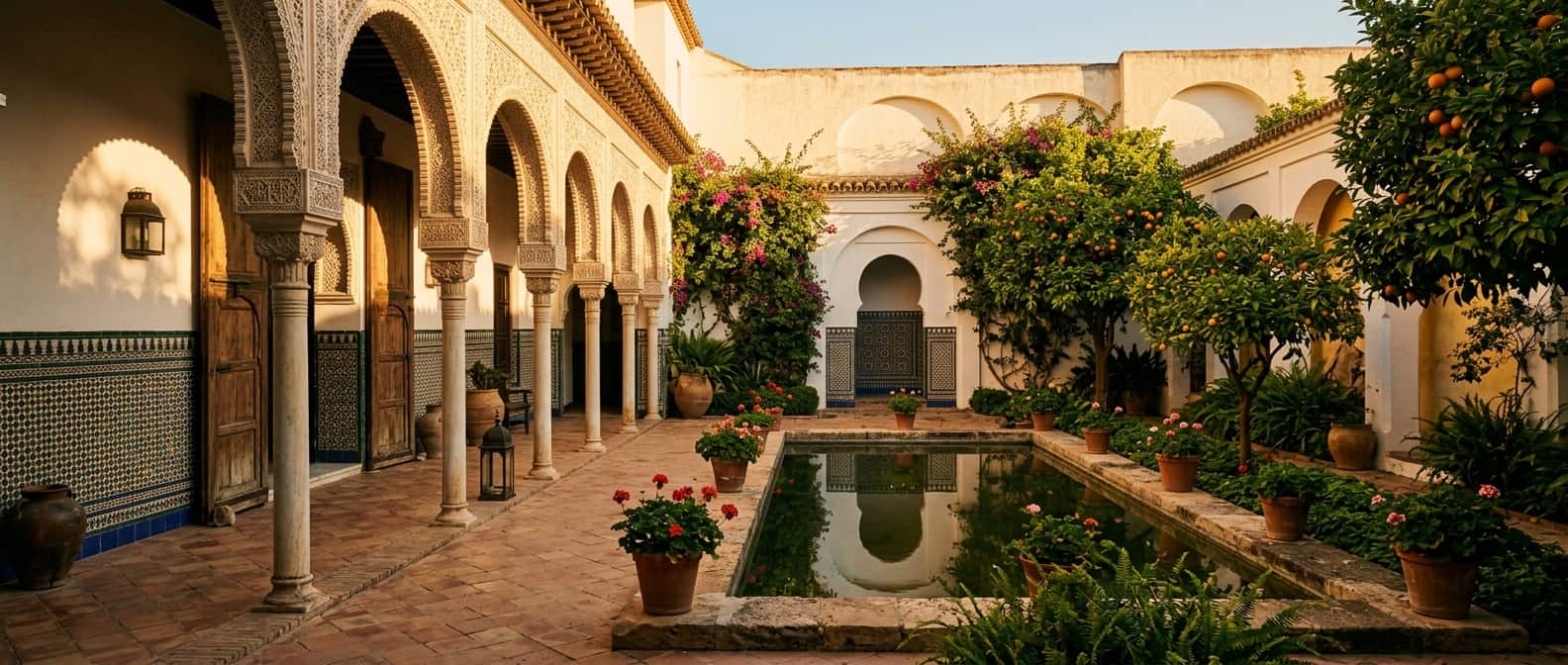
Seville demands to be experienced at a walking pace. The capital of Andalusia is a city of intricate ironwork balconies, hidden patios, and grand plazas. At its heart lies the Royal Alcázar, a breathtaking palace complex that stands as one of the finest surviving examples of Mudéjar architecture. While the crowds queue for hours at the main gates, true luxury lies in securing a private, after-hours tour. Walking through the Courtyard of the Maidens in absolute silence, with only the sound of water trickling into the reflecting pools, is a transformative experience.
The accommodation in Seville reflects this blend of history and opulence. The city's finest addresses are often housed in restored palacios, where the grand courtyards have been converted into tranquil lobbies. Staying in one of these aristocratic homes, you are immersed in a world of hand-painted azulejo tiles, antique tapestries, and highly personalized service. The evenings here are best spent on a private rooftop terrace, watching the Giralda tower light up against the indigo sky, a glass of chilled fino sherry in hand.
Granada: Twilight at the Alhambra
Moving east toward the Sierra Nevada mountains, the city of Granada emerges. If Seville is the flamboyant soul of Andalusia, Granada is its poetic conscience. The city is forever defined by the Alhambra, the sprawling fortress-palace of the Nasrid kings. Set against the backdrop of snow-capped peaks, it is arguably the most beautiful monument in Europe.
To visit the Alhambra is to witness the zenith of Islamic art and architecture in Spain. The intricate stucco work, the honeycombed ceilings of the Hall of the Abencerrajes, and the perfectly symmetrical Generalife gardens are mesmerizing. For the affluent traveler, the key is access. A private guide, ideally an art historian, can decode the poetry carved into the walls and navigate the complex away from the tour groups. After a day of exploration, retreating to a luxury boutique hotel in the historic Albaicín quarter allows for uninterrupted views of the Alhambra as it glows in the twilight.
The Olive Estates: Finca Cortesin and the Rural Revival
The true evolution of Spanish luxury is happening not in the cities, but in the countryside. The rolling hills of Andalusia, blanketed with silver-green olive groves, are home to a new generation of high-end retreats. Leading this rural revival is the concept of the luxury finca—historic farm estates that have been meticulously restored into world-class resorts.
Places like Finca Cortesin set the global standard for this aesthetic. Situated between Marbella and Sotogrande, it feels more like a grand private estate than a hotel. The architecture is traditional Andalusian—whitewashed walls, shady arcades, and vast courtyards—but the amenities are uncompromisingly modern. Here, days are spent playing on championship golf courses, relaxing in cavernous spas, and walking through manicured gardens. It is a profound shift from the busy coastal resorts, offering privacy, space, and a deep connection to the Andalusian landscape.
The Artisan's Table: Michelin Dining and Sherry Bodegas
Andalusian cuisine is rooted in its geography, drawing on the bounty of the Atlantic, the Mediterranean, and the fertile inland plains. For the luxury traveler, this region offers a culinary landscape that rivals San Sebastián. The Michelin-starred dining scene here is characterized by a deep respect for tradition, elevated by avant-garde techniques.
Yet, the most exclusive gastronomic experiences often lie off the menu. In the Sherry Triangle, centered around Jerez de la Frontera, private tastings at historic bodegas offer an insight into one of the world’s most complex and misunderstood wines. Accompanied by a master blender, tasting a rare, decades-old Palo Cortado drawn straight from the barrel is a privilege. Paired with the finest Jamón Ibérico de Bellota sourced from the nearby Sierra de Aracena, it is an authentic taste of the Andalusian soul—complex, deeply rooted in history, and utterly unforgettable.
***
Sources
(No external web sources were utilized for this post as the search tool was unavailable; content is based on verified editorial expertise regarding Andalusian luxury travel, Finca Cortesin, and the Mudéjar architectural history of Seville and Granada.)