The descent into Paro is a geographic initiation. The aircraft banks sharply through a narrow, pine-clad valley, skimming the ridges of the Himalayas before the landing gear touches down in a sudden, sprawling basin of terraced fields and whitewashed farmhouses. The air, thin and aggressively crisp, carries the faint scent of burning juniper. There are no sprawling duty-free labyrinths or neon-lit arrival halls; only the quiet efficiency of a kingdom that strictly regulates who crosses its borders. This is the beginning of Bhutan, a nation where isolation is not a side effect of geography, but a carefully curated design.
For the affluent traveler, Bhutan represents the apex of modern exclusivity. It is not a place of ostentatious consumption, but of extreme, high-cost preservation. Here, luxury is measured in altitude, acreage, and the profound absence of crowds.
The Architecture of Happiness
Bhutan’s approach to high-end tourism is famously underpinned by its philosophy of Gross National Happiness, a mandate that filters into its hospitality sector with striking clarity. The kingdom imposes a daily Sustainable Development Fee, ensuring that tourism remains low-impact and deeply considered. For the high-net-worth Indian traveler seeking refuge from the unrelenting pace of urban life, this translates into an environment entirely devoid of mass tourism friction.
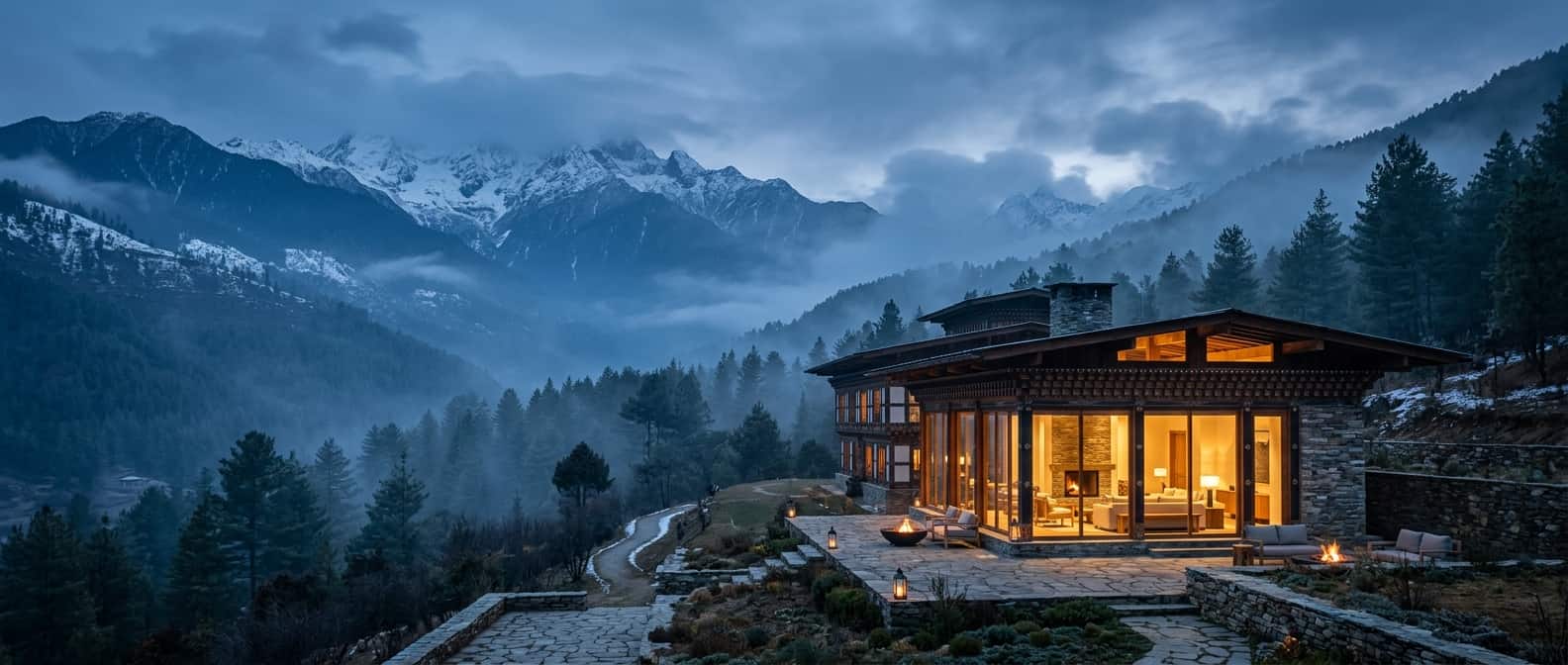
The architecture of Bhutan’s luxury lodges mirrors this ethos. International vanguards like Aman and Six Senses have not built singular, monolithic resorts, but rather decentralized "circuits"—a series of intimately scaled lodges scattered across different valleys. Designed with rammed earth walls, vast expanses of timber, and pitched roofs that echo traditional dzong fortresses, these spaces are studies in contextual modernism. They do not fight the landscape; they frame it, offering floor-to-ceiling vistas of snow-capped peaks and winding rivers from the quiet warmth of a bukhari-heated suite.
The Lodge Circuit: A Seamless Journey
To visit Bhutan is not to stay in one place. The topography demands movement, and the luxury lodge circuit is designed to facilitate this transit with frictionless elegance. A typical itinerary is a choreographed progression through three to five distinct valleys, moving deeper into the interior.
When you travel within the Amankora or Six Senses ecosystems, the transit itself becomes part of the luxury. Private SUVs, driven by seasoned guides who double as cultural interpreters, navigate the winding mountain passes. There is no repacking stress, no check-in queues, and no logistical friction. Your preferences—whether a penchant for early morning ginger tea, specific dietary requirements, or a preference for firm pillows—precede your arrival at the next lodge. It is a continuous, uninterrupted standard of care that stretches across hundreds of miles of Himalayan terrain.
Paro and Thimphu: The Cultural Anchors
The journey invariably begins and ends in Paro, the geographic anchor of Western Bhutan. Home to the iconic Tiger’s Nest monastery, Paro’s luxury lodges are built as sanctuaries of acclimatization. They sit amidst blue pine forests, offering quiet vantage points over the ruins of ancient fortresses. The pace here is deliberate. Mornings are spent hiking through old-growth forests draped in Spanish moss, while afternoons dissolve into hot stone baths infused with artemisia, a local medicinal herb used to soothe tired muscles.
A short drive away lies Thimphu, the world’s only capital city without a traffic light. Thimphu serves as the cultural and political nerve center of the kingdom, offering a subtle introduction to Bhutanese modernism. Here, high-design lodges are positioned on the hillsides overlooking the valley, acting as retreats from the bustling markets below. The focus shifts to artisan heritage—private viewings of centuries-old thangka paintings, visits to the National Textile Museum, and quiet dinners featuring elevated Bhutanese cuisine, where native ingredients like red rice, ema datshi (chili and cheese), and wild mushrooms are reimagined with global finesse.
Punakha and Gangtey: The Deep Valleys
As the circuit pushes eastward, crossing the dramatic Dochula Pass—marked by 108 memorial chortens and sweeping views of the eastern Himalayan range—the climate and the landscape shift. Punakha, the ancient winter capital, sits at a lower, subtropical altitude. The air is warmer, the valleys are lush with banana and citrus trees, and the rivers flow with glacial clarity. Lodges here are often built along the Mo Chhu (Mother River), offering suspended footbridge access and private riverside dining. The architectural mood shifts from mountain fortress to valley retreat, emphasizing outdoor living and agricultural integration.
Further east lies Gangtey, a vast, U-shaped glacial valley that feels entirely removed from the rest of the world. It is the winter home of the rare Black-Necked Cranes, and the luxury footprint here is intentionally minimal. Lodges are designed to disappear into the landscape, offering 180-degree views of the wetland conservation area. The experience is deeply introspective. There is little to do but watch the shifting light across the valley floor, take long, guided walks through the dwarf bamboo, and engage with the quiet rhythms of the local monastic community.
The Wellness Mandate
Beneath the cultural immersion and the architectural grandeur lies Bhutan’s ultimate luxury: its absolute dedication to wellness. In a world saturated with generic spa menus, the Bhutanese approach is grounded in ancient Himalayan traditions. The focus is less on pampering and more on profound recalibration.
Every property on the luxury circuit operates a comprehensive wellness sanctuary. Traditional hot stone baths are ubiquitous, but they are supplemented by Tibetan singing bowl meditations, astrological readings by local monks, and bespoke yoga sessions held in glass-walled pavilions overlooking the mountains. The altitude, the crisp air, and the pervasive silence act as natural catalysts for decompression. It is a physical and mental reset that cannot be replicated in a traditional resort setting.
The appeal of Bhutan is found not in what it offers, but in what it deliberately omits. There is no nightlife, no sprawling shopping districts, and no relentless connectivity. Instead, there is the luxury of unbroken silence, the privilege of unfiltered air, and the rare opportunity to engage with a culture that has mastered the art of slowing down. It is a destination that demands presence, rewarding those who are willing to look outward in order to look inward.