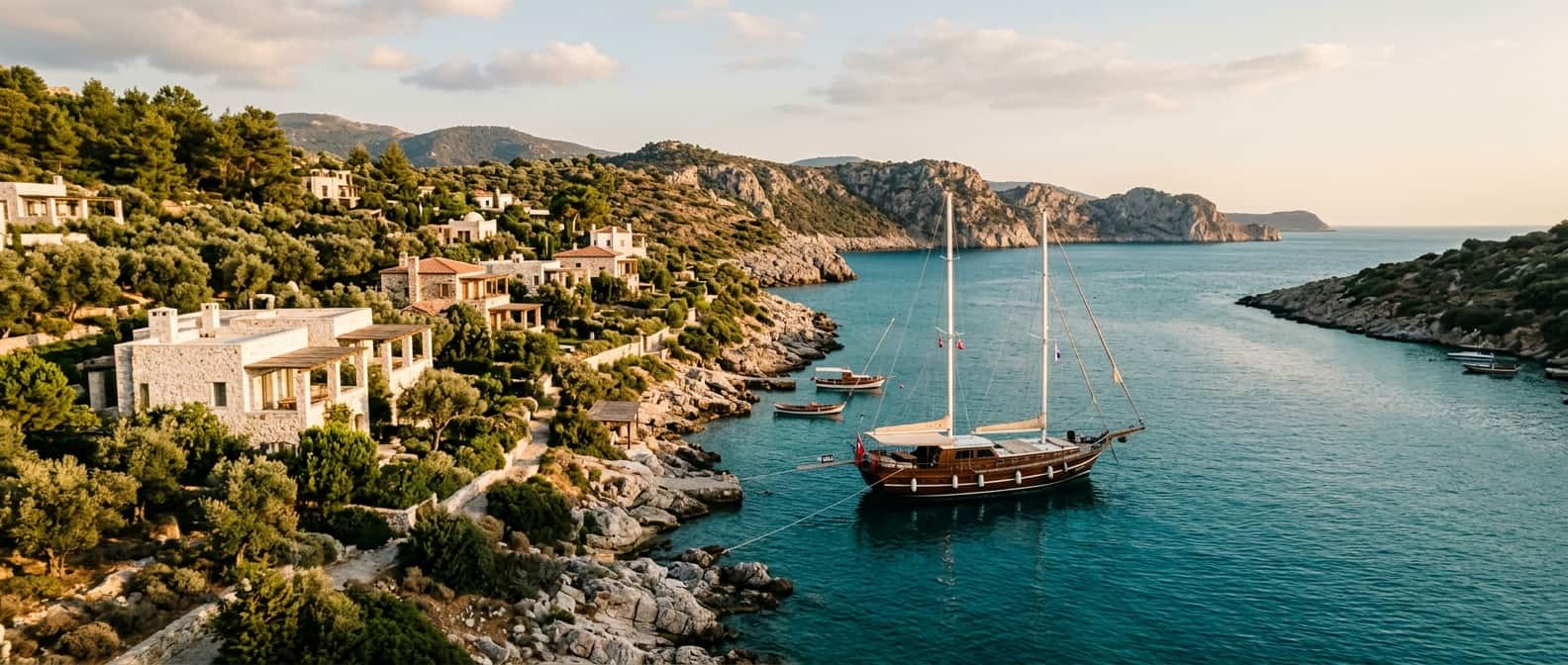
The scent of crushed wild thyme and sea salt rides on the warm Meltemi wind long before the coastline comes into view. Here, where the Aegean Sea cuts deep into the Anatolian peninsula, the water is a profound, almost electric shade of lapis lazuli. The Turkish Riviera, anchored by the magnetic pull of Bodrum, is a landscape of stark contrasts: whitewashed stone villages cascading down arid hillsides, and sleek wooden gulets slicing through silent bays. It is a place that demands a slower pace, where the blinding Mediterranean noon inevitably gives way to long, golden evenings under ancient olive groves.
The Aegean Alternative
For years, the default summer migration for affluent Indian travelers pointed toward the Amalfi Coast or the French Riviera. Yet, as those storied European shores grow increasingly saturated and the logistics of securing immediate access become tedious, a quiet recalibration is occurring. The Turquoise Coast offers an alternative that sacrifices none of the glamour but restores the privacy and breathing room that define true luxury. Bodrum, often lazily compared to St. Tropez, is entirely its own entity—a sophisticated peninsula that balances its bohemian fishing-village roots with billion-dollar mega-yacht infrastructure.
The appeal is multifaceted. The proximity is a clear advantage, with a shorter flight path from Mumbai or Delhi to Istanbul, followed by a brief, scenic hop to Milas-Bodrum Airport. But the true draw is the spatial luxury. While Italian cliffside towns force a vertical, cramped intimacy, the Turkish Riviera sprawls. It offers vast private estates, isolated beach clubs accessible only by water, and a hospitality ethos that blends Mediterranean indulgence with deeply ingrained Anatolian warmth. The season here extends beautifully, with late September and early October offering the most exquisite light and temperate waters, long after the August crowds have dispersed.
Amanruya: The Stone Sanctuary
To understand the architectural language of quiet luxury in Bodrum, one must look to Amanruya. Tucked into a protected pine forest on the northern coast of the peninsula, overlooking the Bay of Mandalya, the property feels less like a hotel and more like a private Ottoman village. The design is a masterclass in contextual restraint, utilizing local stone, rich mahogany, and hand-fired terracotta to create spaces that are monumental yet deeply grounding.
Each of the standalone guest pavilions is essentially a private compound, complete with its own grey-green marble pool and a garden fragrant with jasmine. For the discerning Indian traveler, privacy of this magnitude is a non-negotiable metric of luxury. There are no crowded lobbies or fought-over sunbeds here; the rhythm of the day is dictated entirely by personal preference. The Beach Club, a series of terraced stone platforms descending to the sea, offers perhaps the most serene swimming experience on the peninsula. It is a place for slow mornings that blur into late lunches, characterized by impeccable, invisible service that anticipates needs before they are articulated.
Macakizi: The Pulse of Bodrum
If Amanruya is the sanctuary, Macakizi is the beating heart of Bodrum’s social landscape. Situated in the sheltered bay of Türkbükü, this iconic hotel has spent over four decades perfecting a very specific brand of barefoot, effortless glamour. What began as a bohemian retreat for artists and writers in the 1970s has evolved into the peninsula’s most coveted reservation, without losing an ounce of its original soul.
The architecture is practically camouflaged into the hillside, hidden behind explosions of violent-pink bougainvillea. Life at Macakizi revolves entirely around the wooden decking that lines the water. By day, it is a canvas of tanned limbs, oversized sunglasses, and the clinking of icy rosé glasses. The water here is deep, clear, and perfectly still, inviting guests to dive straight from the deck into the Aegean. For a demographic used to highly structured itineraries, Macakizi forces a surrender to the immediate moment. It is the place to see and be seen, yet it maintains an absolute policy of unpretentious ease. The transition from daybed to dining table requires nothing more than a linen shirt, embodying the ultimate luxury of not having to try too hard.
Chartering the Gulet
To remain entirely on land is to miss the true essence of the Turquoise Coast. The ultimate expression of luxury in this region is the private charter of a gulet—a traditional two- or three-masted wooden sailing vessel, historically used by sponge divers, now reimagined as floating, five-star villas. While modern motor yachts are abundant, a masterfully crafted wooden gulet offers a tactile, romantic connection to the sea that fiberglass simply cannot replicate.
A private charter allows for the exploration of the Gulf of Gökova and the Datça Peninsula, regions where the roads simply stop and the only access is via water. Days are measured by anchorages in unnamed, pine-fringed coves where the water is so clear the yacht’s shadow is cast perfectly on the seabed thirty feet below. A full crew, including a private chef, ensures that the standard of hospitality rivals any land-based resort. Breakfasts of fresh honeycomb, local cheeses, and simit are served on the aft deck as the morning mist burns off the water, followed by afternoons exploring sunken ruins with a Seabob. It is the definitive antidote to the rigid schedules of modern urban life.
The Cuisine of the Coast
The culinary narrative of the Turkish Riviera is a revelation of freshness and simplicity. It stands in stark contrast to the heavy, complex sauces of classic European fine dining, relying instead on the absolute perfection of seasonal ingredients. Olive oil, wild herbs, line-caught seafood, and sun-ripened tomatoes form the foundation of a diet that feels simultaneously indulgent and restorative.
At high-end establishments like the Mandarin Oriental’s dining outposts or the tables at Macakizi, traditional Anatolian recipes are elevated with modern techniques. Yet, the most memorable meals often occur in less formal settings: a simple meze of charred eggplant, sea beans, and octopus served on a wooden pier, accompanied by a glass of crisp, mineral-heavy local white wine. The concept of the 'meyhane'—a traditional Turkish tavern—has been refined for the luxury traveler, offering an evening of communal dining that stretches late into the night. It is a culinary philosophy that values the integrity of the produce over performative technique, perfectly mirroring the region’s broader approach to hospitality.
The Aegean coast does not ask you to conform to a rigid idea of a holiday. It simply offers its deep blue waters, the scent of its pine forests, and the quiet dignity of its stone architecture, inviting you to disappear into its rhythm for a while.