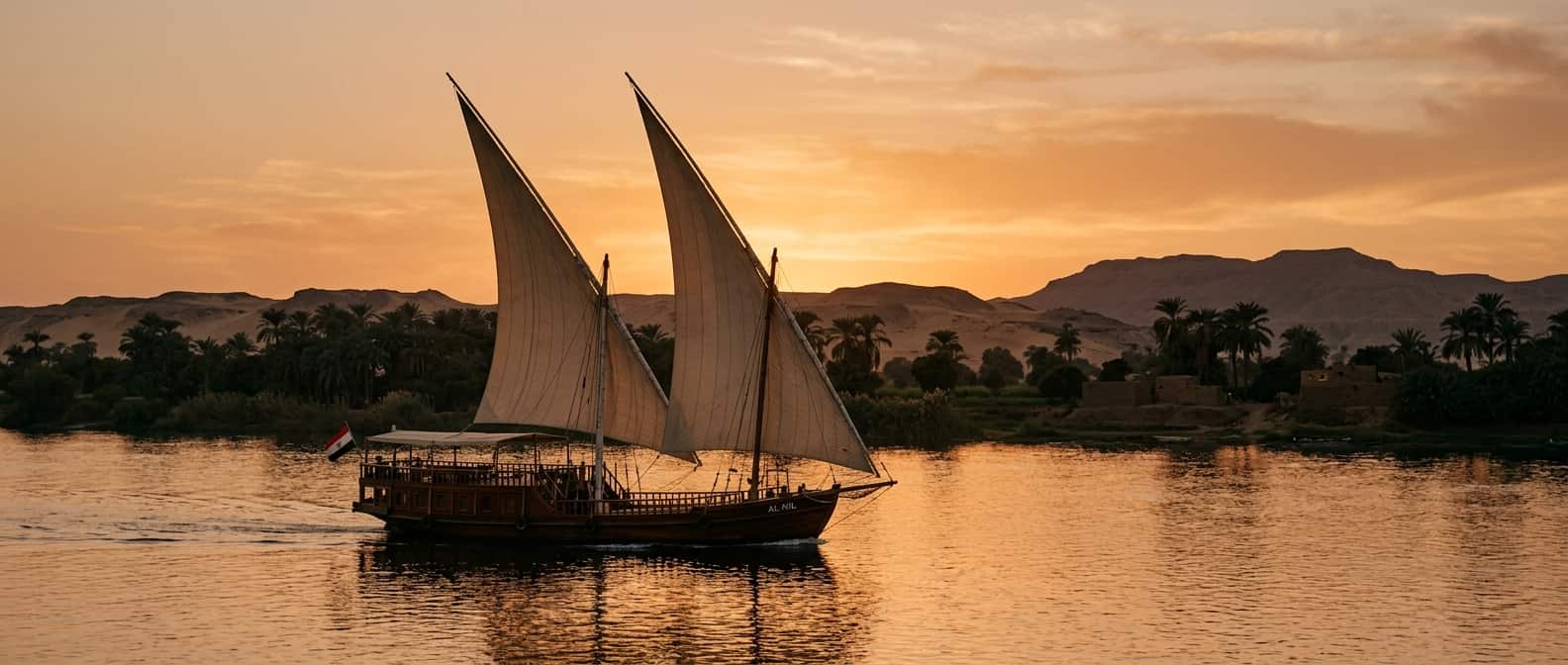
The late afternoon sun hits the limestone cliffs of the Nile Valley, turning the water a deep, liquid copper. There is no low hum of a diesel engine, no crowded buffet deck, and no race to the next temple. There is only the soft snap of a canvas sail catching the desert wind, and the quiet splash of water against a wooden hull. This is the Nile as it was meant to be seen—not from the towering decks of a modern river cruiser, but from the shaded deck of a traditional dahabiya.
For the modern luxury traveler, exclusivity is no longer just about high-thread-count sheets; it is about the luxury of silence and the privilege of access. As recent industry data highlights, affluent Indian travelers are increasingly prioritizing slow, transformative journeys over rapid-fire sightseeing. Nowhere is this shift more beautifully realized than on the world's longest river.
The Return of the Slow Cruise
In an era of hyper-connectivity, slow cruising has emerged as a vital antidote. The standard Nile cruise—typically a frenetic three-to-four-day dash between Luxor and Aswan on a massive floating hotel—often reduces Egypt's profound antiquity to a blur of hurried shore excursions.
A dahabiya changes the rhythm entirely. These twin-masted wooden sailboats move gently, dictated by the wind and the current. They require you to slow down, to watch the agrarian life on the riverbanks unfold at the pace of an earlier century, and to absorb the sheer scale of the landscape without distraction.
What is a Dahabiya?
Derived from the Arabic word for "gold," the dahabiya was the vessel of choice for Egyptian royalty, European aristocrats, and early archaeologists in the 19th and early 20th centuries. Today’s iterations maintain that elegant historic silhouette but have been meticulously reimagined for the modern luxury traveler.
With typically only four to ten cabins, a dahabiya functions less like a cruise ship and more like a floating boutique hotel or a private yacht. The shallow draft of these wooden boats allows them to navigate where larger vessels cannot, docking at secluded islands, hidden village shores, and lesser-known archaeological sites that the mega-ships bypass entirely.
The Art of the Itinerary
The true luxury of a dahabiya lies in the itinerary. While large ships must adhere to rigid schedules to secure docking space at major monuments, a dahabiya captain has the freedom to pivot.
You might find yourself exploring the Temple of Horus at Edfu in the quiet hours of early morning, long before the tourist buses arrive. You might moor at a remote sandbank near Gebel el-Silsila for a private, candlelit dinner under a canopy of desert stars. Your guide—often an expert Egyptologist permanently attached to the boat—can tailor the daily explorations to your specific historical interests, whether that involves deep-diving into the architectural nuances of the Ptolemaic era or simply walking through a sleepy riverside village.
Design and Gastronomy on the Water
The interiors of a premier dahabiya are a study in understated, regional elegance. Forget the ostentatious glitz of commercial cruisers; here, you will find polished mahogany, hand-woven Egyptian cottons, antique brass fittings, and curated local artworks. The cabins, while compact by nature of the boat, are masterclasses in intelligent luxury design, often featuring panoramic windows that allow you to watch the Nile glide by from your bed.
Gastronomy is equally curated. Because the chef is cooking for a handful of guests rather than a dining room of two hundred, the culinary experience is highly personalized and hyper-local. Ingredients are frequently sourced from the markets and farms along the riverbanks, translating into fresh, vibrant Egyptian and Mediterranean dishes served alfresco on the shaded upper deck.
Planning Your Passage
The optimal window for sailing the Nile is between October and April, when the Egyptian sun is forgiving and the evenings carry a crisp desert chill. For the discerning Indian traveler, reserving an entire dahabiya for a private family group or a gathering of friends offers the ultimate bespoke experience—a private floating sanctuary in one of the most historically dense corridors on earth.
In a world where true privacy is increasingly scarce, stepping aboard a dahabiya feels like stepping out of time. It is a quiet reminder that the most profound travel experiences are not measured by how much ground you cover, but by how deeply you connect with the current beneath you.