The air at the equator carries a distinct, heavy stillness, broken only by the sharp call of a blue-footed booby slicing through the morning mist. Beneath the dark, glassy surface of the Pacific, hammerhead sharks drift like shadows against the volcanic rock. This is the Galápagos—a jagged archipelago of basalt and ash that feels less like a destination and more like a privileged glimpse into the earth’s rough draft. For years, traveling here meant compromising on comfort in the name of access. Today, a new class of expedition vessels has rewritten that equation, allowing a seamless transition from the high-touch luxury of the mainland to the profound isolation of the islands.
The Arrival: Landing at the Edge of the World
Touching down on Baltra Island is a study in stark contrasts. The landscape is unforgiving—sun-baked earth dotted with towering prickly pear cacti—yet the logistics of arrival have been refined to a quiet science. Private transfers bypass the crowded ferry terminals, whisking you directly to awaiting tenders. There is no waiting in line beneath the equatorial sun; instead, there is only the sudden, cooling spray of the ocean as you cross the Itabaca Channel.
The shift from the modern world to the ancient one happens almost instantly. Within hours of landing, the rhythm of the archipelago takes over. You are no longer on mainland time. The schedule here is dictated by the tides, the heat of the afternoon, and the movement of the wildlife. It is an immediate and necessary surrender. For affluent Indian travelers accustomed to the manicured perfection of traditional island resorts, the Galápagos offers something far more potent: an unvarnished authenticity that refuses to be tamed, softened only by the impeccable service waiting offshore.
The Vessel: Redefining Expedition Luxury
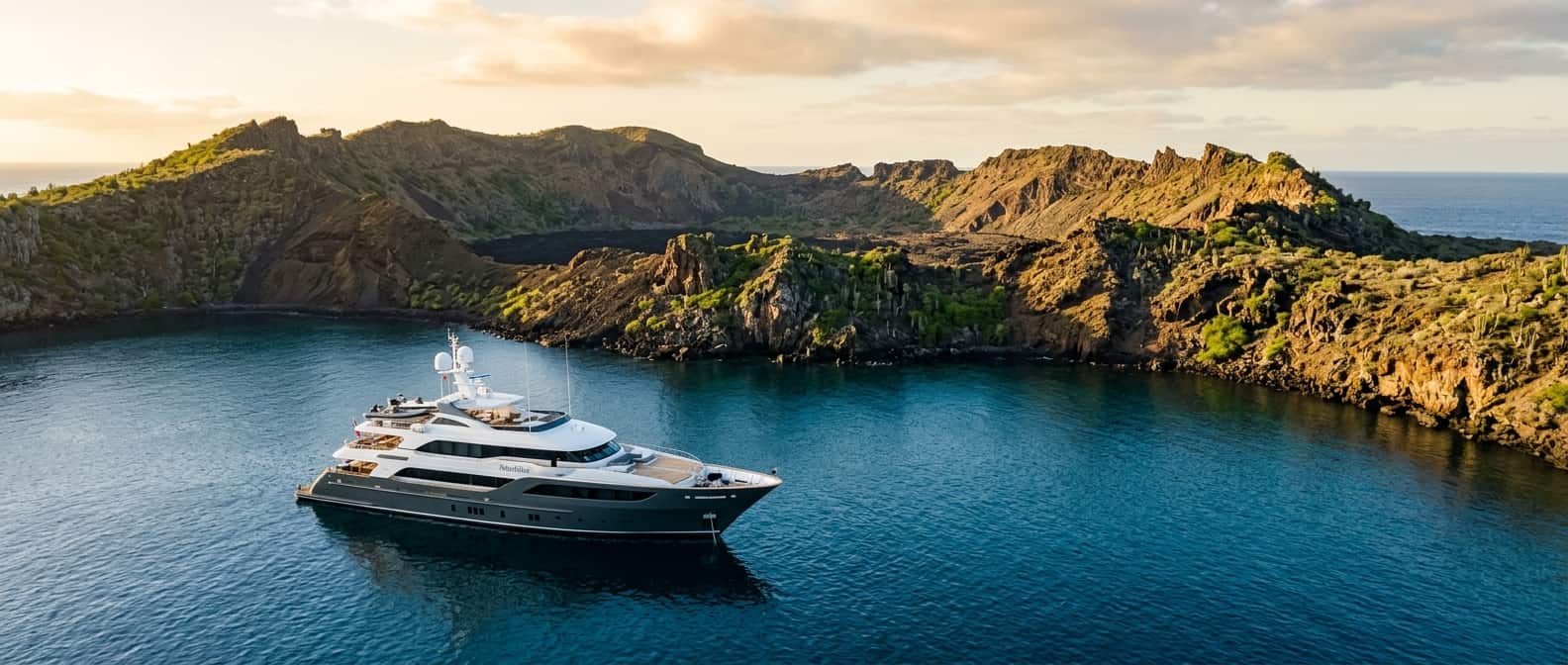
The days of choosing between ecological access and genuine luxury are over. Ships like the Aqua Mare have imported the ethos of the Mediterranean superyacht to the eastern Pacific. With space for just a handful of guests, these vessels operate on a scale that guarantees deep privacy. The interiors are a masterclass in restrained design—walnut veneer, tactile linens, and expansive floor-to-ceiling windows that ensure the volcanic landscape is always the focal point.
Crucially, this luxury is entirely self-sufficient. There is no need to return to port. Desalination plants, sophisticated stabilization systems, and executive chefs trained in high-end Peruvian and Ecuadorian gastronomy mean that the standard of living aboard rivals the best properties in Quito or Lima. Dining happens on the aft deck under a canopy of southern stars, the quiet hum of the engines the only reminder that you are moving toward the next uninhabited cove. This is mobility as the ultimate privilege: waking up each morning to a completely new, untouched horizon.
The Wildlife: Encounters Without the Crowds
The true luxury of the Galápagos is not thread count; it is proximity. Because the wildlife here evolved without human predators, they possess a total lack of fear. Marine iguanas sun themselves on the paths, utterly indifferent to your presence. Sea lions turn aquatic acrobatics into a spectator sport just inches from your mask. However, experiencing this without the bottleneck of larger tour groups requires the tactical advantage of a small vessel.
By arriving at visitor sites at first light, before the larger ships have weighed anchor, expedition yachts grant their guests the island in complete solitude. You can walk the sharp lava fields of Fernandina or snorkel the sunken caldera of Genovesa in near silence. Expert naturalist guides—often limited to a one-to-eight ratio on these premier vessels—transform these encounters from mere sightseeing into deep, contextual understanding. They don't just point out a species; they unpack the intricate, fragile mechanics of the ecosystem right in front of you.
The Conservation: Travel as Preservation
In an era where the impact of travel is under constant scrutiny, the Galápagos stands as a testament to strict, successful regulation. The national park authority dictates every itinerary, ensuring that no single site is ever overwhelmed. To travel here on a high-end expedition vessel is to participate in a tightly controlled preservation effort. The premium paid for these smaller, more efficient yachts directly subsidizes the ongoing conservation work required to keep the archipelago intact.
Many of the top-tier operators have integrated sustainability into their core operations, utilizing low-emission engines, eliminating single-use plastics, and sourcing ingredients directly from mainland organic cooperatives. There is a profound satisfaction in knowing that your presence, rather than eroding the destination, is actively funding its protection. This is regenerative travel at its zenith—a model where exclusivity is directly tied to ecological responsibility.
The Logistics: Seamless Transitions from the Mainland
The journey to the Galápagos necessitates a passage through mainland Ecuador, typically Quito or Guayaquil. Far from a mere layover, this transition is increasingly curated as a vital part of the experience. Quito, nestled high in the Andes, offers a colonial elegance that serves as the perfect counterbalance to the raw nature of the islands. Boutique properties housed in restored 16th-century mansions provide a final touch of urban sophistication.
Coordinating the leap from the high-altitude capital to the equatorial islands requires flawless execution. The best operators handle the myriad permits, transit control cards, and domestic flight logistics invisibly. Your only responsibility is to board the aircraft. This friction-free movement is essential; it ensures that the cognitive shift from the demands of daily life to the absolute presence required by the Galápagos is uninterrupted.
True luxury in the modern age is not simply comfort—it is the absence of noise. As the yacht slips anchor and the dark outline of the islands fades into the twilight, you are left with a rare, absolute quiet. The Galápagos does not ask for your attention; it simply commands it.