Every Maldives resort photographs the same way. A jetty, a gradient of blue, a villa on stilts at golden hour. Scroll for twenty minutes and sixty-eight islands blur into one island you have seen sixty-eight times. That is the actual problem with planning a Maldives trip — not a shortage of information, but a shortage of difference. The photographs are interchangeable. The holidays are not.
Two couples can book the same week, spend within a lakh of each other, and come home with completely different trips — because one of them landed on a house reef they could swim to from the villa steps, and the other spent ₹60,000 on boat trips to find a fish. The gap is never luck. It comes down to six variables that almost nobody compares systematically, because no two resort websites present them the same way.
This is the system we use to narrow sixty-eight resorts down to three, in order, and the season to run it in is now.
Start with the calendar, not the resort
The Maldives has two weather regimes and they are genuinely different holidays. The northeast monsoon, roughly November to April, is the dry season: calm seas, clear skies, low humidity, the water at its most absurdly transparent. The southwest monsoon, May to October, is warmer-priced and quieter, with more rain, more wind, and choppier crossings — but it is also when the plankton blooms bring manta rays and whale sharks in, with Hanifaru Bay at its best from July to October.
If you are booking for the view, you want the dry half. Within it, December to March is peak, and two windows spike hardest for Indian travellers: Diwali and the Christmas–New Year fortnight. Those weeks sell out first and price highest, often four to six months ahead. April–May and late October–November are the shoulder — the same sea, noticeably less money.
Which puts you, reading this in September, in the useful part of the calendar: the good weather starts in about six weeks and the peak-season inventory is still open.
The six things that actually separate one island from another
We score every resort on the same six axes, so that comparing two of them is like-for-like rather than a contest between two marketing departments. You can see these scores on every resort card on our Maldives booking site — but the framework is worth understanding whoever you book through.
- Romance — is this an adults-only island or a family resort? A resort can be beautiful and still be the wrong room: a honeymoon next to the kids’ club is a specific kind of disappointment, and it is not visible in any photograph.
- Villa — floor area, privacy, whether there is a private pool, and how close the next villa is. Water villas in particular vary enormously: some are a generous suite over a lagoon, some are a warm room with a ladder.
- Beach — the sand itself. How wide it is, whether it survives high tide, whether you can actually swim off it or whether the reef edge makes that awkward. Some famous islands have a spectacular beach on one side and almost none on the other.
- House reef — can you snorkel straight off the island, or is every underwater experience a scheduled boat trip? This is the single biggest driver of whether a trip feels generous or nickel-and-dimed.
- Food — how many restaurants, how good, and crucially how much of it your meal plan actually covers.
- Transfer — seaplane, speedboat or domestic flight; how long, how much, and what it does to your arrival day. More on this below, because it is the one people get wrong.
The trick is not to find the resort with the highest total. It is to work out which two of those six you genuinely care about, and then refuse to pay for the other four. A couple who will spend six hours a day in the water should not be buying a fourth restaurant. A couple who want to read on a beach for five days should not be paying a seaplane premium to reach a world-class dive site.
The transfer is the decision most people get wrong
Your resort transfer is not a logistical detail. It is usually the second-largest line on the bill after the villa, it is charged per person and per return, and it silently decides what time your holiday starts.
Speedboat
Fifteen to ninety minutes depending on the atoll. Runs day and night, which is the important part — a late arrival is fine. Typically the cheapest option, broadly USD 100–600 per person return depending on distance and whether it is shared or private.
Seaplane
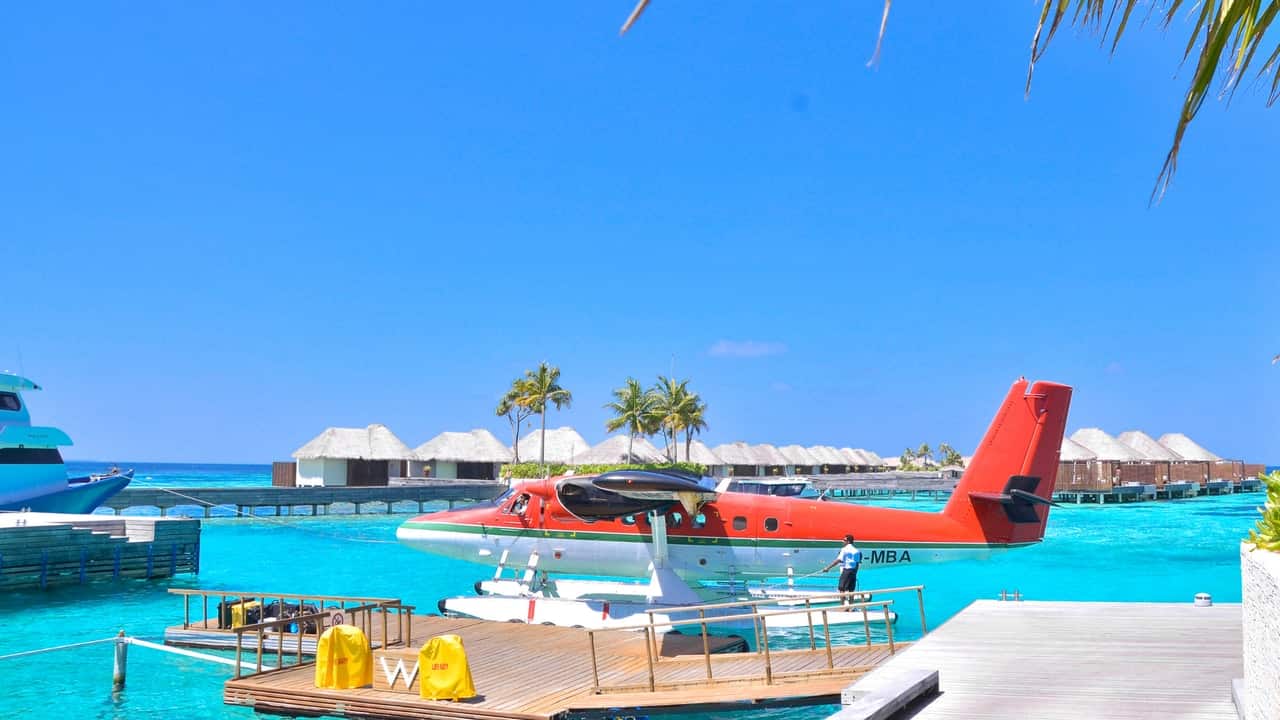
Fifteen to fifty-five minutes, and genuinely one of the best things about the trip — you see the atolls from 300 metres up. But seaplanes fly in daylight only, roughly 06:00 to 16:00, because they land on open water with no runway lighting. Check-in for the last rotation typically closes around 15:30. Budget roughly USD 300–850 per person return.
That daylight rule has a consequence people discover too late: if your flight from India lands in Malé after about 15:00, you cannot reach a seaplane resort that day. You overnight in Malé at your own cost and fly out the next morning — so you have paid for a resort night you never slept in. Match your outbound flight to your transfer type. If the resort is seaplane-only, take the morning departure.
Domestic flight plus speedboat
How the far southern and northern atolls work. Two legs instead of one, but usually cheaper than a seaplane over the same distance, and it is not daylight-constrained in the same way.
Meal plans, decoded
On a resort island you are a captive market. There is no walking into town for dinner — the island is the town. That makes the meal plan a far bigger decision here than anywhere else you travel.
- BB — breakfast only. Looks cheap, and is the basis most headline rates are quoted on. Works only if the resort’s à la carte pricing is survivable, which at the top end it frequently is not.
- HB — half board: breakfast and dinner. The usual sweet spot, especially if you are out snorkelling through lunch anyway.
- FB — full board: all three meals, normally at the main buffet restaurant.
- AI — all-inclusive: meals plus drinks, sometimes plus activities. Read what is excluded. Premium wines, the speciality restaurants and most excursions usually are.
The honest rule: price the trip on the plan you will actually eat, not the one that produces the lowest headline number. A ₹2.1L BB rate that becomes ₹3.4L once you have eaten dinner five times is not a ₹2.1L holiday. This is why every price on our resort list is shown all-in for two adults over five nights, with the meal plan stated on the card, so the comparison is honest before you get to the invoice.
Why your trip should probably span two villas, not one
The beach-villa-or-water-villa question is posed as a choice, and it is a false one. A beach villa gives you space, direct sand, shade and much better value per square foot. A water villa gives you the thing you actually came for: the lagoon directly beneath the floor, the ladder into the water, the view with nothing in it. Each is a compromise the other solves.
So do both. Split the stay — three nights in a beach villa, two in a water villa — and end on the water. It is a better holiday in a specific way: the final two days are the ones you remember, and the first three cost less than five water-villa nights would have.
The reason more people do not do this is purely administrative. Most resorts enforce minimum-night policies per room category, so a split has to be built to respect them, and most booking engines simply cannot hold two room types across one stay. Ours can — the split-stay builder works across two room categories in a single trip and keeps the minimum-night rules intact, which is the fiddly part.
What it actually costs, in rupees, all-in
Maldives headline rates are misleading in a structural way, because the taxes are large and they are not in the quoted number. On top of the room rate you should expect:
- 17% TGST — the tourism goods and services tax.
- 10% service charge — effectively mandatory, applied at the resort.
- Green tax — USD 12 per person per night at resorts (USD 6 at guesthouses of 50 rooms or fewer), doubled from USD 6 in January 2025.
- Departure tax — USD 50 in economy, USD 120 in business, normally collected in your air ticket.
TGST and service charge alone put roughly 27% on top of the rate before green tax and transfers. A quote that does not include them is not a quote.
For calibration, here is what the real all-in number looks like for two adults over five nights, drawn from live rates on our own resort list:
- Entry — from about ₹1.4L (Malahini Kuda Bandos). Close to Malé, speedboat transfer, genuinely a Maldives holiday.
- Mid — around ₹2.1L (Kandima Maldives). Large island, lots to do, strong value.
- Premium — around ₹4.5L (Hurawalhi, adults-only). Where the honeymoon bracket really sits.
- Design-led — ₹6.0L–₹6.6L (COMO Cocoa Island, Amilla Maldives).
- Top — up to ₹18L (Kudadoo Maldives Private Island, all-inclusive premium).
Flights are the smaller variable: return economy from India generally runs ₹15,000–₹45,000 depending on route and how early you book. Delhi, Mumbai and Bengaluru have direct service, Delhi–Malé is about 4 hours 15 minutes, and Kochi is the closest major Indian airport at roughly 2 hours 45 minutes.
The paperwork is genuinely easy
This is the least stressful part of the trip, and worth stating plainly because a surprising number of people still think they need to apply for something.
- Indian passport holders get a free 30-day visa on arrival at Velana International Airport. No embassy, no advance application, no fee.
- Carry a passport with at least six months’ validity, a return ticket, confirmed accommodation and sufficient funds.
- Submit the free online IMUGA Traveller Declaration within 96 hours before arrival. It takes about ten minutes.
The checklist, in order
- Fix the week first. Season beats resort — and decide early whether you are paying the Diwali or New Year premium.
- Pick your two priorities from the six. Write them down before you look at a single photograph.
- Filter by all-in rupee budget, not headline rate.
- Check the transfer type against your flight arrival time, before you book the flight.
- Choose the meal plan you will actually eat.
- Ask whether a split-stay fits the resort’s minimum-night rules.
- Confirm exactly what your all-inclusive plan excludes.
- Submit IMUGA three days before you fly.
Then narrow it to three
Sixty-eight resorts is not a shortlist, it is a wall. The point of a scoring system is to get you to three islands you could genuinely be happy on, and then to choose between them on the two things you said you cared about rather than on whichever website had the better photographer.
We built maldives.flygoldfinch.com to do exactly that: all sixty-eight resorts scored on the same six axes, all-in rupee pricing with the meal plan stated, honest availability, and split-stay itineraries that respect the minimum-night rules. You can browse the full list, or tell us your dates, budget and the two things that matter, and we will come back with three — and the reason each one is on the list.