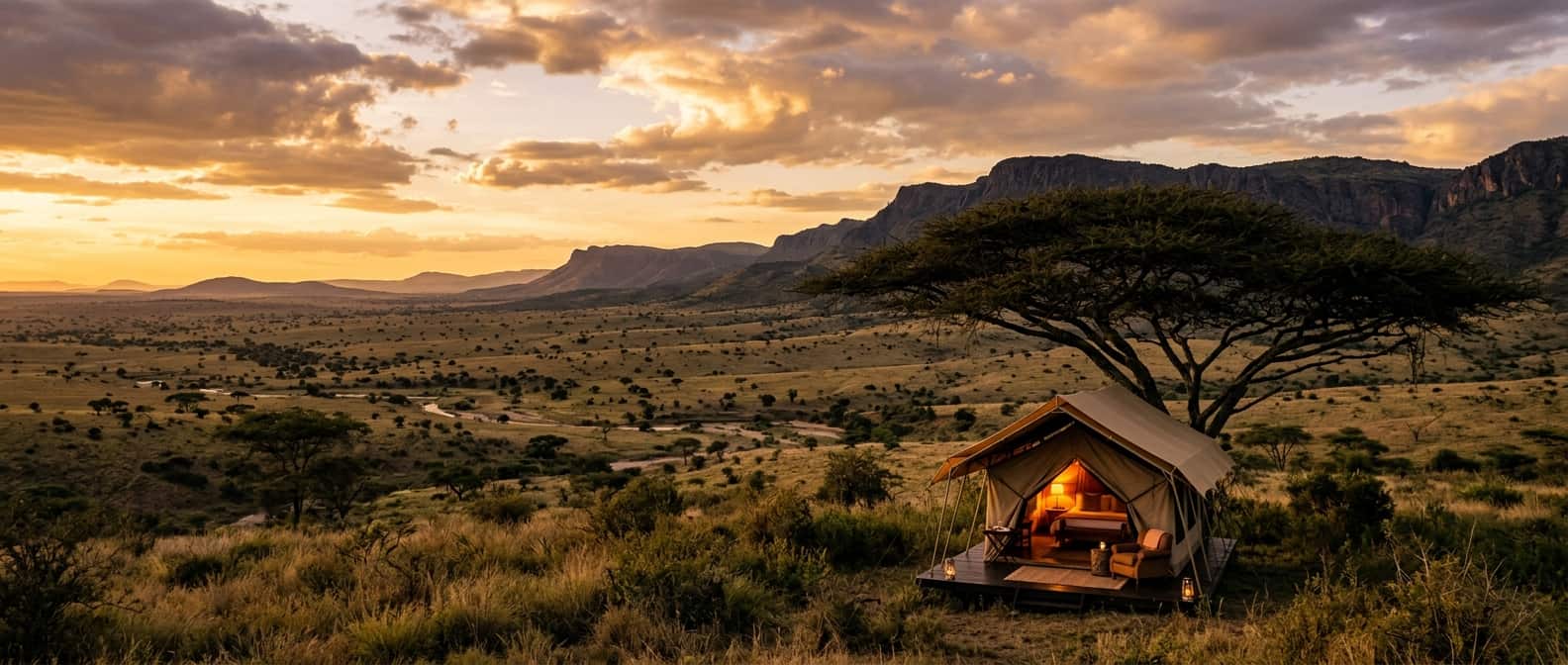
The wind moving across the Laikipia Plateau carries the scent of wild sage, red dust, and approaching rain. Far below the escarpment, a solitary bull elephant cuts a slow, deliberate path through the acacia scrub, his silhouette striking against the dying amber light of the afternoon. This is not the crowded plains of the Maasai Mara, but a vaster, quieter earth. Here, the sheer scale of the landscape enforces a profound stillness, reducing the noise of the modern world to an absolute and beautiful silence.
The Quiet Return to the Wild
For the seasoned traveler, the traditional African safari can occasionally feel like a victim of its own success. The great migrations draw fleets of vehicles, and the wild, while undeniable, is often shared with a chorus of strangers. Laikipia represents the antidote. Spanning nearly two million acres in central Kenya, this high-altitude plateau stretches from the foothills of Mount Kenya to the edge of the Great Rift Valley. It is a place of staggering topography—a mosaic of sweeping grasslands, rocky outcrops, and dense riverine forests that remain largely untouched by mass tourism.
To arrive here is to step into an older, more deliberate rhythm. The air is thinner and cooler, carrying a crystalline quality that sharpens every shadow and horizon. For the affluent Indian traveler seeking something beyond the prescribed checklists of the Serengeti or the Mara, Laikipia offers an intimacy with the wild that is increasingly rare. It is a destination defined not by what it has built, but by what it has preserved. Here, luxury is measured in acres of private wilderness per guest, ensuring that your encounter with a pride of lions or a reticulated giraffe is a solitary, unhurried privilege.
Beyond the Mara: The Laikipia Difference
The topography of Laikipia dictates a different kind of safari. The absence of national park restrictions on these private conservancies changes the geometry of exploration. You are not confined to a network of graded dirt roads or rigid schedules. Instead, the bush opens up to night drives under a canopy of southern stars, guided walking safaris that tune your senses to the minutiae of the earth, and horseback expeditions that allow you to move among herds of zebra and eland without triggering their flight response.
This freedom alters the emotional resonance of the journey. In Laikipia, you are not merely an observer sitting behind the glass of a Land Cruiser; you are a participant in the landscape. The wildlife here is abundant, harboring some of Kenya's most significant populations of endangered species, including the black rhino and the Grevy's zebra. Yet, the encounters feel earned, serendipitous, and intensely private. The drama of the bush unfolds without an audience, allowing you to witness the raw, unedited narratives of the wild exactly as they have played out for millennia.
Conservation as the Ultimate Luxury
Laikipia’s evolution from a patchwork of colonial-era cattle ranches to one of Africa’s most successful conservation models is the defining narrative of the region. The luxury lodges that dot this landscape are not merely places to sleep; they are the financial engines of massive ecological preservation. When you book a stay at a Laikipia retreat, the capital flows directly into anti-poaching units, wildlife veterinary programs, and community education initiatives.
This is regenerative travel realized in its highest form. The sophistication of the hospitality—the plunge pools overlooking waterholes, the cellar-temperature South African wines, the crisp linen under canvas—does not come at the expense of the environment, but rather underwrites its survival. Engaging with the conservationists, tracking wild dogs with local Samburu guides, and understanding the delicate balance between community and wildlife elevates the safari from a vacation to a deeply resonant intellectual and emotional experience. It is a model of luxury that asks nothing of the earth and gives everything back to it.
Lodges of Note: Segera and Borana
The accommodations in Laikipia are studies in contextual design, blending seamlessly into the vastness of the plateau. Segera Retreat, an oasis of botanical gardens and striking sculpture set against the savanna, epitomizes this balance. Its villas, crafted from timber and thatch, feel both ancient and fiercely contemporary, offering sweeping views of Mount Kenya. The retreat's commitment to sustainability is absolute, operating entirely on solar power while delivering a standard of culinary and spatial luxury that rivals the world’s finest hotels.
Further east, Borana Conservancy offers a different, deeply rugged elegance. Perched on a hillside with panoramic views of the Samangua Valley, Borana Lodge is built from local stone and cedar, its organic architecture mirroring the surrounding kopjes. Here, the focus is on active engagement with the land. Whether galloping across the plains on horseback, mountain biking down game trails, or simply watching elephants bathe in the river from the vantage point of your private deck, Borana integrates the guest into the wild with unparalleled grace. Both properties understand that true luxury lies in the flawless execution of simplicity.
The Rhythm of the Plateau
As days in Laikipia blend one into the next, a certain recalibration occurs. The urgency of emails and the friction of urban life dissolve, replaced by an acute awareness of the light, the weather, and the subtle movements in the brush. You begin to wake naturally with the dawn chorus of the white-browed robin-chat, and your evenings become defined by the crackle of a campfire and the distant, guttural call of a leopard.
This is the ultimate promise of Laikipia. It does not just show you the wild; it allows you to briefly, beautifully inhabit it. It is a place that reminds you of your own smallness in the face of nature’s grand design, yet elevates your spirit through the sheer magnificence of its isolation. To leave the plateau is to carry a piece of its profound quiet back with you into the noise of the world.