There is a moment in the early hours in Kyoto, before the city awakes, when the air smells faintly of cedar and cold stone. The morning mist settles low over the Kamo River, blurring the edges of wooden machiya houses that have stood for centuries. Here, a short bullet-train ride from the neon pulse of Tokyo, time does not merely slow down; it alters its cadence entirely. For the discerning traveler arriving from the perpetual hum of Mumbai or Delhi, Kyoto offers more than a visual reprieve—it presents an education in the art of stillness.
The Parallel City
To visit Kyoto is to navigate two cities occupying the same geography. There is the Kyoto of the surface—the crowded approach to Kiyomizu-dera, the relentless shutter-clicks at the Golden Pavilion, the polite chaos of Nishiki Market. And then there is the parallel city, hidden behind unmarked wooden gates and walled gardens, accessible only to those who know how to ask. This second Kyoto is a realm of profound exclusivity, rooted in omotenashi, the Japanese philosophy of anticipatory hospitality.
It is here that you find temples that open their doors for private viewings before dawn, allowing you to trace the raked gravel of a Zen garden in complete solitude. It is a world where concierges arrange access to generational craftsmen—kimono weavers, ceramicists, tea masters—who do not advertise their services. The true luxury of Kyoto is not defined by opulence, but by access. It is the privilege of stepping off the crowded thoroughfare and into a quiet, meticulously curated vacuum, where every shadow and stone has been placed with intent.
Sanctuaries of Wood and Paper
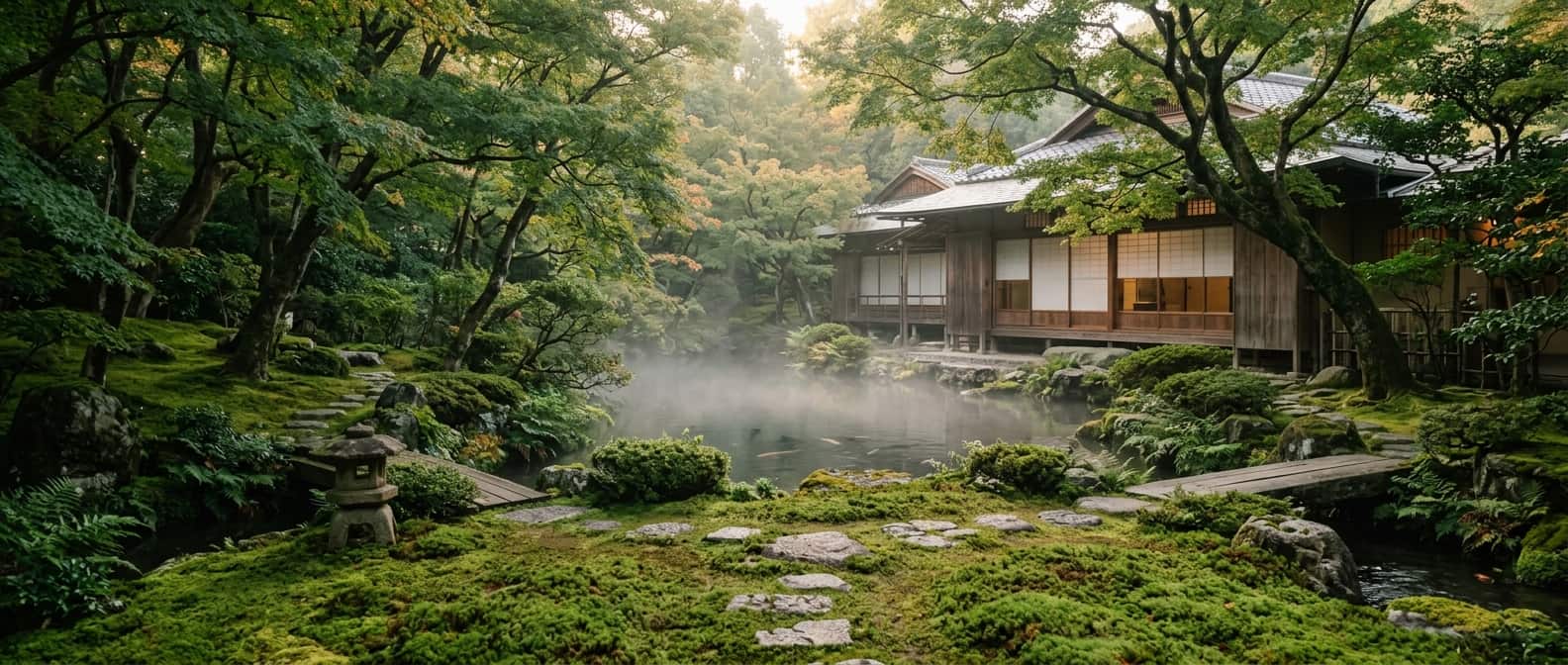
The soul of Japanese hospitality is best understood within the walls of a high-end ryokan. While global luxury hotel brands have successfully interpreted the local aesthetic, the traditional ryokan remains an uncompromising immersion into Kyoto’s cultural rhythm. Among the most revered is Tawaraya, a 300-year-old institution that operates with an almost monastic devotion to detail. There is no grand lobby, no sprawling spa. Instead, there is the quiet perfection of your private tatami room, the scent of fresh rush grass, and a wooden soaking tub filled with water that feels as soft as silk.
For those seeking a bridge between the traditional and the contemporary, Aman Kyoto represents a flawless synthesis. Set within a forgotten secret garden at the foot of Mount Hidari Daimonji, its pavilions of dark timber and glass disappear into the surrounding forest. Here, luxury is entirely elemental. You are invited to bathe in mineral-rich onsen water drawn from local springs, sleep on futons elevated by modern ergonomics, and wake to the sight of maple leaves pressed against your window like a living screen. It is an architecture of subtraction, removing everything until only the essential beauty remains.
The Art of Kaiseki
Kyoto is the undisputed crucible of kaiseki, the multi-course dining tradition that elevates seasonal foraging to high art. Originating from the austere meals served during traditional tea ceremonies, kaiseki has evolved into a masterclass of technique, presentation, and seasonal acutely. For the affluent Indian palate, accustomed to bold, layered spices, kaiseki offers a different kind of intensity: a relentless focus on the purity of the single ingredient.
At restaurants like Kikunoi or the intimate counter at Kiyama, a meal might begin with a single, perfect piece of sea bream, its texture enhanced by a razor-thin slice of kelp. A clear broth follows, carrying the faint, earthy aroma of matsutake mushrooms harvested that morning. Every dish is a reflection of the precise micro-season—there are seventy-two in the traditional Japanese calendar—dictating not only the ingredients but the very ceramics upon which they are served. To dine at this level is to surrender to the chef’s narrative. There are no menus to decipher, no modifications to be made. It is an exercise in profound trust, rewarded by an experience that engages all five senses.
Private Geisha and the Floating World
The geisha districts of Kyoto, known as hanamachi, remain one of the most misunderstood and fiercely guarded aspects of Japanese culture. In Gion, tourists often crowd the cobblestone streets at dusk, hoping for a fleeting glimpse of a geiko (as geisha are called in Kyoto) or a maiko (an apprentice) hurrying to an appointment. Yet, the true world of the geiko—the karyukai, or "flower and willow world"—takes place entirely behind closed doors, within the private ochaya (teahouses) that line the Shirakawa Canal.
Gaining entry to these teahouses has historically required a strict system of introductions, a barrier designed to protect the intimacy and trust of the community. Today, specialized fixers and the concierges of elite properties can arrange private evenings for their guests. These are not mere performances; they are highly sophisticated social engagements. The geiko are master conversationalists, trained in classical dance, shamisen, and the nuanced art of making a guest feel entirely at ease. To spend an evening in an ochaya, drinking cold sake as a maiko performs a dance that has not changed in two hundred years, is to briefly step into a floating world that refuses to succumb to modernity.
The Rhythm of the Seasons
Kyoto is a city governed by the subtle shifts of nature, and understanding this rhythm is the key to unlocking its full potential. The frantic beauty of the cherry blossom season in spring and the fiery canopy of maples in autumn draw the largest crowds, painting the city in vivid, saturated hues. Yet, there is a compelling argument to be made for the quiet luxury of the off-seasons.
In the deep heat of summer, the city retreats to the shaded riverbanks of Kibune, where restaurants build wooden platforms directly over the rushing water, allowing guests to dine while the cool mist rises from the stream. In winter, when the crowds have long dispersed, a dusting of snow on the eaves of a wooden machiya transforms the city into a stark, monochromatic painting. It is during these quieter months that Kyoto is most willing to reveal its secrets. You are left with the quiet drip of melting snow in a courtyard garden, the warmth of a charcoal brazier, and the profound, enduring elegance of a city that knows exactly who it is.