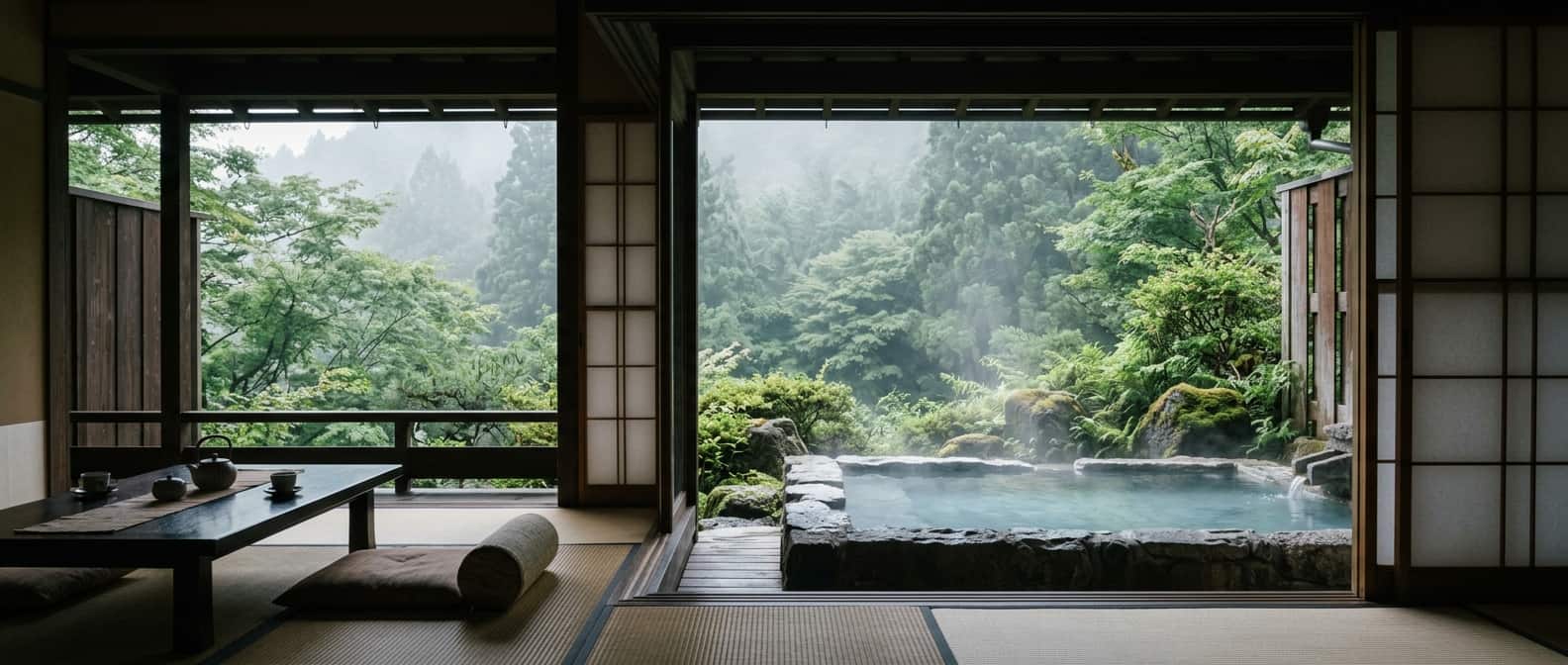
The air in the cedar forests of Kumamoto carries a distinct weight, heavy with the scent of wet bark and subterranean heat. Steam rises through the canopy in thick, lazy plumes, blurring the sharp lines of ancient volcanic rock and minimalist timber architecture. Here, the manicured perfection of Kyoto feels a world away. This is Kyushu, Japan’s southernmost main island, where luxury is not defined by proximity to famous shrines, but by an absolute, unyielding isolation.
For the affluent Indian traveler, Japan has long been a pursuit of the Golden Route—a meticulously choreographed dance between Tokyo’s neon grids, Kyoto’s geisha districts, and Osaka’s culinary frenzy. But as those corridors grow increasingly crowded, the true connoisseurs of slow travel are looking south. Kyushu offers an older, wilder Japan. It is a landscape shaped by active calderas and geothermal veins, where high-design ryokans are tucked into deep valleys and access is fiercely guarded. Here, the pace of life decelerates, stripped of the frantic energy of the north, leaving only the profound stillness of the island's natural rhythms.
The Seven Stars: Japan's Most Elusive Train Journey
There is perhaps no greater symbol of Kyushu’s approach to luxury than the Seven Stars in Kyushu. Often described as a boutique hotel on rails, the train is less a mode of transport than a masterclass in Japanese craftsmanship. Securing a suite on the Seven Stars is famously difficult; it relies on a lottery system that makes it one of the most exclusive travel experiences in the world, far removed from the mass transit efficiency of the shinkansen.
Inside, the carriages are a study in obsessive detail. Kumiko woodworking—an intricate, nail-less lattice technique—filters the harsh afternoon light into soft geometric patterns across the walnut floors. The porcelain sinks in the en-suite bathrooms are hand-painted by the late Sakaida Kakiemon XIV, a living national treasure. Every element, from the woven bamboo blinds to the plush velvet seating in the Blue Moon lounge car, is designed to ground the passenger in the specific terroir of the island.
As the train winds along the jagged coastline of the East China Sea and up into the forested highlands of Mount Aso, the journey becomes meditative. Dining on board is a hyper-seasonal affair, with multi-course kaiseki menus featuring ingredients sourced from the very valleys the train glides through. For the discerning traveler, the Seven Stars is the definitive introduction to Kyushu—a slow, deliberate immersion into an island that demands to be savored rather than merely seen.
Kurokawa Onsen: The Architecture of Water and Wood
Deep in the shadow of the Kuju Mountains lies Kurokawa Onsen, a thermal spring village that has fiercely protected its architectural heritage. Unlike the concrete resort towns that proliferated across Japan in the late twentieth century, Kurokawa mandated a strict preservation of its Edo-period aesthetic. The result is a cinematic enclave of dark cedar, sliding shoji screens, and glowing paper lanterns suspended over a rushing mountain river.
The luxury here is entirely sensory and elemental. At properties like Takefue, a ryokan hidden within a vast bamboo forest, the boundaries between the built environment and the wilderness dissolve. Private rotemburo (outdoor baths) are carved directly into boulders, fed by alkaline waters that carry the faint, mineral scent of the earth. Guests soak in silence, surrounded by towering bamboo stalks that click and sway in the mountain wind.
Service at these high-end ryokans is characterized by omotenashi, the Japanese philosophy of anticipatory hospitality. It is completely unobtrusive yet hyper-attentive. Meals are served in private tatami rooms, futons are laid out out while you bathe, and the outside world is deliberately held at bay. For the affluent traveler escaping the relentless heat and noise of the Indian summer, this isolation is the ultimate luxury—a space where time is measured only by the changing temperature of the bathwater and the shifting light in the forest.
The Artisan Valleys: Saga's Porcelain Heritage
Moving westward into Saga Prefecture, Kyushu’s narrative shifts from the raw power of nature to the meticulous refinement of human hands. This is the birthplace of Japanese porcelain, a legacy that stretches back over four centuries. The towns of Arita and Imari are quiet, unassuming valleys that quietly produce some of the most sought-after ceramics in the world.
For the luxury traveler, Saga offers an incredibly intimate look at living craftsmanship. Rather than viewing ceramics behind glass in a Tokyo museum, visitors can secure private audiences with multi-generational kiln masters. In these dusty, sunlit studios, you can commission bespoke dining sets or acquire rare, museum-quality pieces directly from the artisans. The experience is highly curated, often involving private tea ceremonies using centuries-old vessels, providing a tactile connection to Japan's artistic heritage.
The high-design lodges in this region seamlessly integrate this heritage into their architecture. Meals are presented on exquisite local Arita-yaki porcelain, turning every dinner into an impromptu exhibition. It is a form of luxury that honors provenance and patience, appealing to those who collect stories and craftsmanship rather than mere souvenirs.
Culinary Terroir: Volcanic Soil and Fukuoka's Michelin Stars
Kyushu’s volatile geology has gifted the island with an incredibly fertile volcanic soil, creating a culinary terroir that rivals anywhere else in Japan. The produce here is intensely flavorful, and the seafood, drawn from the colliding currents of the Genkai Sea and the Pacific Ocean, is exceptional. While Osaka claims the title of Japan’s kitchen, Kyushu is its private garden.
Fukuoka, the island's cosmopolitan gateway, is a quiet culinary powerhouse. Beyond its famous yatai (open-air food stalls), the city hides a network of highly exclusive, Michelin-starred establishments. Small, unmarked wooden doors lead into intimate dining rooms where master chefs practice their craft for audiences of no more than six or eight. Sushi here leans heavily on local catch like sekisaba (mackerel) and wild red snapper, prepared with a delicate touch that honors the pristine quality of the fish.
Further inland, the focus shifts to the land. Kagoshima is famous for its kurobuta (black Berkshire pork) and kuroge wagyu, a deeply marbled beef that rivals the more famous Kobe varieties. Meals in Kyushu’s remote ryokans are profound expressions of seasonality. A summer kaiseki might feature sweet ayu (sweetfish) grilled over binchotan charcoal, accompanied by mountain vegetables foraged that morning. It is dining deeply rooted in a specific place and moment, offering a level of authenticity that cannot be exported.
The Slow Return: Why Kyushu is the New Standard
The appeal of Kyushu lies in its resistance to scale. It cannot accommodate the massive tour buses or the hurried, checklist-driven itineraries that define the Golden Route. Its roads are narrow, its ryokans are small, and its best experiences require time, patience, and a willingness to surrender to the local pace.
For the modern Indian luxury traveler, whose everyday life is often defined by hyper-connectivity and endless demands, Kyushu offers a rare commodity: genuine disconnection. It is a place where luxury is stripped of its ostentation and returned to its elemental roots—the heat of the earth, the craft of human hands, and the quiet beauty of a deeply respected landscape.
Leaving the island, as the mountains recede and the heavy scent of cedar fades, one realizes that the true privilege of visiting Kyushu is not what you acquire, but what you are finally able to leave behind.