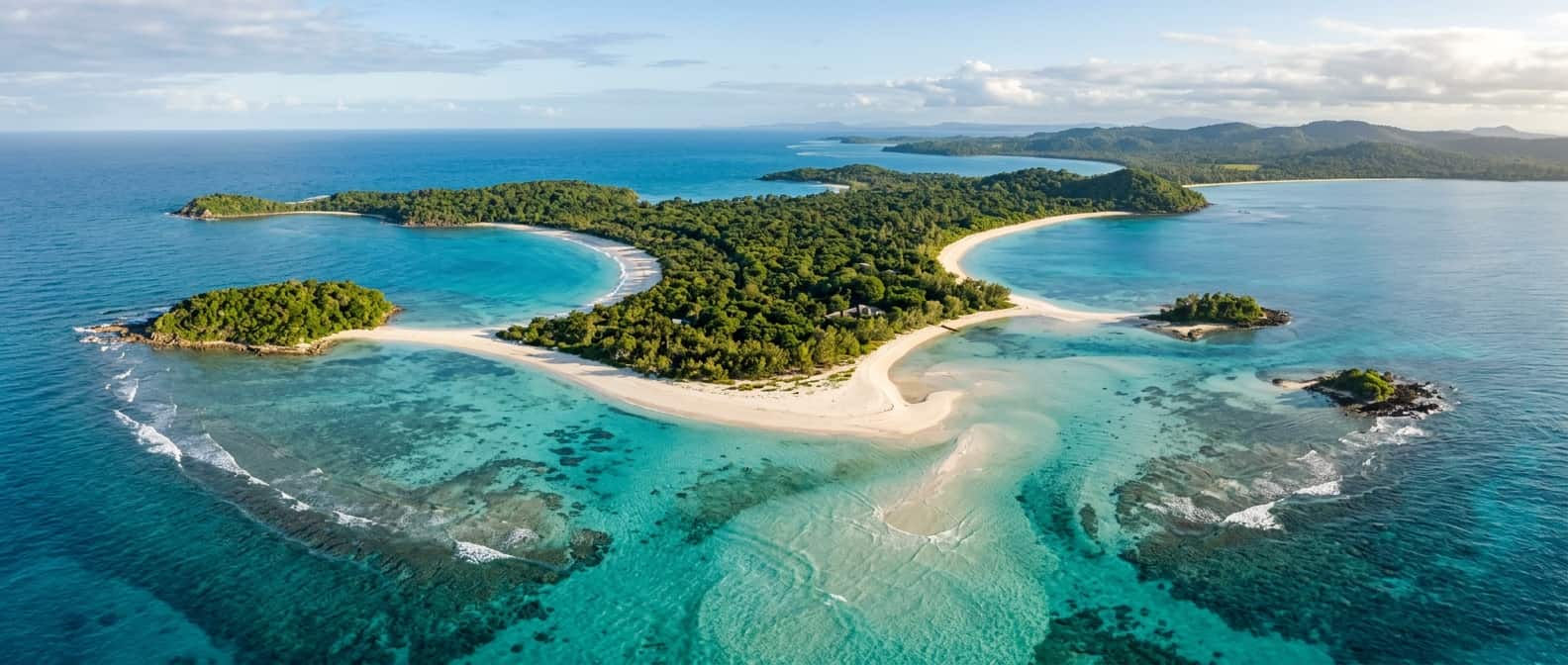
There is a distinct kind of silence that belongs only to places severed from the rest of the world. Off the northeastern coast of Madagascar, where the Indian Ocean shifts from bruised navy to impossible aquamarine, the air smells of vanilla and salt. Here, on the fringes of the world’s oldest island, luxury is measured not in opulence, but in absolute, unfettered isolation.
The Evolutionary Ark
Madagascar has always been an outlier. Cast adrift from the supercontinent of Gondwana some 88 million years ago, its flora and fauna evolved in a vacuum. For the affluent Indian traveler accustomed to the synchronized luxury of the Maldives or the structured safaris of East Africa, Madagascar offers a wilder, more kinetic alternative. It is a destination that demands a willingness to embrace the untamed, rewarding that effort with an ecosystem found nowhere else on earth.
The island’s topography shifts dramatically—from the spiny forests of the south, where baobabs stand like ancient sentinels, to the dense, rain-soaked canopies of the northeast. This is a place where lemurs leap through the mist and chameleons shift in the shadows, a living testament to evolution left entirely to its own devices.
The Northern Archipelago
The true locus of high luxury in Madagascar lies off its northern coast, specifically in the Nosy Ankao archipelago. Here, the concept of barefoot luxury is executed with a quiet, deliberate perfection. The journey itself is an initiation: a private helicopter charter from Diego Suarez or Nosy Be, sweeping over a bruised landscape of extinct volcanoes and emerald forests before descending toward a sliver of white sand surrounded by a marine reserve.
This is the domain of Miavana by Time + Tide, a property that has fundamentally recalibrated the standard for luxury in the Indian Ocean. Designed by the architects behind Seychelles’ North Island, the villas are built from local stone, glass, and reclaimed wood, blending seamlessly into the coastal forest. The focus is outward—on the expanse of the ocean, the passing whales, and the sheer, unbroken horizon.
The Rhythm of the Remote
Days in the archipelago are dictated not by itineraries, but by the tides and the wind. The marine life here is staggering in its diversity. Blue safaris reveal coral reefs teeming with manta rays and sea turtles, while deeper waters offer catch-and-release fishing for giant trevally. For those inclined toward terra firma, helicopter excursions to the mainland provide access to remote lemur habitats and the surreal limestone formations of the Tsingy.
But the true luxury of this region lies in its deceleration. The Indian outbound traveler often moves at a relentless pace, seeking out the new and the novel with an exhausting intensity. Madagascar enforces a different rhythm. It is a place to sit on a private deck as the sky bruised purple and orange, to listen to the ocean breathe, and to understand that the rarest commodity in modern travel is an authentic sense of solitude.
The Ethical Imperative
To travel to Madagascar in this echelon is to participate in a delicate ecological balance. The high-yield, low-impact model championed by properties here ensures that the immense cost of access directly funds conservation efforts. The presence of affluent travelers helps to protect the marine reserves from illegal fishing and provides vital economic alternatives to local communities.
It is luxury with a mandate—a recognition that the privilege of experiencing such a fragile ecosystem comes with the responsibility of preserving it. The design, the operations, and the ethos of these sanctuaries are deeply intertwined with the landscape they inhabit.
The edges of the map are retreating. As the world becomes increasingly accessible, the truly remote destinations are disappearing. Madagascar remains one of the last holdouts—a place of staggering beauty, complex ecology, and profound quiet. It is not a destination for the passive observer, but for those who understand that the highest form of luxury is an encounter with the extraordinary.
Sources
(Note: Web search was unavailable, relying on internal editorial knowledge for property details like Miavana by Time + Tide and Nosy Ankao archipelago.)