The Indian Ocean trade winds carry the scent of crushed vanilla pods and salt spray across the volcanic escarpments of the southwest coast. Here, far from the bustling public beaches, the architecture of hospitality is turning inward. Iron gates open onto private driveways lined with banyan trees, revealing limestone estates that blur the line between wilderness and high-end sanctuary. Mauritius is no longer just a dot on the map for a fleeting honeymoon; it has matured into a landscape of quiet, intentional luxury.
The Visa-Free Renaissance
For the affluent Indian traveller, the calculus of the international holiday is shifting. A recent industry report notes an 89% increase in high-net-worth travellers planning to spend more on foreign vacations over the next year. With this surge comes a desire for frictionless travel. The appeal of a destination where the passport control is an afterthought—a hallmark of the visa-free honeymoon trend—has never been stronger.
But ease of entry is only the opening note. The real draw is what awaits on the other side. Moving away from the crowded all-inclusive models of the past decade, a new tier of Mauritian hospitality has emerged. It caters to a demographic that values time over itinerary, replacing generic buffets and crowded catamarans with curated isolation. The island has become a canvas for bespoke experiences tailored to the discerning Indian couple, where luxury is defined not by gold leaf, but by space, silence, and absolute privacy.
Architecture of the Coast
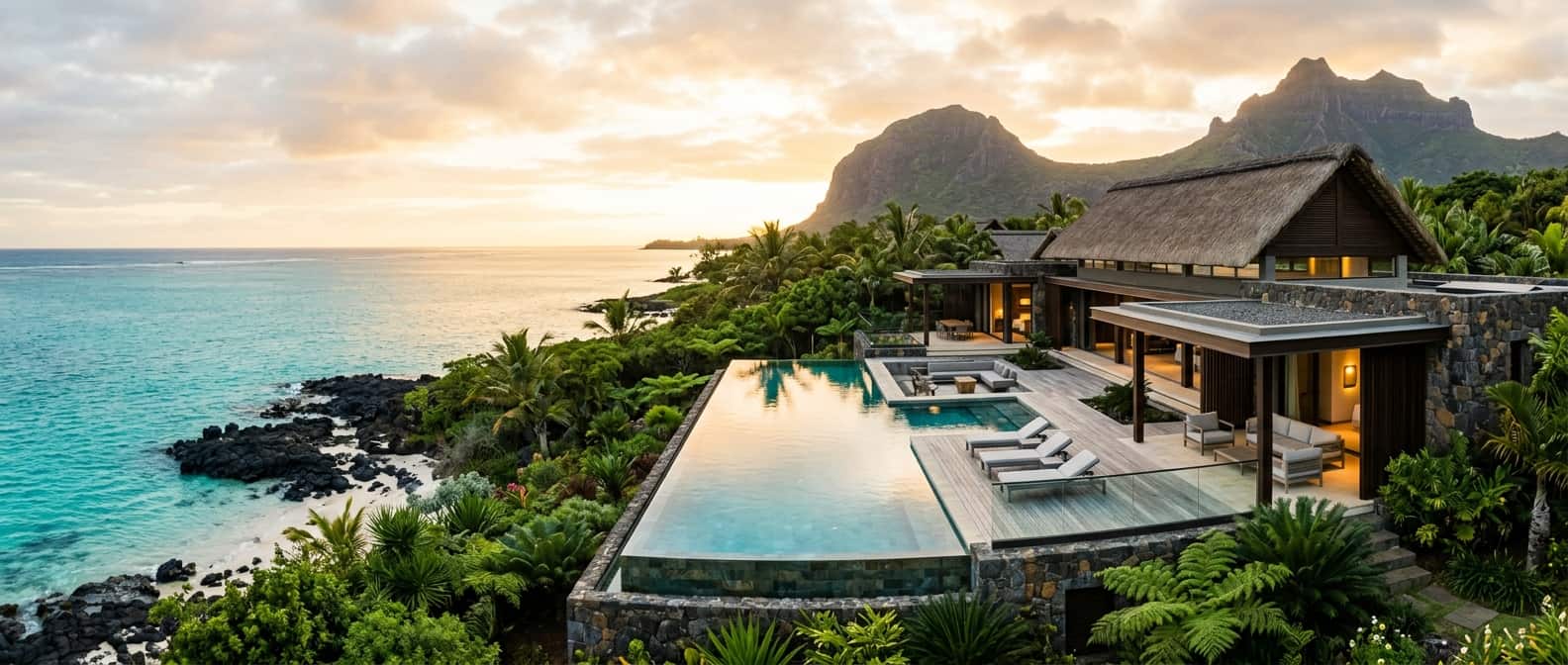
The visual language of the new Mauritian retreat is one of profound restraint. The most sought-after properties on the island have abandoned the colonial pastiche in favour of a design ethos that respects the dramatic topography. On the rugged southern coast, where the surf breaks violently against basalt cliffs, low-slung pavilions disappear into the indigenous foliage.
These private estates are studies in indoor-outdoor living. Walls retract to invite the trade winds, while infinity pools made of dark slate mirror the brooding sky above the Indian Ocean. Inside, the luxury is tactile: raw silk, hand-carved local timber, and cool stone beneath bare feet. This is an architectural response to the shift toward intentional travel, where the physical space is designed to lower the resting heart rate the moment you cross the threshold. It is an environment built entirely for two, offering a sanctuary where the outside world feels entirely remote.
Gastronomy and the Slow Life
To eat well in Mauritius today is to understand its complex history as a crossroads of the spice route. The island’s high-end culinary scene has evolved from imported European fine dining to a proud, sophisticated elevation of local terroir. Executive chefs at top-tier resorts are foraging for sea urchins at dawn and cultivating their own organic gardens in the fertile volcanic soil.
For the Indian palate, which often seeks both comfort and innovation, this translates into a gastronomic revelation. Private beach dinners now feature delicate palm heart salads, slow-cooked venison from local estates, and freshly caught marlin seared over open flames. The emphasis is on slow food, consumed over hours under a canopy of stars. It is an invitation to linger, to taste the island’s heritage through a modern lens, and to appreciate the artistry of a meal prepared exclusively for your table.
The Wellness Shift
The concept of the vacation has fundamentally changed. Rest and recharge are now the primary motivations for leisure travel, a sentiment echoed by recent studies on global travel trends. In Mauritius, this has manifested in a total reimagining of the resort spa. No longer an amenity, wellness is now the architectural and philosophical anchor of the estate.
Couples are booking extended stays not to see the island, but to reconnect with themselves. Treatments are hyper-personalized, drawing on ancient Ayurvedic principles tailored to the modern nervous system. Open-air pavilions offer aerial yoga at sunrise, while hydrotherapy circuits utilise the mineral-rich waters of the Indian Ocean. This is wellness that goes beyond the superficial, designed to induce a state of deep, restorative calm that lasts long after the return flight lands in Mumbai or Delhi.
When to Go
Timing a Mauritian escape requires understanding its micro-climates. While the island is a year-round destination, the Indian luxury traveller seeking the pinnacle of the experience should look to the transition months of May, September, and October. During these windows, the intense heat of the tropical summer subsides, leaving behind days of flawless azure skies and evenings cool enough to warrant a light cashmere wrap.
These months also avoid the peak European winter crowds, ensuring that the island’s best tables, private charters, and exclusive estate rentals remain accessible. It is during these quieter periods that Mauritius truly reveals its character—unhurried, endlessly accommodating, and breathtakingly beautiful.
True luxury requires no audience. On the quiet edges of this Indian Ocean island, surrounded by the deep blue and the dramatic green, the greatest privilege is simply being entirely alone together.