The scent of wild thyme and sun-baked limestone hits the air long before the Aegean Sea fully reveals itself through the cypress trees. Here, the light behaves differently—harsher than the soft pastel glow of the Riviera, yet profoundly clarifying as it strikes the ruins of ancient amphitheatres and the pale marble of modern sanctuaries. There are no super-clubs pulsing bass across the water, no queue of cruise ships obscuring the horizon. Instead, there is only the rhythmic cicada hum and the deep, ink-blue expanse of the Argolic Gulf.
For the affluent Indian traveler, Greece has long been synonymous with the blinding white architecture and sheer caldera drops of Santorini and Mykonos. But as the Cyclades bend under the weight of high-season crowds, a quiet recalibration is occurring. The discerning gaze is shifting south and west, away from the islands and toward the Peloponnese—a rugged, deeply historical peninsula that offers the country’s most elevated, isolated luxury experiences.
Beyond the Cyclades
To understand the appeal of the Peloponnese is to understand the changing currency of luxury travel. Visibility is no longer the ultimate goal; privacy is. The Peloponnese, connected to the Greek mainland by the narrow Isthmus of Corinth, is vast enough to swallow the summer crowds whole without ever feeling busy. It is a landscape of high mountains, deep gorges, and coastal roads that wind past Byzantine castles and dormant fishing villages.
For those flying in from Mumbai or New Delhi, Athens serves as the entry point. But rather than boarding a crowded ferry at Piraeus, the journey to the Peloponnese is a smooth, two-hour chauffeured drive—or a brief helicopter transfer—down the eastern coast. This immediate access to isolation is part of the peninsula’s draw. There is no waiting for the Meltemi winds to die down so a boat can dock; there is only the seamless transition from the tarmac to the terrace. The Peloponnese is where wealthy Athenians have historically maintained their summer estates, hiding in plain sight along a coastline that rivals the Amalfi for sheer drama, but with none of the vehicular gridlock.
Amanzoe and the New Architecture of Rest
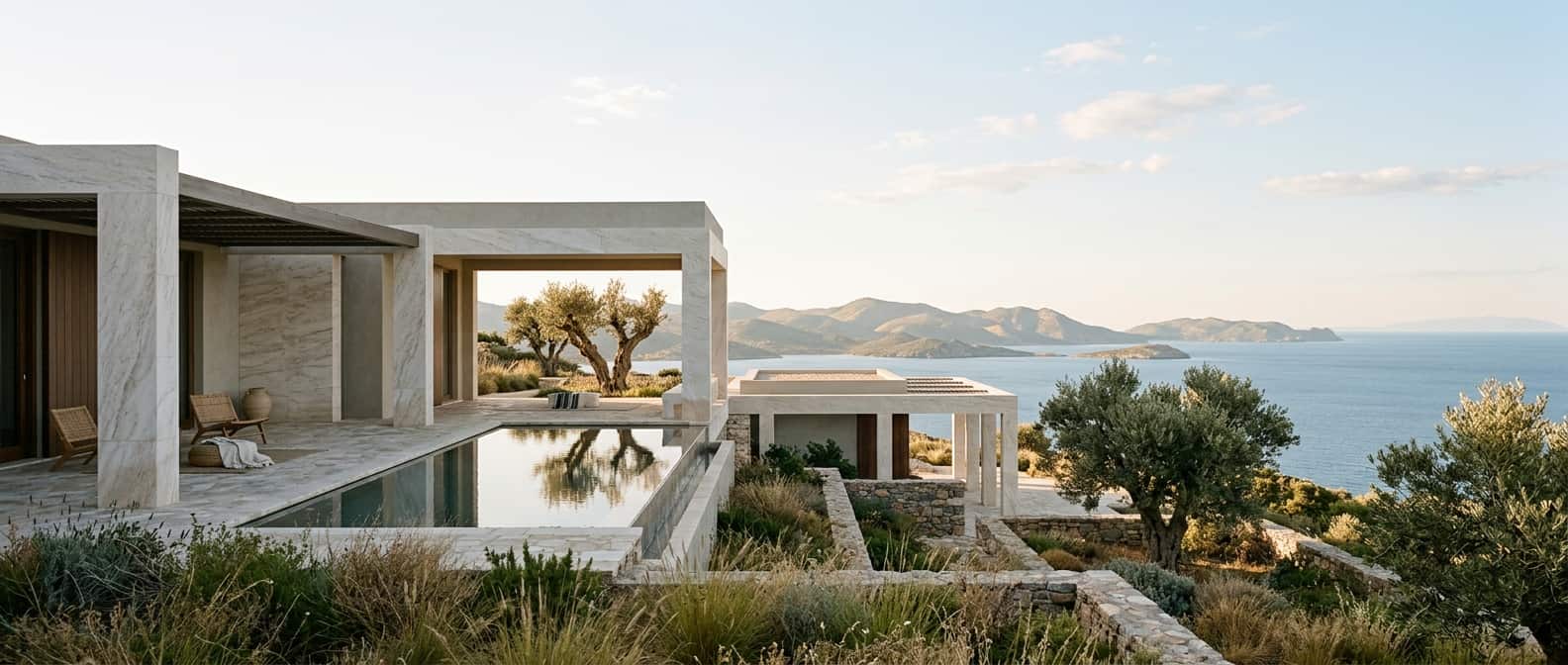
At the epicenter of this regional renaissance is Amanzoe. Perched on a hilltop near Porto Heli, the resort has not just redefined Greek luxury; it has fundamentally altered the geography of it. Designed by the legendary Ed Tuttle, the property is an architectural triumph—a modern Acropolis of classical proportions, flat-roofed pavilions, and reflecting pools that mirror the sky.
For the luxury traveler, Amanzoe operates as a self-contained universe. The pavilions, each with its own private pool, are spaced far enough apart to ensure absolute silence. Inside, the design is a masterclass in restraint: high ceilings, cool marble floors, and sliding doors that open entirely to the sea breeze. It is here that the concept of 'slow luxury' takes physical form. Days at Amanzoe do not demand an itinerary. They are measured in the slow drift of shadows across the courtyards, private holistic wellness treatments utilizing local olive oil and sea salt, and dinners overlooking a coastline that looks much as it did three millennia ago. This is not the Greece of chaotic beach clubs; it is the Greece of profound, restorative quiet.
The Olive Groves and Ancient Epidaurus
Yet, the luxury of the Peloponnese extends beyond the walls of its high-design resorts. It is woven into the very fabric of the land. This is the agricultural heartland of Greece, where Kalamata olives are harvested and the vines of Nemea produce some of the country’s most structured, complex red wines. The food here is fiercely local, devoid of the internationalized menus found on the islands. At a coastal taverna in Ermioni, lunch might be nothing more than grilled octopus, wild greens foraged from the hillside, and olive oil pressed from the trees shading your table.
This deep connection to the earth is paralleled by a deep connection to history. The Peloponnese is the staging ground for myth: it is the realm of Agamemnon’s Mycenae and the birthplace of the Olympic Games. For the culturally curious traveler, a private, after-hours tour of the Theatre of Epidaurus—an ancient acoustic marvel nestled in a pine forest—offers a visceral connection to antiquity. Standing at the center of the orchestra, where a whisper can be heard in the highest tier of the 14,000-seat amphitheater, is a profoundly grounding experience. It is a reminder of the enduring power of place.
Navigating the Coastline
While the eastern edge of the peninsula, centered around Porto Heli, attracts the super-yacht set, the western coast offers its own distinct rhythm. Here, the landscape flattens out into vast stretches of sandy beaches and the Ionian Sea’s warmer waters. The Costa Navarino development in the Messinia region has single-handedly elevated this stretch of coast.
Comprising multiple distinct properties, including a W and a Mandarin Oriental, Costa Navarino offers a different scale of luxury. It is more expansive, heavily focused on world-class golf—a rarity in Greece—and immersive environmental sustainability. The architecture here is integrated into the dunes and olive groves, prioritizing a low environmental footprint while maintaining uncompromising standards of service. For multi-generational Indian families traveling together, this western coast provides the space and variety that the sheer cliffs of the Aegean islands cannot.
The Shift Toward Slow Hellenic Travel
The true luxury of the Peloponnese is its refusal to perform. It does not exist merely to be photographed; it exists to be inhabited. It requires a slower pace, a willingness to drive down unmarked dirt roads to find a secluded cove, and an appreciation for the quiet dignity of the landscape.
As the definition of outbound luxury continues to evolve—moving away from frantic sightseeing toward intentional, restorative experiences—the Peloponnese stands as a definitive destination. It offers the affluent traveler something increasingly rare in the modern Mediterranean: the luxury of being entirely undisturbed.