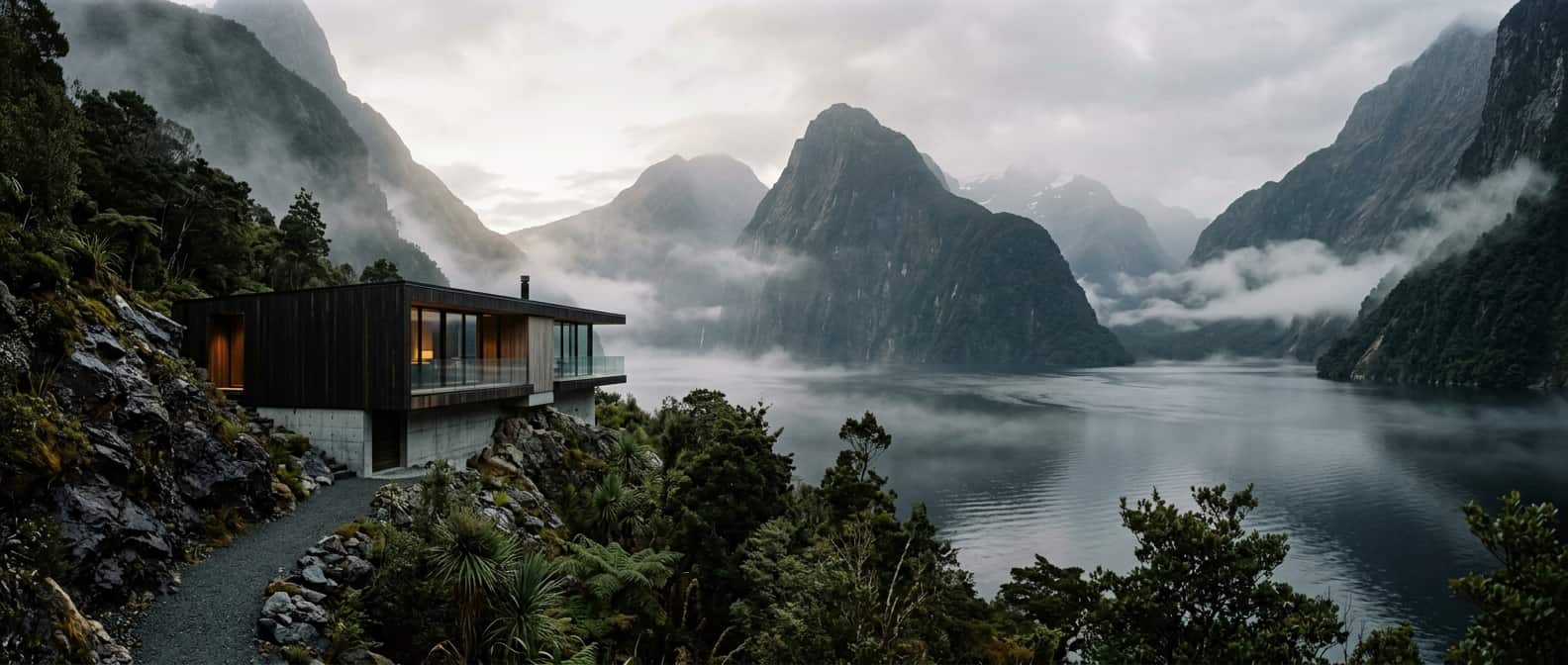
The helicopter banks sharply over the Southern Alps, revealing a sheer drop into a glacial valley where a solitary structure of glass and blackened timber clings to the ridgeline. There are no roads here. The silence is total, broken only by the hum of the rotors and the distant rush of a waterfall cutting through the ancient schist. This is the new architecture of escape—a geography where luxury is defined not by excess, but by absolute, unfiltered isolation.
For the affluent Indian traveler, New Zealand’s South Island presents a radical shift in perspective. Moving beyond the manicured European resorts and the bustling coastal enclaves of Southeast Asia, the Antipodes offer a rugged, primal beauty, tempered by some of the most sophisticated hospitality on earth.
The New Standard of Remote
In recent years, a quiet revolution has taken place across New Zealand’s backcountry. The traditional hunting lodge has been entirely reimagined, stripped of its rustic clichés and rebuilt with an aesthetic that favors minimalist design and hyper-local immersion. Properties like Minaret Station, accessible only by helicopter, have established a benchmark where off-grid sustainability meets uncompromising comfort. Here, the luxury lies in the logistics—the quiet orchestration of delivering world-class service to the edge of the inhabitable map.
The appeal for the luxury outbound market from India is clear. It is the promise of exclusivity that cannot be bought simply with currency, but requires a commitment to distance and geography. These are sanctuaries designed for the elite traveler seeking a complete deceleration.
Southern Alps and Glacial Valleys
The spine of the South Island is dominated by the Southern Alps, a dramatic collision of tectonic plates that has created some of the most staggering topography on the planet. Lodges situated in this region use the landscape not just as a backdrop, but as a defining architectural element. Floor-to-ceiling glass erases the boundary between the interior warmth—often anchored by massive stone fireplaces—and the jagged, snow-capped peaks outside.
Days here are highly curated. A private guide might lead a morning heli-skiing expedition or an afternoon hike across a blue-ice glacier, followed by a soak in a cedar hot tub as the alpenglow ignites the surrounding summits. The emphasis is on private, low-impact encounters with nature.
Fiordland's Silent Majesty
Further south, the terrain shifts into the deep, dark fjords of Fiordland National Park. Here, the luxury experience often transitions from land to water. Bespoke yacht charters navigate the mirror-like surfaces of Milford and Doubtful Sounds, offering a vantage point of sheer cliffs and cascading waterfalls that few ever see.
The lodges in this region, such as Fiordland Lodge in Te Anau, operate as thresholds to this UNESCO World Heritage wilderness. The architectural vocabulary leans into massive log construction and soaring ceilings, providing a sense of scale that mirrors the environment. The focus remains tightly on the immediate surroundings—fly fishing in pristine rivers, or tracking the elusive kiwi bird in old-growth forests.
The Culinary Philosophy of the Deep South
The isolation of these lodges necessitates a profound reliance on local agriculture and foraging. The dining experience is inherently tied to the land. Executive chefs, often drawn from the world’s finest Michelin-starred kitchens, work with ingredients that are fiercely regional—Fiordland venison, Bluff oysters, and alpine herbs gathered just beyond the kitchen door.
This hyper-local approach is paired with the formidable wine culture of Central Otago, renowned globally for its Pinot Noir. For the Indian palate, which increasingly values provenance and clean, robust flavors, the culinary narrative of New Zealand’s high country is a revelation. It is dining stripped of pretense, elevated by the sheer quality of the raw materials.
Logistics of the Long Haul
Reaching this level of remote luxury requires precise orchestration. For the Indian HNI traveler, the journey typically involves flying into Auckland, followed by a private jet or commercial transfer to Queenstown. From there, the final leg is almost always airborne—a scenic helicopter flight that serves as the ultimate decompression chamber, severing ties with the densely populated world left behind.
It is a long journey, but one that is deliberately paced. The isolation of New Zealand’s wilderness lodges is not an obstacle; it is the fundamental draw. It is a commitment to stepping off the map, yielding to the scale of the earth, and finding perfect stillness at the edge of the world.
Sources
Note: Web search was unavailable due to an API error. Destinations and insights were curated based on editorial knowledge of the New Zealand luxury travel landscape.