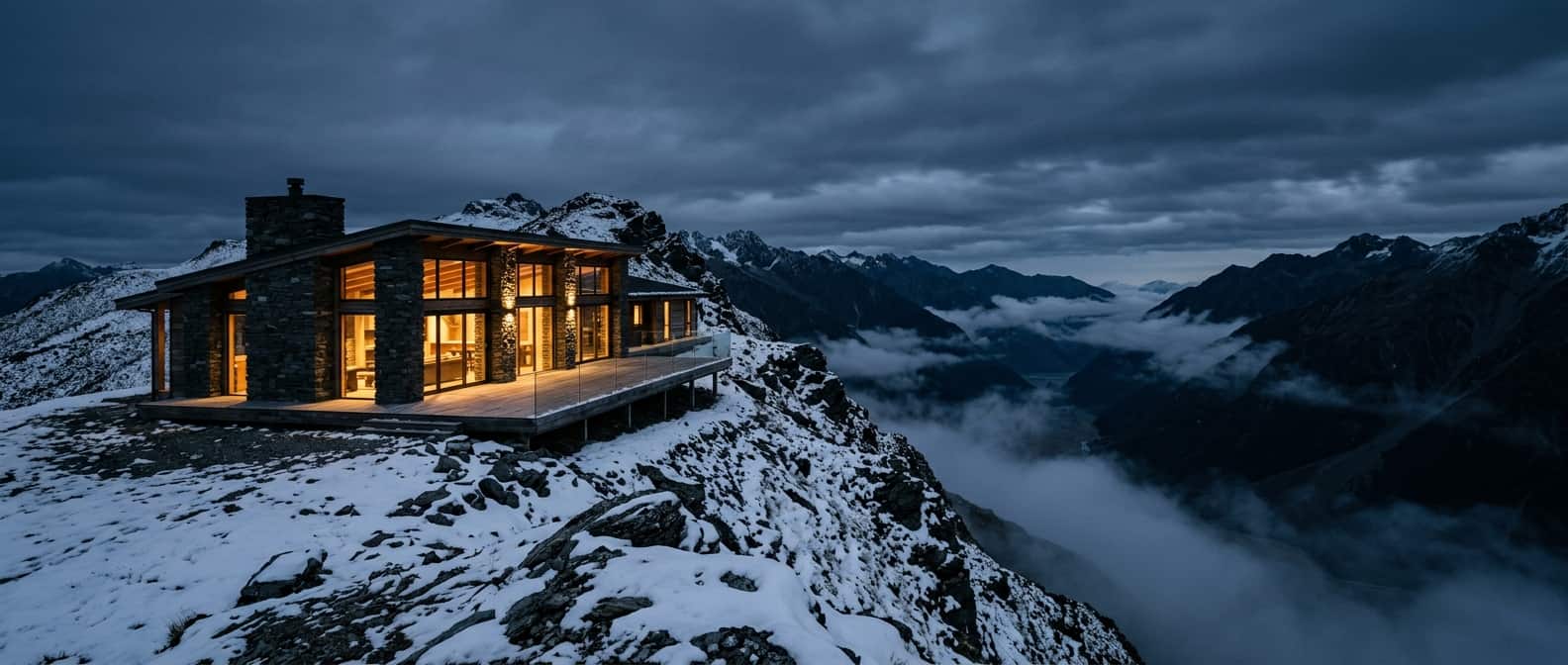
The air above the Tasman Sea carries a specific kind of clarity, one that sharpens the edges of the mountains long before the helicopter touches down. In New Zealand’s Southern Alps, isolation is not merely a byproduct of geography; it is the central architectural principle. For the affluent Indian traveler, whose world is increasingly defined by hyper-connectivity and curated noise, the deep glacial valleys and sheared peaks of the South Island offer something entirely radical: silence, rendered in slate grey and alpine green.
Here, the concept of the ‘lodge’ has been entirely rewritten. Far from the communal fireplaces of traditional ski resorts, the Antipodean super-lodge is a masterclass in quiet luxury—often accessible only by private charter, deeply embedded in the topography, and designed to look outward onto landscapes that feel almost pre-historic in their scale.
The Shift Toward the Antipodes
For years, the compass of Indian luxury outbound travel swung predictably toward the Swiss Alps or the familiar valleys of the Dolomites. But there is a subtle, decisive pivot happening. The modern luxury traveler from Mumbai or Delhi is moving past the known European circuits, looking for an edge—a place where the infrastructure of high luxury meets raw, unmediated wilderness.
New Zealand’s South Island answers this brief flawlessly. It is a destination that demands commitment, a long-haul journey that acts as a natural filter, ensuring that those who arrive are seeking more than just a passing acquaintance with the landscape. The luxury here is not loud or ostentatious. It is measured in the thread count of local merino wool, the exact temperature of a Central Otago Pinot Noir poured at dusk, and the absolute privacy of a valley where your helicopter is the only sound in the sky.
Minaret Station: The Helicopter-Only Sanctuary
To understand the New Zealand standard of luxury, one must begin at Minaret Station. Situated in a glacial valley just west of Lake Wānaka, this alpine lodge is completely inaccessible by road. Guests arrive by helicopter, sweeping over the Southern Alps before descending into a landscape of tussock grass and sheer rock faces.
Minaret Station operates as a working high-country farm, but its accommodation is an exercise in extreme comfort. The individual chalets are connected by raised wooden boardwalks, hovering above the alpine meadow. Inside, sheepskin rugs, open fires, and deep soaking tubs offer a counterpoint to the wildness outside. The days here are dictated by the weather and the helicopter: heli-skiing untouched powder in the winter, or flying over the fjordlands for a private, guided hike in the summer. It is a place that recalibrates your understanding of distance and access.
Blanket Bay: The Edge of Lake Wakatipu
If Minaret Station is about the thrill of the inaccessible, Blanket Bay is about mastery of the landscape. Located on the shores of Lake Wakatipu, roughly an hour’s drive from Queenstown, the lodge sits at the exact point where the water meets the base of the Richardson Mountains.
Built from local schist and timber, Blanket Bay possesses an architectural gravity that matches its surroundings. The great room, with its vaulted ceiling and towering stone fireplace, frames the lake as though it were a cinematic projection. For the Indian traveler accustomed to the polished marble of urban luxury hotels, the tactile, grounded materials of Blanket Bay offer a profound sensory shift. The luxury here lies in the seamlessness of the experience: transitioning from a morning of world-class fly fishing to an evening tasting menu that highlights the absolute best of South Island produce, all without breaking the spell of the environment.
The Fiordland Frontier
Further south and west, the Southern Alps fracture into the Tasman Sea, creating Fiordland—a jagged coastline of submerged glacial valleys. This is perhaps the most dramatic topography on the planet, and navigating it requires a specific kind of expertise.
For the high-end traveler, Fiordland is best experienced not from the deck of a crowded cruise ship, but via private charter or from the vantage point of a boutique eco-lodge tucked into the rainforest. The scale of the fiords, particularly Milford and Doubtful Sound, defies photography. Waterfalls drop hundreds of meters from hanging valleys, and the water is stained dark with tannins from the native beech forests. It is an environment that feels ancient, indifferent, and entirely mesmerizing. To experience it with the logistical backing of New Zealand’s finest guides is to see the earth as it was before human intervention.
The New Zealand Standard
Ultimately, what New Zealand offers is a redefinition of what luxury travel can be. It is not about formal dining rooms or white-gloved service, though the attention to detail is flawless. It is about access—access to clean air, to unbroken horizons, and to experiences that cannot be replicated anywhere else.
For the affluent Indian traveler looking toward the future of outbound travel, the Southern Alps present a compelling proposition. It is a place that asks you to engage with the world on its terms, while providing an infrastructure of comfort that is second to none. The Antipodes are no longer the end of the earth; they are the new center of quiet, uncompromising luxury.