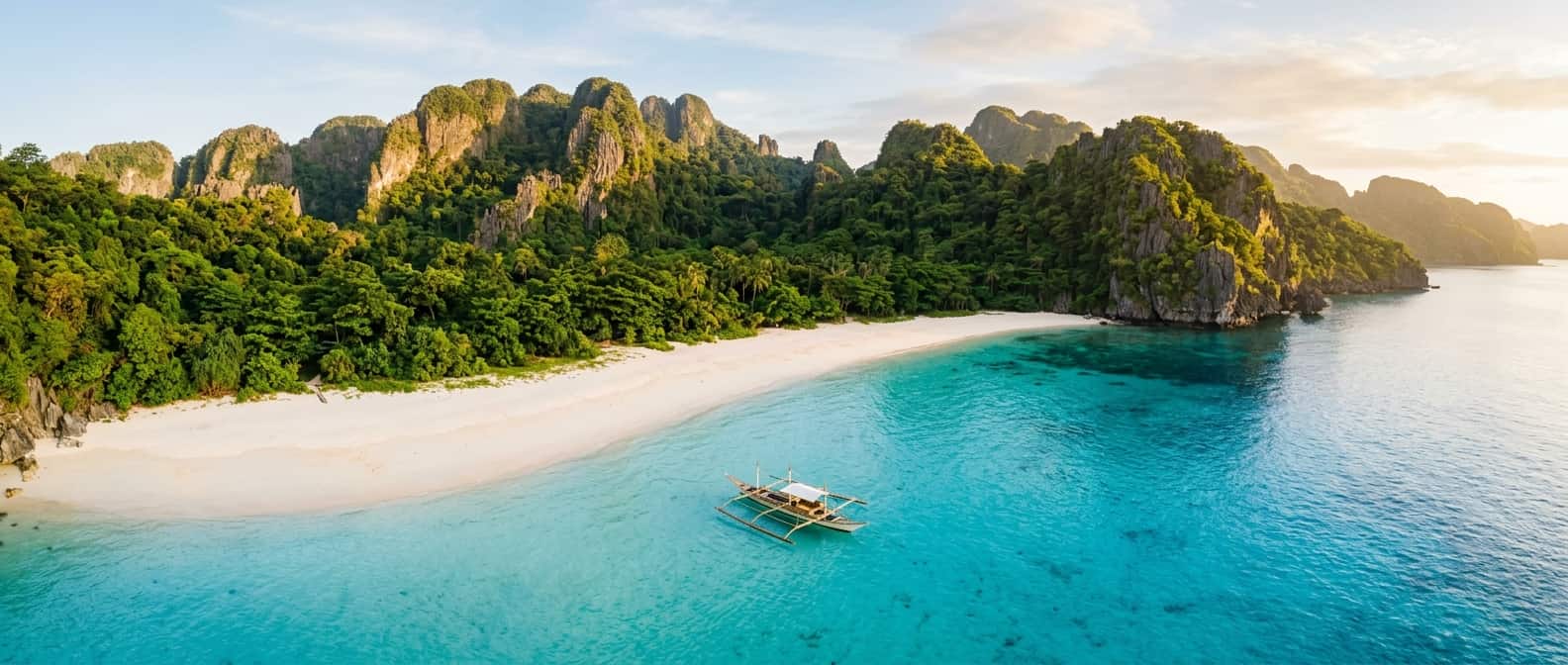
The water in the Sulu Sea does not merely reflect the sky; it seems to emit its own luminescence, a startling shade of electric turquoise that shifting tides only intensify. Approaching by twin-engine plane, the karst cliffs of northern Palawan pierce the horizon like the spine of a submerged dragon. Here, the hum of the modern world dissolves into the rhythmic lap of waves against outrigger hulls. This is not the Southeast Asia of congested resort towns or aggressively marketed beach clubs. It is an older, quieter topography, where luxury is defined by profound isolation and an unbroken connection to the elements.
For affluent Indian travelers who have exhausted the polished perfection of the Maldives and the culinary circuits of European summers, Palawan offers a compelling alternative. It is a destination that demands a little more effort to reach, rewarding that journey with a rawness and exclusivity that is increasingly rare.
The Geography of Solitude
Palawan is not a single destination but an archipelago of over 1,700 islands stretching southwest toward Borneo. While the capital, Puerto Princesa, and the popular town of El Nido serve as the primary conduits, the true essence of luxury lies off the mainland. The geography itself acts as a natural filter, keeping the masses at bay.
The islands in the Cuyo Archipelago and the remote atolls north of El Nido are where the finest properties have quietly established themselves. These are places where you do not book a room, but a casita nestled into the jungle canopy or a villa opening directly onto a private stretch of powdery, white coral sand. The appeal is the utter lack of neighbors. Your days are measured by the shifting light on the limestone and the gentle rustle of palm fronds, rather than an itinerary of structured activities.
Amanpulo: The Benchmark of Barefoot Luxury
It is impossible to discuss high-end travel in the Philippines without addressing Amanpulo. Occupying the entirety of Pamalican Island, a private atoll in the Cuyo Archipelago, the resort remains the high-water mark for hospitality in the region. Arriving via the resort’s private airstrip from Manila, guests are immediately enveloped in an atmosphere of hushed, intuitive service.
The casitas, inspired by traditional Philippine bahay kubo dwellings, are masterpieces of understated design. Timber, rattan, and pebble-washed walls blend seamlessly with the environment. But the true luxury of Amanpulo is the island itself. You are given a private buggy to navigate the sandy, jungle-fringed paths. You can spend an entire afternoon snorkeling the pristine house reef—teeming with hawksbill turtles and reef sharks—without encountering another soul. It is a masterclass in leaving things exactly as they should be.
Beyond the Obvious: Taytay and Linapacan
While Amanpulo commands the spotlight, those seeking a slightly more adventurous, yet equally refined experience are turning their attention to the waters around Taytay and the Linapacan Strait. Here, eco-luxury takes center stage. Properties are increasingly adopting a "tread lightly" philosophy, running on solar power and prioritizing the conservation of the delicate marine ecosystems they inhabit.
Imagine days spent island-hopping on a private, fully-crewed luxury catamaran. You might anchor off an uninhabited island for a bespoke beach picnic of freshly grilled lapu-lapu and sea urchin, prepared by your onboard chef. The waters in Linapacan are famously clear, offering visibility that rivals the world’s top dive sites. It is a sensory immersion that feels entirely divorced from the mainland’s chaos.
Navigating the Logistics
The beauty of Palawan's isolation is precisely what makes it a logistical puzzle. This is not a destination for spontaneous, unstructured wandering. The key to a flawless experience is precision planning, ideally involving private charters and point-to-point transfers.
From Manila, private aviation or scheduled charter flights are the most seamless way to reach the island resorts, avoiding the unpredictability of regional commercial carriers. Once on the ground—or water—travel is primarily by boat. High-speed, air-conditioned catamarans and beautifully restored traditional paraws serve as the elegant connective tissue between islands. It is essential to lean on specialized operators who understand the nuances of the tides and the region’s specific tempo.
The Last True Escape
To travel to Palawan's private islands is to consciously step off the map. It is an acknowledgment that the ultimate luxury in our hyper-connected era is, quite simply, distance. As the boat pulls away from the limestone cliffs, leaving only a fading wake in the impossibly clear water, the profound silence settles over you. It is a silence not of emptiness, but of a world entirely sufficient unto itself.