The wind does not merely blow in Patagonia; it commands. Here, at the ragged, southern edge of the Americas, granite spires tear through low-hanging clouds, and ancient glaciers calve silently into milky-blue lakes. It is a landscape of profound, uncompromising scale—one that demands a specific kind of refuge. For the modern traveler, that refuge is no longer a rustic outpost, but a masterpiece of architectural isolation.
The Architecture of Isolation
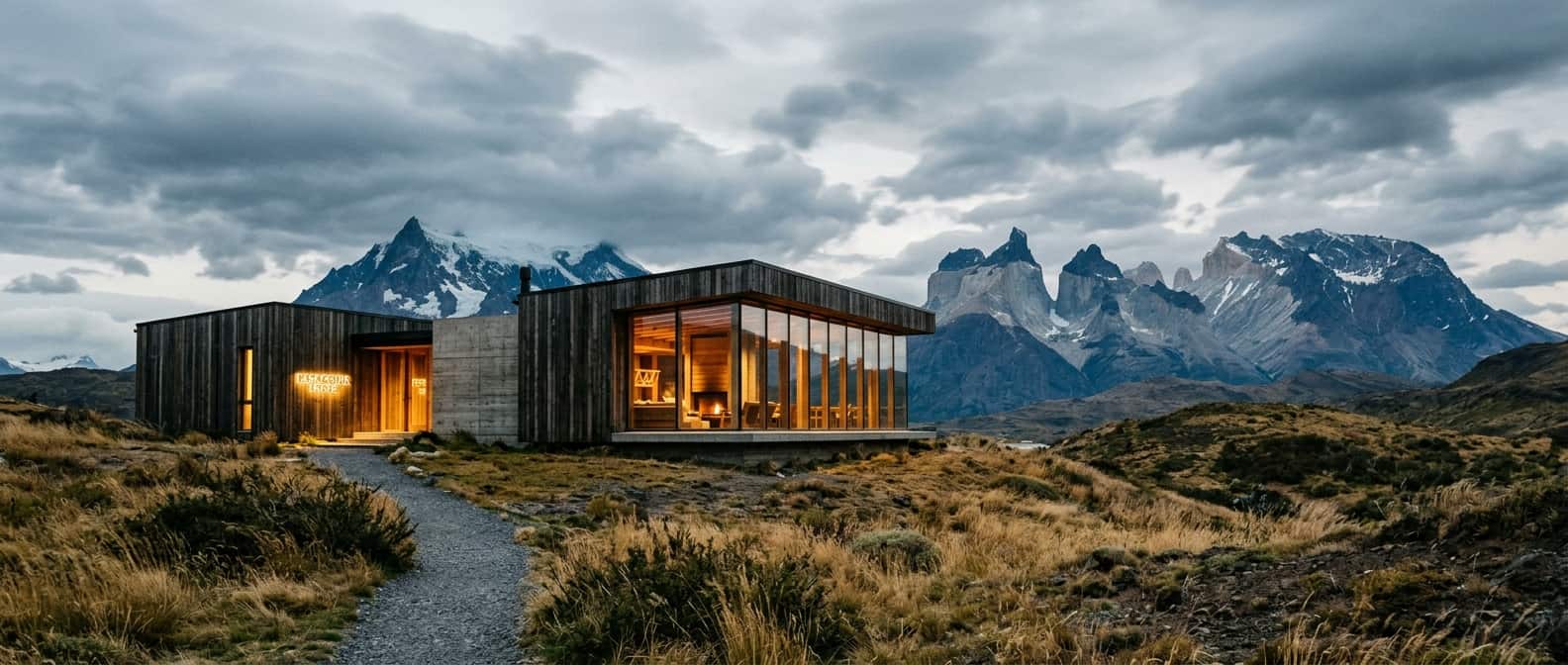
True luxury in the deep south is defined by contrast. The harshness of the Patagonian steppe is immediately offset the moment you step inside lodges like Awasi Patagonia. Built as a collection of independent villas, Awasi is an exercise in restraint. The interiors are swathed in warm lenga wood, sheepskin throws, and floor-to-ceiling glass that frames the jagged teeth of the Torres del Paine. There is no communal dining hall pressure; each villa is assigned a private guide and a 4x4 vehicle, allowing you to trace the contours of the national park entirely on your own schedule.
This model of high-end expedition hospitality shifts the focus from opulent amenities to frictionless access. It is not about gold-leafed lobbies, but rather returning from a ten-kilometer trek to find a wood-burning stove lit, a sommelier pouring a Carménère, and a hot tub steaming on your private deck as the alpacas graze just beyond the glass.
Crossing the Continental Divide
Patagonia is divided by the Andes, split between Chile’s dramatic fjords and Argentina’s sweeping glaciers. While Chile offers the high-drama peaks of Torres del Paine, Argentina holds the hypnotic expanse of Los Glaciares National Park. EOLO Patagonia’s Spirit, set on a 10,000-acre working estancia near El Calafate, captures the essence of the Argentine steppe.
Here, the luxury lies in the vastness. With only seventeen rooms, the lodge feels less like a hotel and more like a private manor. The horizon stretches uninterrupted in every direction. Mornings are spent riding criollo horses alongside the gauchos, while afternoons involve watching the Perito Moreno Glacier—a massive, advancing wall of ice that violently sheds house-sized chunks into Lago Argentino. The experience is visceral, grounding, and deeply exclusive.
The Eco-Luxury Mandate
Operating in one of the world's most pristine environments requires a delicate footprint. The new generation of Patagonian lodges has elevated sustainability from a buzzword to a structural ethos. Tierra Patagonia, blending seamlessly into the hillside above Lake Sarmiento, is practically invisible from a distance. Its aerodynamic, undulating wood structure was designed to withstand the region's fierce winds while minimizing thermal loss.
Inside, the lodge operates with a deep respect for local heritage, employing indigenous architectural principles and sourcing materials almost entirely from Chilean craftsmen. This is slow travel at its most refined—where the carbon offset of your long-haul flight is met with a deep, tangible commitment to conservation on the ground.
The Logistics of the Deep South
Reaching Patagonia from India requires commitment, but the friction of the journey is part of the reward. Most itineraries begin with a flight into Santiago or Buenos Aires, followed by a domestic hop south to Punta Arenas or El Calafate. The season is short and fiercely guarded; November through March offers the most temperate conditions, though the "shoulder seasons" of October and April provide dramatic autumnal colors and fewer crowds.
For the affluent Indian traveler, working with a specialized outfitter is essential. The logistics of crossing the Chilean-Argentine border, securing lodge availability (which often books out a year in advance), and arranging private charter flights require precision.
In Patagonia, the edge of the world is not a cliff, but a sanctuary. It is a place where raw, elemental nature is met with quiet, sophisticated comfort—a rare balance that leaves an indelible mark on the soul long after the southern winds have faded.
Sources
- Awasi Patagonia — Reference for private villas and guide structure in Torres del Paine.
- EOLO Patagonia’s Spirit — Detail on the 10,000-acre estancia model in Argentina.
- Tierra Patagonia — Notes on sustainable architecture and wind-resistant design.