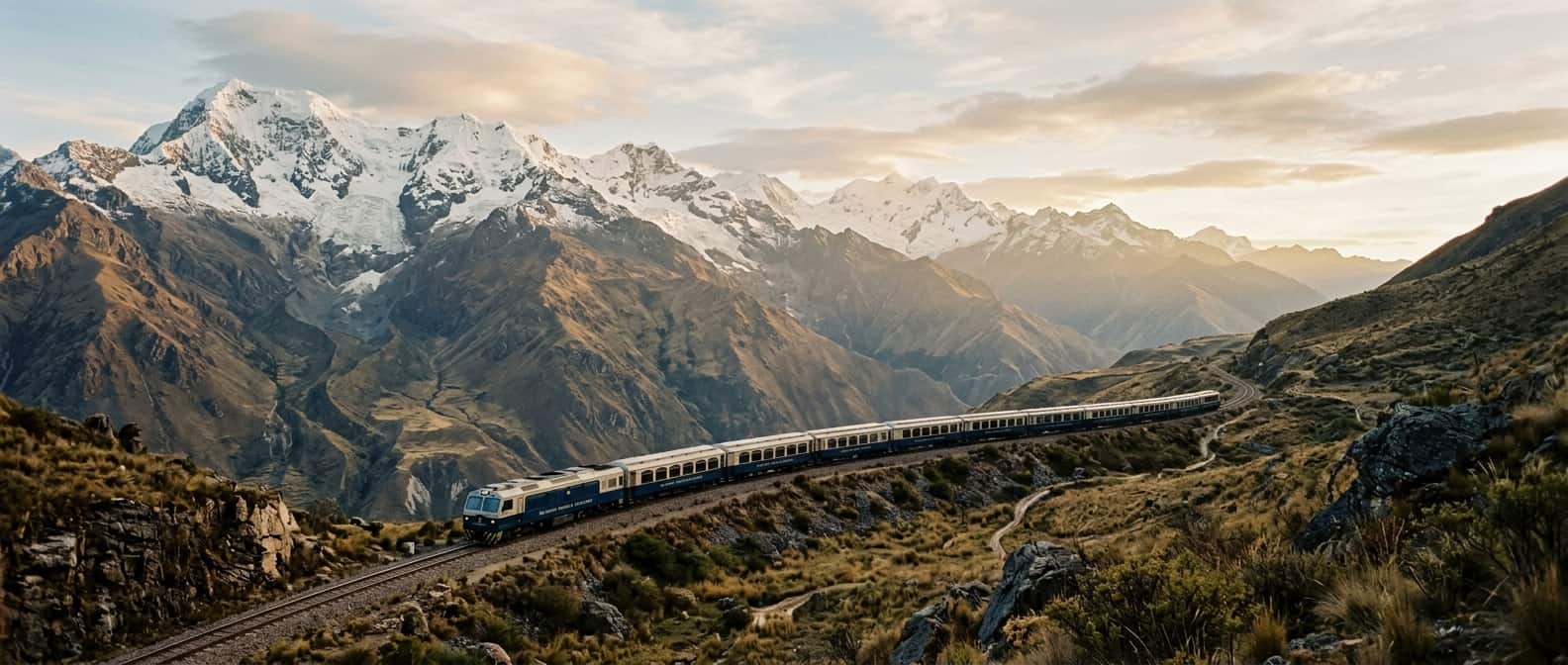
The air at 14,000 feet possesses a specific, sharp clarity. Here, in the high Altiplano stretching between Cusco and Lake Titicaca, the landscape is stripped down to its absolute essentials: golden ichu grass, dark volcanic rock, and the immense, unblinking blue of the Andean sky. Through this stark, cinematic terrain moves the Belmond Andean Explorer, its midnight-blue carriages pulling luxury and warmth through one of the earth’s most unforgiving environments. For the discerning Indian traveler, this is the definitive way to read the geography of Peru.
The Ascent to Cusco
Every journey into the Inca heartland begins with altitude. Cusco, the historic naval of the empire, demands a certain physical and temporal slowing down. Rather than rushing straight to the ruins, the modern luxury paradigm involves a quiet acclimatization within the city's ancient walls.
The architectural language here is a layering of epochs. At properties like the Monasterio or the Palacio Nazarenas, sixteenth-century Spanish colonial masonry rests directly atop precision-cut Incan foundation stones. You spend the first two days moving at a deliberate, measured pace—drinking coca tea in sunlit cloisters, exploring the San Pedro market, and adjusting to the thin, bright air. The luxury here is entirely about atmosphere and stillness before the journey ahead.
The Sacred Valley
Descending into the Urubamba Valley—the Sacred Valley of the Incas—brings a perceptible softening of the environment. The air thickens, the temperature rises, and the landscape turns a vibrant, terraced green. This valley is the agricultural and spiritual corridor leading to Machu Picchu, but it is also a destination in its own right, home to some of South America’s most considered experiential lodges.
Sol y Luna, an enclave of private casitas set against the red valley walls, exemplifies this approach. Here, travel becomes deeply textural: horseback riding on Peruvian Pasos, dining on Andean-fusion cuisine where native tubers and grains are elevated to high art, and observing the interplay of light and shadow across the terraces of Moray. It is a region that rewards lingering, rather than mere transit.
The Belmond Andean Explorer
The transition from the valley back to the high plain marks the beginning of the rail journey. The Belmond Andean Explorer is South America’s first luxury sleeper train, and it functions less as transport and more as a mobile, high-design sanctuary. The interiors reflect a quiet, tactile luxury—alpaca wool throws, textured leather, and slate tones that mirror the passing geography.
As the train climbs toward La Raya, the highest point on the route, the observation car becomes the center of gravity. There is no Wi-Fi, no immediate connection to the lower world. There is only the rhythm of the tracks, the sight of grazing vicuñas, and the quiet clink of Pisco Sours being prepared at the bar. It is an exercise in isolation, wrapped in absolute comfort.
The Edge of Titicaca
The arrival at Lake Titicaca, a body of water so vast it creates its own weather systems and horizon lines, feels like reaching the end of a continent. The train halts at Puno, where the air is cold and the light reflects sharply off the water.
Exploring the floating Uros islands or the terraced hills of Taquile Island offers a glimpse into a way of life that has persisted, largely unchanged, for centuries. Yet, returning to the train in the evening—to a perfectly executed dinner service and the warmth of a private cabin—creates a brilliant, necessary contrast. It is the juxtaposition of extreme, ancient landscapes with refined, modern hospitality that defines the true appeal of the Andes.
Travel, at its best, is about shifting your internal rhythm to match the environment. Moving slowly through the Andes does exactly this, replacing the frantic pace of modern life with the steady, measured beat of the train against the tracks.
Sources
Because the web research tool was unavailable during this drafting session, historical and geographic details regarding Cusco, the Sacred Valley, and the Belmond Andean Explorer are drawn from Fly Goldfinch's internal editorial database.