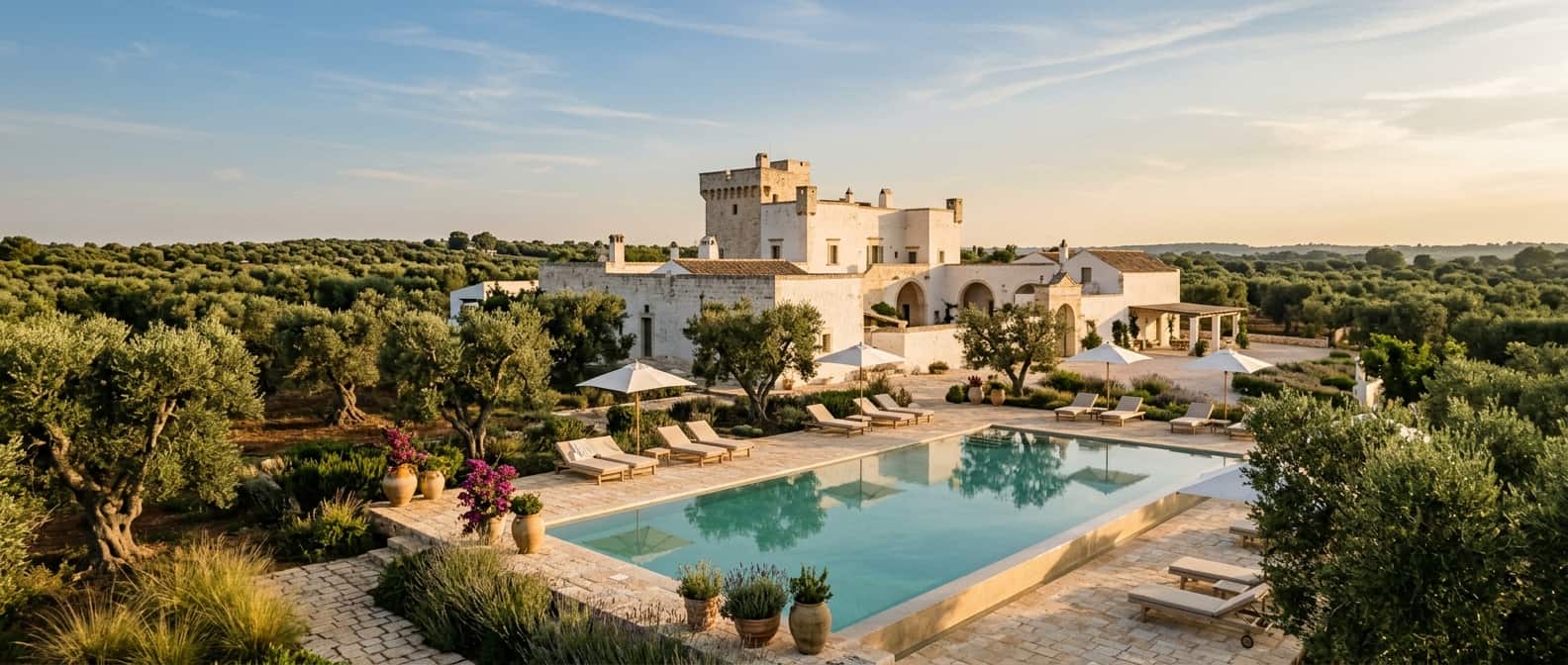
There is a distinct quality to the light in southern Italy—a bleached, unapologetic brightness that settles over ancient olive groves and white-washed stone. For years, the affluent Indian traveler looking toward Italy instinctively gravitated north: the manicured drama of Lake Como, the steep vertical glamour of the Amalfi Coast, or the Renaissance heavy-hitters of Florence and Rome. But a shift has occurred. The modern luxury traveler is moving south to the heel of Italy’s boot, seeking a slower, more grounded form of opulence in Puglia.
Here, the defining luxury experience isn’t a grand palazzo; it’s the masseria. These fortified agricultural estates, many dating back to the 16th century, have been meticulously restored into some of the Mediterranean’s most exclusive boutique hotels. They offer a masterclass in rustic minimalism, proving that true luxury often whispers rather than shouts.
The Evolution of the Masseria
Historically, a masseria was a working farm—a self-sufficient universe with its own olive presses, chapels, and fortifications built to repel marauding pirates. Today, that defensive architecture provides a profound sense of privacy and seclusion.
The transformation from agrarian compound to high-design sanctuary has been handled with deep reverence for the region’s vernacular. Architects have embraced the local tufo limestone, vaulted ceilings, and cavernous fireplaces. Instead of importing foreign concepts of luxury, they have elevated the indigenous. The result is an aesthetic that feels entirely rooted in its landscape—a seamless blend of ancient stone, raw linen, and bespoke contemporary furnishings.
Defining Estancias of the South
If there is a pioneer in Puglia’s hospitality renaissance, it is arguably Borgo Egnazia. Though technically a modern construction designed to resemble a traditional Apulian village, it set a new benchmark for scale and service in the region. It is sprawling, cinematic, and impeccably staffed, making it a favorite for high-profile weddings and multi-generational family buyouts.
For those seeking authenticity over scale, the smaller, historic masserie offer an entirely different rhythm. Masseria Torre Maizza, now under the Rocco Forte umbrella, injects a dose of vibrant, contemporary Italian design into a 16th-century estate, complete with a nine-hole golf course winding through ancient olive trees. Meanwhile, places like Masseria Moroseta lean heavily into architectural minimalism. Designed by Andrew Trotter, Moroseta is a stark, blindingly white modernist interpretation of the traditional masseria, beloved by the international design crowd for its ascetic purity and exceptional farm-to-table dining.
A Culinary Philosophy Rooted in the Earth
To visit Puglia without surrendering to its food is to miss the point of the region entirely. Apulian cuisine is the epitome of cucina povera—the peasant cooking tradition that relies on hyper-local, hyper-seasonal ingredients. In the context of a luxury masseria, this philosophy is elevated into a refined, sensory experience.
Dining here is deeply connected to the estate itself. The olive oil pooling on your plate was likely pressed from the trees shading your suite. The tomatoes, bursting with the concentrated heat of the Mediterranean sun, were harvested that morning. Meals are long, languid affairs, often taken in a central courtyard under strings of festoon lights or in converted stables where the stone walls hold the cool air. It is a stark contrast to the performative dining often found in traditional luxury hubs; here, the luxury lies in the absolute integrity of the ingredient.
Navigating the Apulian Rhythm
A holiday in Puglia requires a recalibration of one's internal clock. The region demands a surrender to the riposo—the prolonged afternoon rest where villages shutter and the world seems to pause. This is not a destination for frantic sightseeing.
Days are best spent lingering by a stone-lined pool, driving a vintage Alfa Romeo along the coastal roads to the baroque city of Lecce, or chartering a private gozzo (a traditional wooden boat) to explore the sea caves of Polignano a Mare. The Adriatic and Ionian seas bracket the region, offering stretches of dramatic coastline and hidden coves, though the true heart of Puglia remains stubbornly inland, anchored to the red earth and the silver-green canopy of the olive groves.
It is a place that understands the ultimate contemporary luxury is space, silence, and the time to enjoy them both.
Sources
- Borgo Egnazia — Reference for the benchmark of Apulian village-style luxury hospitality.