The light in southern Italy possesses a certain weight. It hits the ancient limestone walls not with a glare, but with a warm, pervasive glow that seems to rise from the earth itself. Here in Puglia, the heel of the Italian boot, the landscape is defined by centuries-old olive groves that stretch toward the Adriatic Sea. For decades, the global luxury travel circuit bypassed this quiet agricultural region in favor of the vertical drama of the Amalfi Coast or the renaissance splendor of Tuscany. But over the last decade, a silent architectural revolution has transformed Puglia into the Mediterranean's most sought-after sanctuary.
This is the era of the masseria—fortified, 16th-century farmhouses that have been painstakingly restored into minimalist, ultra-luxury estates. For affluent travelers seeking isolation without compromising on high design or culinary excellence, Puglia offers a masterclass in the art of slow living.
The Architecture of Solitude
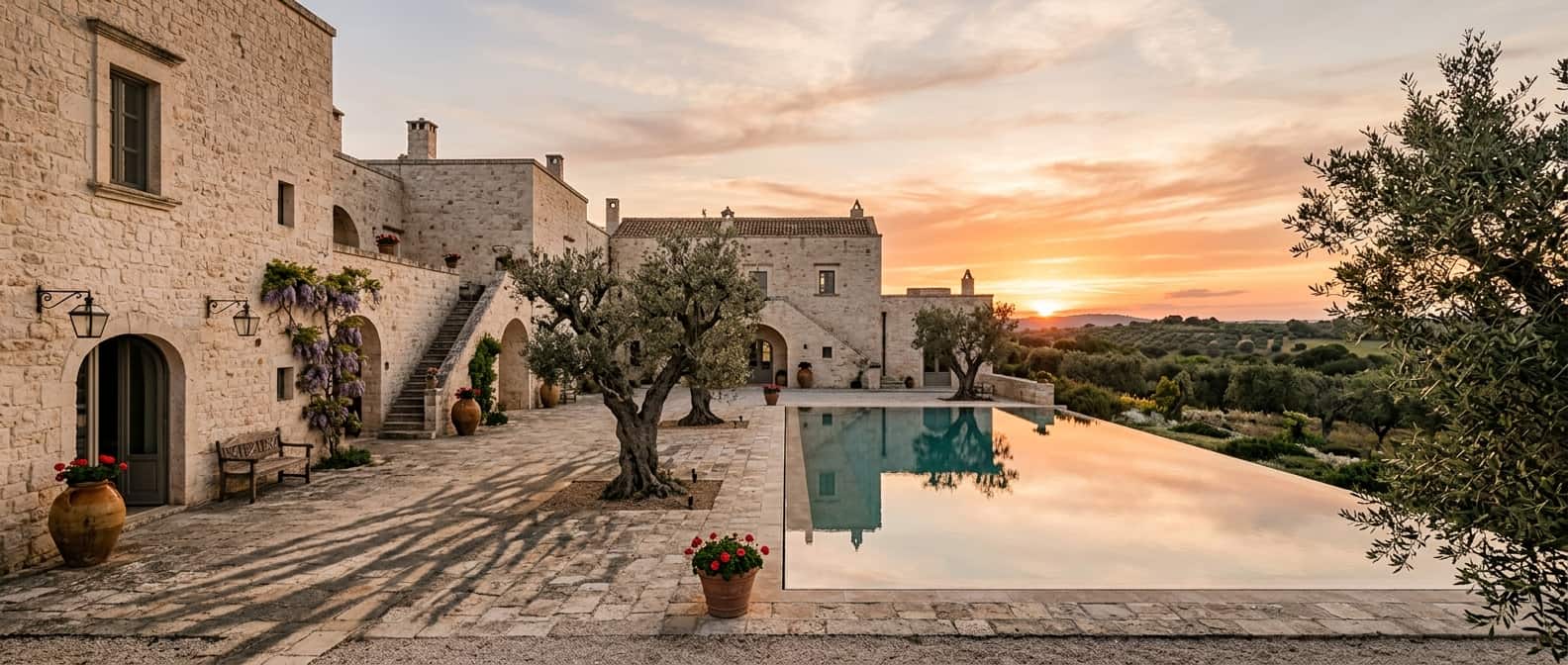
Historically, a masseria was a working agricultural complex. Enclosed by high stone walls to protect against coastal raiders, they were self-sustaining universes of olive presses, stables, and living quarters. Today, the very architecture that was designed to keep the world out is what draws the modern luxury traveler in.
The restoration of these estates has been characterized by profound restraint. Instead of opulent additions, architects have leaned into the monastic simplicity of the original structures. Think vaulted tufa stone ceilings, polished concrete floors, and raw linens. The aesthetic is incredibly tactile, relying on neutral tones that defer to the vibrant greens of the surrounding olive trees and the sharp blue of the Apulian sky. It is an environment that forces a deceleration of pace.
Borgo Egnazia: The Village Reimagined
No conversation about Apulian luxury is complete without examining Borgo Egnazia. Rather than restoring a single estate, the visionary Melpignano family constructed an entire faux-ancient village from scratch, using local tuff stone and traditional building techniques. It is a masterpiece of atmospheric design that feels entirely authentic to the region.
Wandering through Borgo Egnazia's narrow, candlelit alleyways reveals hidden piazzas, spectacular swimming pools, and a Roman-inspired spa that ranks among the finest in Europe. It operates on a scale of luxury that manages to feel profoundly intimate. For honeymooners or those celebrating milestone occasions, the private villas—complete with private pools, walled gardens, and dedicated massaie (local matriarchs who cook traditional meals in your kitchen)—offer an unparalleled level of discretion.
Masseria Torre Maizza: The Rocco Forte Touch
If Borgo Egnazia is an exercise in expansive world-building, Masseria Torre Maizza represents the refined, boutique iteration of Apulian hospitality. Acquired and thoroughly revitalized by Rocco Forte Hotels, this 16th-century estate seamlessly blends the rustic charm of southern Italy with the polished service expected by international elite travelers.
Set amidst ancient olive groves and a sprawling nine-hole golf course, Torre Maizza is enveloped in bougainvillea and jasmine. The interiors, designed by Olga Polizzi, inject subtle bursts of color and contemporary Italian flair into the traditional whitewashed stone. The result is a vibrant, sophisticated retreat where days slip away beside the colonnaded pool or at the estate’s private beach club on the Adriatic coast.
The Culinary Ethos of the South
Puglia produces roughly forty percent of Italy's olive oil, and this agricultural abundance dictates the region's culinary philosophy. The food here is cucina povera—the cuisine of the poor—elevated to its absolute zenith. It relies on the flawless execution of hyper-local, seasonal ingredients rather than complicated techniques.
Dining at a luxury masseria is an exercise in purity. Imagine dining in a courtyard beneath strings of festoon lights, the table set with hand-painted ceramics. The menu might feature crudo caught that morning in the nearby port of Savelletri, handmade orecchiette pasta tossed with bitter turnip tops, and burrata so fresh it practically demands silence. It is an unpretentious approach to gastronomy that feels deeply luxurious in its authenticity.
Puglia from the Water
While the interior estates provide the anchor for an Apulian journey, the coastline demands exploration. The region boasts the longest coastline of any mainland Italian province, flanked by both the Adriatic and Ionian seas.
Chartering a private yacht for the day allows access to the dramatic, sea-carved caves of Polignano a Mare and the Maldives-like clarity of the waters near Salento in the south. The contrast between the stark, sun-bleached cliffs and the vibrant azure of the water is striking. Returning to the quiet, stone-walled embrace of a masseria as the sun sets after a day on the water is the defining rhythm of an Apulian summer.
The New Pace of European Luxury
Puglia represents a broader shift in what the modern luxury traveler values. The performative exclusivity of the traditional European hotspots is being traded for space, privacy, and an authentic connection to the land. The masseria movement proves that the ultimate luxury is not found in gold leaf or grand lobbies, but in the quiet perfection of a limestone courtyard, the shade of an ancient olive tree, and a glass of Primitivo poured as the evening light begins to fade.
It is a destination that does not ask to be conquered, only experienced at the pace it dictates.