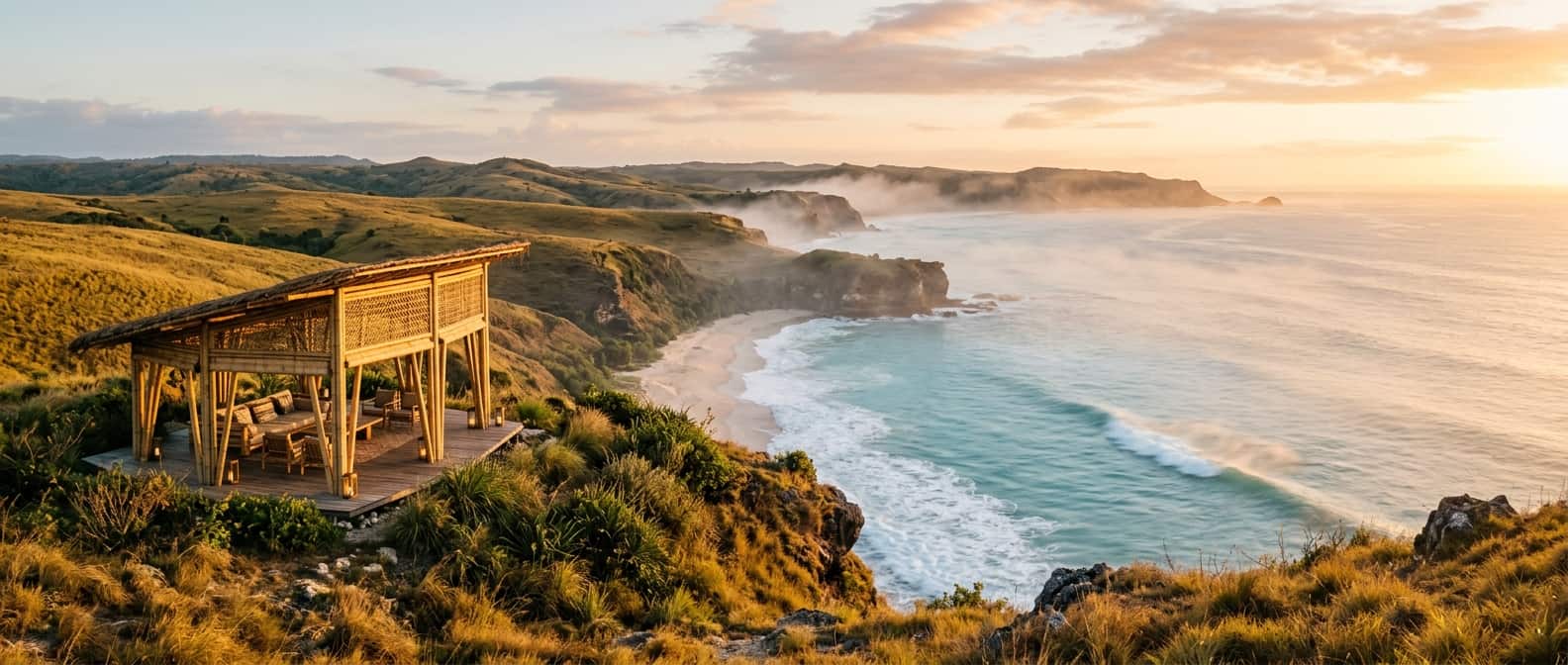
The wind off the Indian Ocean carries the scent of salt, drying grass, and distant sandalwood. Here, on the rugged edge of the Indonesian archipelago, there are no beach clubs, no gridlocked scooters, and no wellness influencers filming their morning routines. Instead, wild sandalwood ponies gallop across empty, crescent-shaped beaches as the tide rolls in. Sumba Island is a place where the landscape feels fiercely alive, untouched by the heavy hand of mass tourism. It is Indonesia stripped down to its elemental beauty—a frontier of towering limestone cliffs, ancient megalithic tombs, and sprawling savanna. For the discerning traveller, it represents the rarest commodity in modern travel: true, unadulterated isolation.
The New Frontier of Indonesian Hospitality
For decades, Bali has been the undisputed anchor of luxury travel in Southeast Asia. Yet, as its coastal roads have grown heavier with traffic and its rice terraces crowded with day-trippers, a certain echelon of traveller has quietly looked eastward. Just a fifty-minute flight from Denpasar, Sumba offers an entirely different proposition. It is roughly twice the size of Bali but holds a fraction of its population. The appeal here is not just geographic; it is philosophical.
Sumbanese hospitality is defined by space and silence. It is an island that demands surrender to its natural rhythm, where luxury is measured in acres of private coastline rather than the number of infinity pools. The properties that have broken ground here are not merely resorts; they are ambitious, low-impact estates that blur the lines between high design and rugged topography. They cater to a global elite—and increasingly, the affluent Indian traveller—who seek out destinations that require a bit of intention to reach. Sumba is not a place you happen upon. It is a place you choose for its profound, quiet gravity.
Where to Stay: The Vanguard of Sumba
At the pinnacle of Sumba’s accommodation landscape is Nihi Sumba, a property that has consistently redefined the global standard for remote luxury. Originally a surf lodge, it has evolved into a sprawling, 560-acre estate of teak and thatch villas that spill down a forested hillside toward a private stretch of the Indian Ocean. Every detail at Nihi is considered, from the plunge pools overlooking the surf break to the legendary equestrian centre. It is a masterclass in barefoot opulence.
Further west, Cap Karoso has emerged as the modernist counterpoint to Nihi’s rustic romance. Founded by a French couple, the property integrates brutalist-leaning concrete and natural wood with indigenous Sumbanese motifs. It operates a zero-waste organic farm that dictates the menus of its sophisticated, open-fire dining venues. The atmosphere is distinctly cosmopolitan, drawing a chic, art-forward crowd. Staying at either property is an exercise in immersion. You are not shielded from the wilderness; you are comfortably, exquisitely embedded within it.
The Rhythm of the Island: What to Do
Days on Sumba are dictated by the sun and the tide. There is no itinerary to aggressively tick off, but rather a slow unspooling of experiences. The ocean is the primary theatre. Surfers make the pilgrimage for some of the most consistent, private breaks in the hemisphere, but the waters are equally accommodating for morning paddleboarding or deep-sea fishing expeditions.
Inland, the landscape begs to be explored on horseback. Riding a native Sumbanese pony through the shallows of the ocean at sunset is a rite of passage, an experience that feels entirely untethered from the modern world. For the culinarily inclined, the island offers exceptional foraging and farm-to-table experiences. Private picnics can be arranged beside towering, multi-tiered waterfalls hidden deep within the jungle, where the only sound is the cascade of water and the call of tropical birds. It is a return to an analogue existence, elevated by seamless, intuitive service.
Understanding the Marapu Culture
To visit Sumba solely for its resorts is to miss the beating heart of the island. Unlike much of Indonesia, Sumba remains deeply rooted in Marapu, an ancient animist religion that honours ancestral spirits. The evidence of this belief system is etched into the landscape itself. Colossal stone megaliths, which serve as tombs for nobility, dominate village squares, their intricate carvings telling stories of lineage and status.
Visitors can—and should—arrange respectful visits to traditional villages with a local guide. Here, you will witness the soaring, high-pitched roofs of clan houses, designed to provide a resting place for spirits descending from the heavens. The island is also renowned for its ikat textiles, a painstakingly slow weaving process where threads are bound and dyed before being set on the loom. Purchasing a piece of Sumbanese ikat is not merely acquiring a souvenir; it is investing in a textile art form that takes months, sometimes years, to complete. The culture is complex, vibrant, and entirely un-sanitized for tourists.
Logistics for the Discerning Indian Traveller
Reaching Sumba requires a brief but necessary layer of logistics, which naturally filters out the casual weekender. For Indian travellers, the most seamless route is a flight to Bali’s Ngurah Rai International Airport (DPS), followed by a short, scheduled domestic hop to either Tambolaka (TMC) in the west or Waingapu (WGP) in the east, depending on your chosen lodge. The premier resorts offer private tarmac-to-villa transfers in custom, air-conditioned 4x4s, turning the rugged arrival drive into a comfortable introductory safari.
Given its proximity to the equator, Sumba is a year-round destination, though the dry season from May to October offers the most predictable weather for outdoor pursuits. It is an island that requires an open mind and a willingness to embrace the wild. Sumba will not coddle you with predictable resort-town conveniences. Instead, it offers something infinitely more valuable: the rare, exhilarating feeling of standing at the edge of the known world, with nothing but the ocean breeze against your skin.