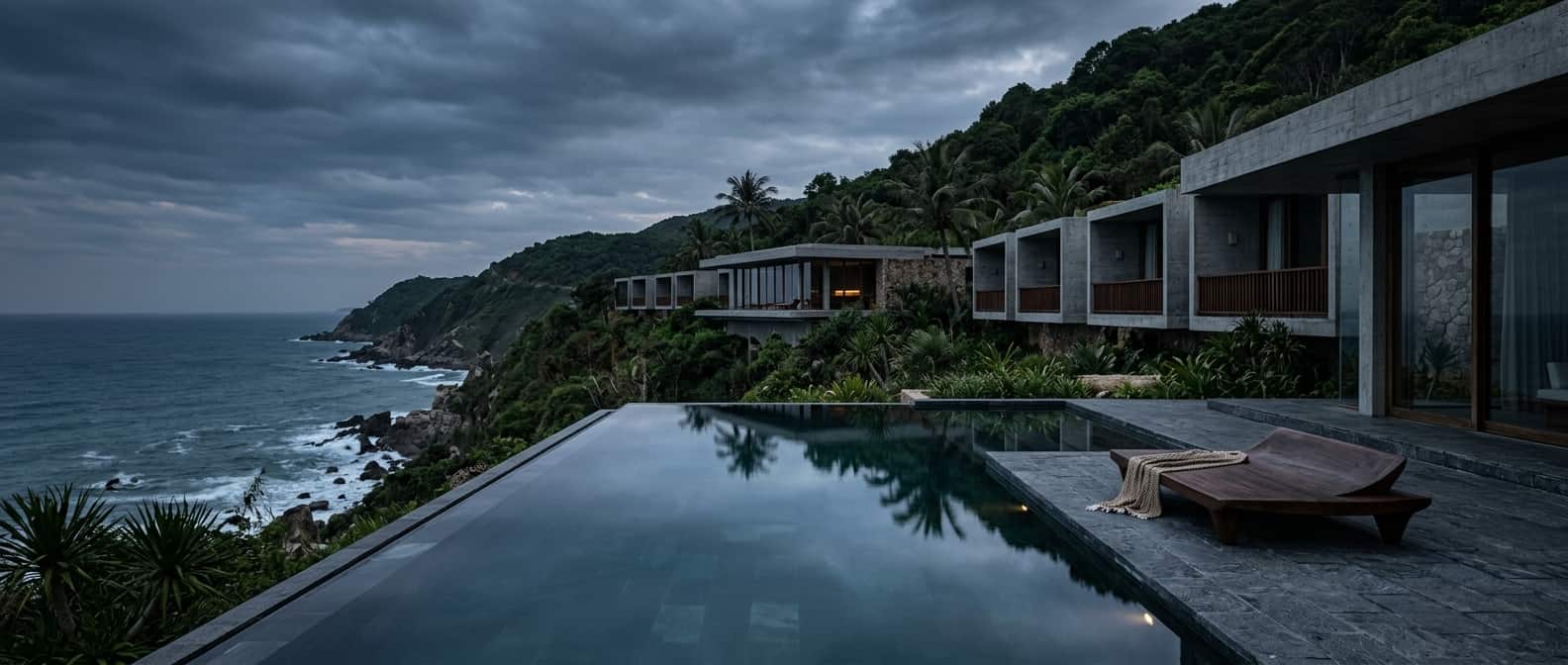
The air here smells of salt, pine needles, and rain-soaked earth. It is a striking contrast to the kinetic energy of Vietnam’s northern and southern metropolises. Here, along the central coast spanning from Da Nang down to the craggy cliffs of Vinh Hy Bay, the volume drops. The frantic hum of motorbikes is replaced by the rhythmic strike of the South China Sea against granite boulders. This is Vietnam’s quiet coast—a stretch of dramatic topography that has recently become the canvas for some of Asia’s most ambitious and rigorously designed luxury sanctuaries.
For the affluent Indian traveler accustomed to the dense opulence of heritage hotels or the familiar rhythms of Thailand and Bali, this emerging corridor offers something profoundly different. It is an exercise in restraint. The properties here do not shout; they frame. They use modernist architecture, indigenous materials, and vast, empty space to pull the landscape into sharp focus, redefining what luxury means in Southeast Asia.
The Architecture of Isolation
True luxury, increasingly, is the absence of other people. The vanguard properties along the central coast understand this implicitly. They are not merely hotels; they are private ecosystems. To arrive at Amanoi, perched in the remote wilderness of Nui Chua National Park, is to feel you have reached the edge of the world. The pavilion roofs, inspired by traditional Vietnamese communal halls, curve gently against the skyline, almost camouflaged by the surrounding canopy.
The design ethos here champions isolation without austerity. Villas are spaced so generously that you rarely see another guest. Private infinity pools seemingly dissolve into the ocean horizon, while interior spaces employ dark timber and lattice windows to create moody, contemplative retreats from the tropical glare. It is a masterclass in biophilic design, where the boundary between the wild outside and the refined inside is purposefully blurred.
A Return to Vernacular
Further north, in the Phu Yen province, Zannier Hotels Bãi San Hô takes a different but equally compelling architectural approach. Rather than imposing a uniform aesthetic on the landscape, the resort acts as a living museum of Vietnamese vernacular architecture. Three distinct villa styles—inspired by the stilt houses of the Ede people, the longhouses of the Cham, and the traditional fishing villages of the coast—are scattered across a sprawling, pristine peninsula.
This commitment to authentic craftsmanship is staggering. Roofs are thatched by hand, walls are built using traditional woven bamboo, and the interiors are punctuated with antique Vietnamese artifacts. Yet, this is not a rustic experience. The integration of modern technology, seamless service, and impeccable culinary programs elevates the vernacular into the realm of ultra-luxury. It is an approach that resonates deeply with travelers who seek cultural immersion without sacrificing comfort.
The Heritage Dialogue
Even in more accessible corridors like Hoi An, the narrative of Vietnamese luxury is evolving. The Four Seasons Resort The Nam Hai has long been the standard-bearer for luxury in the region, but it continually refines its dialogue with the surrounding culture. Designed by the visionary architect Reda Amalou, the resort takes its cues from the principles of feng shui and the layout of the Tu Duc royal tombs in Hue.
The result is a symmetry that feels both deeply grounded and incredibly expansive. A central axis of cascading pools leads directly to a private stretch of Ha My Beach. The villas, centered around a raised, theatrical sleep-and-bathe platform, feel less like hotel rooms and more like private pavilions for a modern emperor. It proves that a resort can honor the architectural heritage of its location while delivering an uncompromisingly contemporary luxury experience.
The Culinary Reimagining
You cannot separate Vietnam from its culinary heritage, yet the central coast’s luxury properties have elevated local gastronomy beyond street-food romanticism. Dining here is an intensely curated affair, often anchored in hyper-local sourcing and sustainable farming. Menus highlight pristine local seafood, heirloom herbs, and ancient fermentation techniques, presented with Michelin-level precision. This sophisticated culinary narrative offers Indian travelers, who value bold and intricate flavors, an entirely new vocabulary of Southeast Asian dining—one that balances wellness with profound indulgence.
The New Metric of Time
What unites these distinct properties is their shared understanding of time. In these sanctuaries, time is not measured by packed itineraries or the relentless pursuit of "experiences." It is measured by the shifting light on the water, the slow unfolding of a lotus flower, or the precise, unhurried service of a dedicated butler.
For the high-net-worth traveler, this slow, deliberate pacing is the ultimate indulgence. It allows for a decompression that is impossible in busier, more traditional resort destinations. The central coast of Vietnam demands that you stop moving and start observing. It is a quiet proposition, but an immensely powerful one.
---
Title: The Quiet Coast: A Field Guide to Vietnam’s High-Design Sanctuaries Category: Destinations Deep-Dive Author: Fly Goldfinch Team Excerpt: Beyond the bustle of Hanoi and Saigon lies a string of modernist, high-design retreats redefining slow luxury along Vietnam's dramatic central coastline. Read time: ~4 min Featured: No Cover: `/app/agents/generated/covers/vietnam-central-coast-luxury-resorts-amanoi-guide.jpg` Word count: 810 words